
The Next Generation Is Coming for Your Job - Here’s How to Stay in the Game

This article contains affiliate links. We may earn a small commission on items purchased through this article, but that does not affect our editorial judgement.
We are witnessing something unprecedented in business history: the systematic obsolescence of an entire generation of leaders (writes Marco Ryan).
Experience isn't the issue; if anything, it has never been more valuable. The difficulty lies in the fact that the instincts which built their careers are now working against them.
The traditional CEO playbook was designed for a different time. It rewarded hierarchy, intuition, and the confidence that came from pattern recognition in stable industries. These leaders rose through systems that valued refinement over reinvention, and they succeeded by taking decisive action informed by sector knowledge and accumulated judgement.
What once made those leaders effective— and often invaluable— now places them at a disadvantage, as the gap between what they were trained to do and what their organisations now demand continues to widen. Many continue to lead by instinct, relying on experience shaped in a more stable era, but the conditions have changed around them, and the cost of clinging to familiar habits is now showing itself in declining performance, weakening influence, and eroding confidence from those around them.

The numbers tell the story. Some 40% of Fortune 500 companies have disappeared since 2000. Average CEO tenure has also fallen from an average of 10 years in the 1990s to just over four today. The data reflects a sharp – and for some, a worrying - collapse of an old-school leadership philosophy that simply no longer exists. And it highlights the pressure that leaders now face in markets that shift direction with little warning and where traditional strengths—stability, control, predictability—carry less weight than they once did.
Customer expectations change faster than most planning cycles allow, and competitive advantage fades quickly. The leaders who are managing this level of volatility share a quality that many of their predecessors never needed to develop: “digital curiosity”. The term has less to do with technical expertise and more to do with the habit of inquiry – that is, asking different questions, pursuing unfamiliar perspectives, and staying open to possibilities outside the usual frame of reference. It is a capability that influences how leaders make decisions, interact with their teams, and understand the systems they are responsible for, and it increasingly distinguishes those who are keeping pace from those who are being left behind.
That shift in mindset has already begun to reshape the top of organisations. A growing number of progressive, digitally curious CEOs are staying close to emerging technologies because they recognise the strategic risks of staying distant. They are engaging more directly with the systems shaping performance, competitiveness, and resilience, often because they know that leaving it to others is no longer an option.
Pascal Soriot, for example, took over AstraZeneca in 2012 at a time when the company’s prospects looked uncertain. Profits had fallen by 31%, key patents had expired, and the pipeline was weak. His decision to relocate the headquarters to Cambridge meant the firm could tap into a wider innovation ecosystem. He increased investment in R&D, focused on growth in emerging markets, and stabilised the business to the point that it could reject a lucrative takeover offer. AstraZeneca is now one of Europe’s most successful pharmaceutical firms.
The same approach can be seen at Bank of America under Brian Moynihan. Rather than treat digital as a separate function, he has made it central to how the bank operates. The bank has spent $3.8 billion annually on digital transformation, deploying the AI assistant Erica to nearly 20 million users. "We've had algorithm machine learning-type models all over our company for years," Moynihan said, pointing to the billions invested over the last decade on "data cleanliness, data order, and getting the data in the right place". While other banks struggled with digital disruption, Bank of America became a digital leader.
Ed Bastian has taken a comparable approach at Delta Air Lines. Under his leadership, the airline developed platforms such as Delta Concierge and Delta Sync as part of a broader strategy to improve the customer experience through integrated technology. Speaking at CES 2025, he made his position clear: “At Delta, it's not technology for technology’s sake; it's always about putting people first. We call it ‘innovating with heart,’ using technology to create premium experiences with humanity at the core.” Delta is now both the largest U.S carrier by revenue and the most consistently profitable.
What sets these leaders apart from old-school CEOs is their willingness to admit what they didn’t know, and a drive to learn and become digitally intelligent. Digital curiosity represents a fundamental shift in how they approach uncertainty. Where traditional leaders see digital transformation as a problem to solve, digitally curious leaders like Soriot, Moynihan and Bastian see it as an opportunity to harness.
This is why leaders who operate from legacy instincts tend to frame decisions around preservation and delegate technology decisions to IT departments. "How do we protect our business and stay in control?” is a common question I’ve heard. Digitally curious leaders, on the other hand, stay in the room, ask a different set of questions entirely: What kind of business should we become? What are we not seeing? What are we assuming without evidence? They do not hand over responsibility for technology to someone else but stay involved, challenge the brief, and expect clarity from the people around them.
It’s important to realise that digital intelligence has nothing to do with programming experience – many top leaders are clueless when it comes to coding. What’s more important is those leaders’ capacity to interrogate systems they didn’t grow up with, to spot unintended consequences before they escalate, and to stay accountable for outcomes even when the mechanics are unfamiliar.
So, if you’re a senior leader who wants to remain relevant—and effective—over the next five to ten years, you’ll need to make a conscious shift in mindset if you want to stay in the game. These are the five habits and mindsets that now define high-impact leadership:
- Stay involved in the right conversations. Don’t outsource your understanding of technology, data, or systems. Ask questions. Push for clarity. Expect your team to justify decisions that touch the foundations of how the business runs.
- Interrogate the data. Don’t accept dashboards or reports at face value. Ask where the data came from, how it’s being interpreted, and what’s missing from the picture. Context matters more than output.
- Test and adapt. Avoid all-or-nothing bets on major programmes. Run smaller experiments. Learn from what doesn’t work. Make failure a source of intelligence, not embarrassment.
- Make room for challenge. The best insight often sits lower in the organisation—closer to the systems, tools, and day-to-day realities. Create space for those voices to speak up. Reward dissent when it helps refine the work.
- Use judgement where machines can’t. Automation can handle routine decisions. Your job is to frame the right problems, weigh the trade-offs, and make the calls that require real leadership.
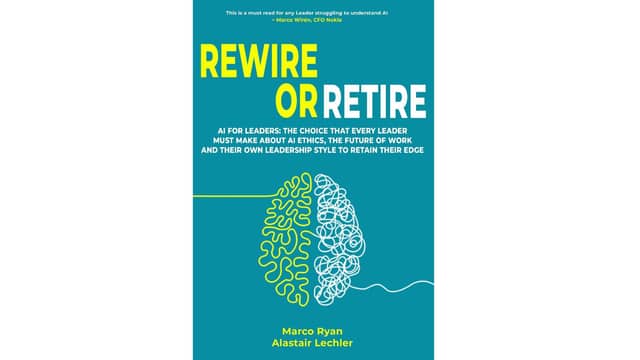
These tips and ideas, and the behaviours that support them, are explored in much greater depth in Rewire or Retire, a book I co-authored with Alastair Lechler. It’s aimed at senior leaders who are beginning to ask whether the skills and instincts that brought them here are still enough to carry them forward. The book includes a practical dQ (digital intelligence) assessment tool, as well as insights from over 100 senior leaders across business, government and the military.
Their stories show that it’s possible to change your way of thinking without giving up who you are if you’re willing to engage honestly with the reality of what’s changing around you.
Marco Ryan is an experienced Non-Executive Director, digital advisor and former Chief Digital Officer at BP. He is Cyber Leader in Residence at Lancaster University Management School and teaches on its Cyber Executive MBA. His latest book, Rewire or Retire, helps board members and senior leaders understand the impact of AI on leadership, offering clear strategies for adapting in an age of rapid digital change.
Story by Marco Ryan/Belters News