
Andy, from Poole in Dorset, said his world ‘crumbled’ when he was diagnosed with MND in 2021. The progressive neurological condition affects the brain and nerves, and has no cure. Average life expectancy after diagnosis is just two to three years.
Yet four years on, Andy, a former consultant anaesthetist, is determined not to let the disease define him.
“This is about showing that it’s still possible to do something meaningful with the time you have,” he said.
A devoted father of three, Andy spent two decades working in the NHS. Outside work, he was an energetic sportsman – climbing, running, skiing and playing rugby with his local club and university team.
The first signs of MND came as far back as 2010, when he noticed twitching in his muscles. Following a serious skiing accident in 2016, the symptoms escalated – cramps, tremors and weakness in his hands. At first, he put it down to nerve damage and underwent surgery in 2020, but the problems didn’t go away.
“I started noticing little things. I couldn’t open jars as easily, I lost an arm wrestle I’d normally win,” he said. “Eventually, I couldn’t ignore it.”
It wasn’t until 2021 – during the height of the COVID pandemic – that he was told he likely had motor neuron disease. He was alone in the consultation room.
“I could see the look on the consultant’s face. He said: ‘I’m really sorry – it’s motor neuron disease.’ I held it together until I got to the car. Then I just broke down,” Andy said.
“My medical background meant I knew exactly what I was facing. It was utterly devastating – your whole life collapses in on itself. It affects everything – family, friends, work, the future you thought you had.”
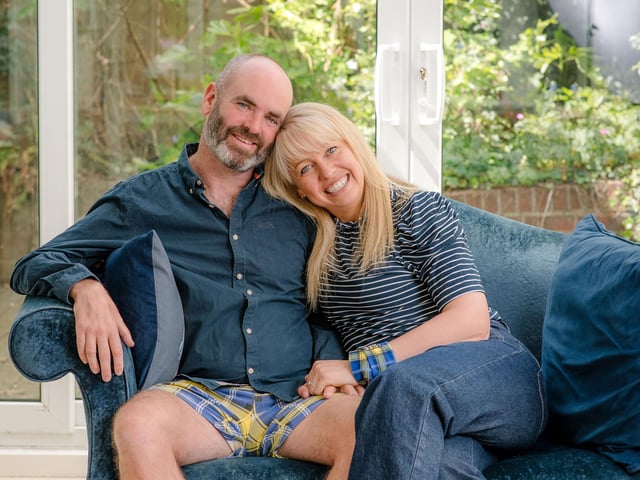
A second opinion and further tests confirmed the diagnosis. Andy tried to return to work but eventually had to step away, focusing instead on spending time with his wife, Susie, and their three sons.
“There’s a period where you live between two lives,” he said. “Your old one, and the new one you never asked for. You grieve each function you lose. But gradually, you find ways to live in the present.”
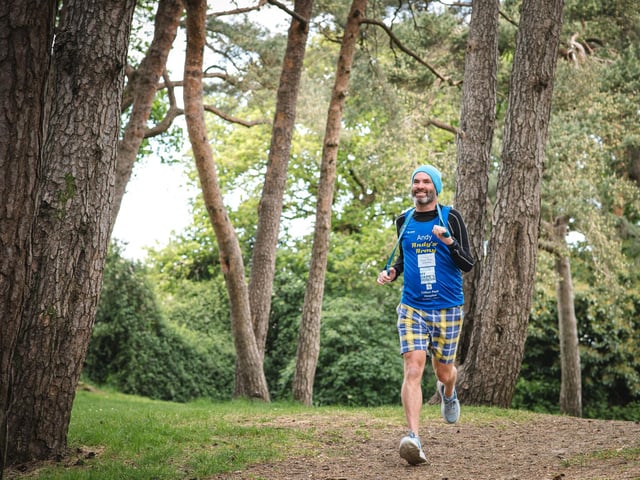
Andy, who still coaches his sons’ rugby teams, says training for events like this weekend’s marathon gives him structure and hope. Despite losing significant arm function and needing special slings to support his limbs while running, he plans to complete the 26.2-mile course in a run-walk strategy, supported by a team of family and friends – known as Andy’s Army.
“There will be dark moments during the run — I know that. But I also know I’ll have people beside me. This is about more than finishing, it’s about making memories and showing others what’s possible.”
Through this challenge, Andy has already raised £25,000 for My Name’5 Doddie Foundation, which was launched by former Scotland and British & Irish Lions rugby legend Doddie Weir after his own MND diagnosis in 2016.
Andy was personally contacted by Weir shortly after his diagnosis – a call he describes as ‘life-changing’.
“I didn’t expect Doddie himself to ring – but he did. I met him once in Barbados when I was 22, and while he of course couldn’t remember that, he did remember the trip,” said Andy. “Even though his voice was failing, he made time to talk. He told me to live in the moment, to stay positive. That call meant everything to me.”
Weir passed away in 2022, but his legacy lives on through the foundation’s focus on accelerating research and supporting people living with MND.
Andy’s fundraising efforts have already made headlines. In 2022, he and a group of friends played the world’s longest continuous beach rugby match – lasting 34 hours – raising almost £135,000 for My Name’5 Doddie Foundation and MND Association. He described the event as ‘physically brutal, but emotionally uplifting’.
Yet the marathon, he says, will be ‘the toughest challenge yet’.
Andy’s condition has progressed across his body, but particularly affects his arms and shoulders. He can no longer lift his arms for long periods, and running involves carefully timed bursts followed by walking intervals to allow his body to rest. Yet he still considers himself ‘fortunate’.
“I’ve been lucky that it’s progressed slowly. But I know it won’t stay that way forever,” he said. “There will come a time when I can’t do this – so I’m doing it now, while I still can. I have friends who’ve since passed away who weren’t fortunate enough to get this time, so I have to make the most of it.”
He plans to think of someone affected by MND with every mile. Whilst time is not important, he hopes to complete the distance in under six hours.
“It’s painful, but it’s also a privilege. There are so many people who’d give anything to be able to do this.”
Andy’s wife Susie – a former GP who left medicine following his diagnosis to become a full-time writer and spend more time at home with him – says the experience has brought both grief and perspective for the couple and their sons Charlie, 15, Sam, 13, and Jack, 12.
“We’ve had to accept a very different life to the one we planned,” she said. “But Andy’s approach has been extraordinary. Even on the hardest days, he reminds me we’re still here. We still have each other.”
“The marathon will be incredibly demanding for him – physically and emotionally – but I know he’ll get through it. That’s what he does.”
Andy hopes his efforts can raise awareness, but also help fund breakthroughs.
“There are no effective treatments. The drugs don’t do much. That’s why research is vital,” he said. “We need real progress, real hope. Hopefully for me – although I’m realistic – but definitely for those who come next.”
To support Andy’s marathon effort and donate to the My Name’5 Doddie Foundation, visit justgiving.com/page/andy-vaughton-10. For more information on the charity’s work, visit: www.myname5doddie.co.uk.
1. Contributed
Andy Vaughton in training Photo: Submitted
2. Contributed
Andy Vaughton, wife Susie Vaughton, and their dog Gizzie Photo: Submitted
3. Contributed
Andy Vaughton, wife Susie Vaughton, and their dog Gizzie Photo: Submitted
4. Contributed
Doddie Weir Photo: Submitted