
Hospital worker raises over £2,300 for Kent Association for the Blind ahead of Cataracts Awareness Month


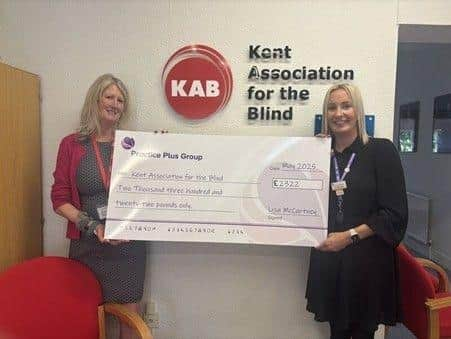
Hospital worker, Lisa McCartney, 37, from Rainham, proudly handed over a giant cheque for £2,322 to local charity the Kent Association for the Blind (KAB) during the start of Cataracts Awareness Month (June), after raising the funds running the London Marathon in April.
KAB helps people with visual impairments, including those with cataracts and offers advice, emotional support, and practical help to improve independence and daily life. Commenting on her fundraising total, Lisa says: “Donating such a sizeable cheque both in value and size was such a highlight for me, knowing that the funds generously donated will go some way to helping people with eye conditions. Sight is something we can easily lose due to age, accidents, illness, or hereditary conditions. KAB’s work is life changing, and while my fundraising is just a small contribution, I know every pound donated will make a difference.”
During Cataracts Awareness Month, Practice Plus Group Surgical Centre Gillingham, where Lisa works as a Business Development Manager, is highlighting the importance of keeping up with routine eye tests to help spot early signs of eye conditions like cataracts.
Currently, nearly a third of over 65s in the UK have cataracts that impair their vision - affecting over 670,000 people. Consultant Ophthalmologist, Charles Kanavati, Medical and Clinical Director of Ophthalmology at Practice Plus Group, says it’s important to know when to seek help and how to spot early signs of something potentially more serious. He says:

“Changes in our eyes can occur naturally with age so spotting early signs of conditions such as cataracts is vital to ensuring healthy vision. Cataracts occur when the lens on our eyes starts to form cloudy patches, which can become worse over time and begin to limit our vision - even causing blindness.”
Mr Kanavati continues: “This is usually caused by ageing but can also be attributed to diabetes or the effects of steroid medication. Cataract treatment almost always requires surgery to replace the cloudy lens with an artificial one.
“The most obvious symptoms are blurred and foggy vision. You may notice colours becoming more faded or washed out and as cataracts develop, it may take on a yellow or brownish tinge which can affect your perception of colours.”
Changes in vision when driving can be an early warning of cataracts symptoms says the eye expert: “You may start to notice glare around lights when driving at night and your eyes can take longer to adjust from light to dark, and you may find yourself turning on a lamp to support your reading at night.”
The good news is that cataracts can be diagnosed easily by an ophthalmologist or optometrist, through a consultation and an eye examination. Mr Kanavati advises: “If you begin to experience changes in your eye sight or with your eye itself, don’t hesitate to make an appointment with your eye care provider.”
Cataract surgery is straightforward and has a number of other benefits. Mr Kanavati explains: “The risk of falls reduces, it helps hearing, improves mobility, enables driving and promotes independent living, quality of life and life expectancy. And if you don’t seek help, other eye diseases such as glaucoma and macular degeneration could be hidden behind cataracts, lying undetected.”
Cataract surgery has developed over recent years and patients now have a choice of either a standard lens available on the NHS or they can choose to upgrade through private healthcare providers to premium lenses which offer benefits to lifestyle too and can reduce the need for glasses altogether.
Practice Plus Group Surgical Centre, Gillingham, offers cataract surgery for both NHS and private patients and has shorter than average waiting times. Patients can also self-refer for treatment directly via Wellsoon private healthcare from Practice Plus Group. Visit www.practiceplusgroup.com for more information.