
Education experts issue AI warning regarding these degrees
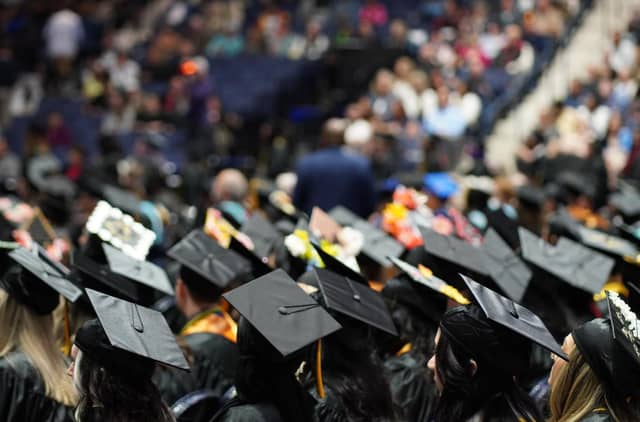

Security and protective service degrees face the highest risk of AI replacement. Communications and performing arts are among the others most at risk. Healthcare and related degrees show the strongest resistance to AI.
New research has revealed the college degrees most vulnerable to being replaced by AI, with security and protective service degrees coming out on bottom.
The study by Teachers To Your Home ranked 37 educational degrees based on their risk of being replaced by artificial intelligence for the postgraduate jobs associated with the degree, using data from the Bureau of Labor Statistics. Researchers determined the automation risk level for each degree using calculations for its associated occupations by the online calculator Will Robots Take My Job? The website ranks the skills required for different jobs based on the need for human involvement, scoring them on their originality, social perceptiveness, coordination, and more.
The top five degrees safest from AI replacement
| Rank | Degree | Resiliency Score (higher is better) |
| 1 | Healthcare and related degrees | 8.24 |
| 2 | Engineering technologies | 7.97 |
| 3 | Engineering | 7.74 |
| 4= | Military | 7.65 |
| 4= | Public policy and social services | 7.65 |
| 5 | Mechanics and repair | 7.60 |
Healthcare and related degrees top the list as most resistant to AI replacement, scoring 8.24 out of 10. Top jobs that require this degree include nurse practitioners specifically scoring high at 9.2 out of 10, as this is a role that requires human empathy and social perceptiveness, things that will be hard to replicate via automation.
Engineering technologies rank second with a score of 7.97, showing strong resilience against automation. Jobs in this field can take you into include construction management for example, which requires management skills, persuasion, negotiation and problem-solving skills.
Engineering degrees secure third position with a score of 7.74. Jobs in this field often require human involvement, like civil engineers, for example, where things like problem solving, manual dexterity, creativity, and social skills are required.
Military and public policy and social services degrees both take fourth place, with them both scoring 7.65 out of 10. With military degrees, top jobs include management analysts, for example, which again requires interpersonal skills, critical thinking, problem solving, and project management, something which AI may struggle with. With public policy and social services, top jobs include the likes of health service management, which requires management of personnel, decision-making, and human empathy.
Mechanics and repair degrees complete the top five resistant fields, scoring 7.6 out of 10. Top jobs in this field include the likes of electricians. They handle tasks that require physical presence, judgment of safety, assessing risks, customer communication and a use of specialised tools, something which AI struggles with.
The top five degrees most at risk of AI replacement
| Rank | Degree | Resiliency Score (lower is worse) |
| 1 | Security and protective services | 5.90 |
| 2 | Communications technology | 6.20 |
| 3 | Library science | 6.23 |
| 4 | Fine and performing arts | 6.30 |
| 5 | Law and legal studies | 6.36 |
At the other end of the spectrum, security and protective services degrees face the highest risk of AI replacement, with a score of just 5.90 out of 10. Low-scoring jobs in this field include paralegals and legal assistants, which are jobs that require tasks like drafting documents, managing case files, and general legal research, which AI could do the task of.
Communications technology ranks as the second most vulnerable degree with a score of 6.20. Top jobs in this field include graphic designers, as example, with AI now being used for things like asset generation, photo editing, and generation of mock-ups.
Library science graduates come third for risk of automation, scoring 6.23 out of 10 for vulnerability. Librarians specifically were shown to have some risk of AI replacement, with tasks like cataloguing, indexing, and reference assistance all potentially being done by AI in the future.
Fine and performing arts degrees come fourth for vulnerability, with a score of 6.30. Top jobs include art directors, with some of their tasks, like asset organisation, mood board creation, and draft creation, potentially being done by AI in the future.
Law and legal studies complete the bottom five with a vulnerability score of 6.36. Low scoring jobs in this field include accountants and auditors for example. Tasks that they cover like data entry, bookkeeping, preparing reports, and running audits are tasks AI may perform in future.
Gillian Dixon, CEO of Teachers To Your Home, said, "The general theme here is that the degrees that can take you into jobs that require human skills like empathy, creativity, and problem solving are safe. This can be seen with jobs in the medical field, where human judgment is best needed when lives are at stake. Sharpening up on skills that AI can't replicate may be the way forward, especially if the world ends up moving faster than we think."