
'I ran, I exercised, I dieted but I didn’t lose any weight. Here’s the routine that helped me finally shed nine stone.'
As an overweight woman, she ran 5ks, tried diet plans and went to the gym twice daily. But she just couldn’t seem to shift any extra pounds.
Dr Kisha Pickford felt despondent and barely recognised herself in the mirror as she approached her 50th birthday.
So the nurse and mum-of-one decided to do a dramatic overhaul of everything she previously thought about diet and exercise. And soon she lost an incredible nine stone (130lbs).
Using tools like meal prepping, keeping a diary and mindfulness made all the difference in bringing about lasting change.
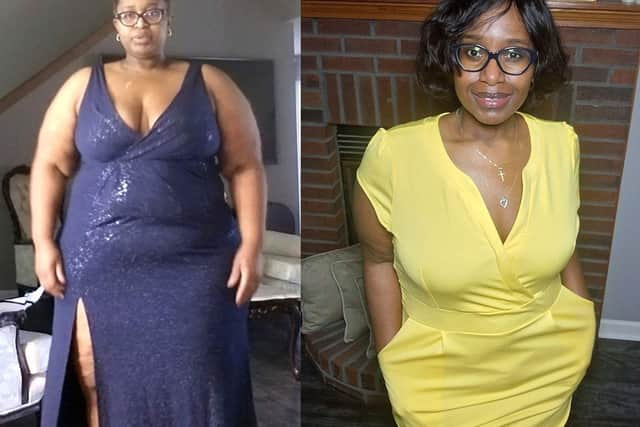

Growing up, food had always been an important part of Kisha’s life, but along with the positives came some negatives, namely emotional eating.
“Food was a central part of life in my Southern Black family and food meant love, tradition, and togetherness,” says Kisha, 53, from Tennessee, USA.
“Sunday dinners, holidays, and celebrations were full of rich, comforting meals, and second helpings were a sign that you were enjoying yourself. But food also became emotional for me, a quiet coping mechanism when life got overwhelming.
“I learned to soothe stress and sadness with snacks or large meals, and over time, I developed habits that were rooted more in comfort than in hunger. No one ever talked about food in terms of nourishment or nutrition.
“Food was more about fullness and family. I didn’t realise it then, but those early patterns created a complicated relationship with food that followed me into adulthood.”
Kisha had carried a little extra weight for most of her life, but as she reached her late 40s and early 50s, she noticed it was harder to lose weight, even with extreme effort.
She was doing two sessions a day at the gym, running 5Ks, and trying every diet plan under the sun, but nothing seemed to stick.
“As a nurse practitioner, I felt conflicted, because I knew what the textbooks said, but my body wasn’t responding the way I expected,” says Kisha.
“I was working long shifts, raising my son, and constantly exhausted. I looked in the mirror and didn’t recognise the woman staring back.
“That’s when I knew: this wasn’t just about my body anymore. It was about my health, my peace, and my future.”
Kisha’s inability to shift her extra weight left her feeling embarrassed and frustrated.
It affected her confidence, relationships, and even her professional presence.
“I hid behind smiles and nice clothes, but inside, I felt like my weight defined me,” she adds.
“I was highly educated and accomplished, a doctorate prepared nurse practitioner, but I still felt like I had to prove my worth because of my size.
“There was a deep internal battle between who I was on paper and how I felt in my body. I often blamed myself, thinking I just lacked discipline.
“But eventually, I realised my weight wasn’t a moral failure: it was a reflection of emotional wounds, lifestyle overload, and a system that didn’t support women like me.”
Determined to make a lasting change, Kisha decided to radically overhaul the way she had been approaching weight loss.
“My first step was giving myself permission to stop suffering,” she says.
“I let go of the idea that weight loss had to be a punishment, and I started focusing on wellness instead of war.”
Kisha sought out education on holistic nutrition, re-evaluated her stress levels, and began working with a coach who helped her get honest about her patterns.
She also created a framework that became the foundation of her transformation and the foundation of the coaching programme rooted in “grace not guilt” that she would eventually set up.
She called it Fresh, an acronym symbolising: Food Freedom, Rewire the Mindset, Elevate with Habits, Simplify Your Environment, and Honour Your Whole Health.
“My transformation involved deep inner work and consistent daily habits,” Kisha explains.
“I didn’t rely solely on workouts or willpower. I had to rebuild my relationship with food, set realistic routines, and most importantly, heal my mindset. I stopped trying to do it all at once and started making aligned, sustainable choices.
“I used tools like journaling, meal prep, gentle movement, and mindfulness. I also used a compounded GLP-1 weight loss medication for a period of time, but I paired it with real-life coaching and holistic strategies.
“And when that medication was no longer accessible, I didn’t panic. I built a system that supported me beyond the scale.”
This time, the steps Kisha took worked. She lost over 130lbs and dropped several clothing sizes, but says that more important than the number on the scale was the impact it had on her confidence.
“More importantly, I lost the fear of starting over,” she says.
“My transformation wasn’t just about numbers; it was about how I carry myself now. I move with confidence. I’m no longer hiding.
“My energy levels are higher, my sleep is better, and I feel free in my body. I’m not trying to be a size 2, I’m trying to be fully well. I now live in a body that supports me, not limits me.
“I feel empowered. For the first time in decades, I feel like I’m leading my life instead of surviving it. I have peace, balance, and clarity. I’ve reclaimed my health on every level - physical, emotional, and spiritual.
“I feel beautiful and strong. I still have goals, but I no longer tie my worth to a number. I walk into rooms with confidence, knowing I’ve done the deep work and that I’m living proof that change is possible, even after 40.”
Kisha’s experience led her to write a book entitled The Weight Is Over: How Women Can Finally Lose Weight After 40 and Keep It Off for Good.
She also launched Ample Health & Wellness to coach other women through the same process.
“My goal isn’t to help women get skinny, it’s to help them get free: free from shame, free from fads, free from the belief that it’s too late,” she adds.
“I believe that with the right tools, mindset, and support, every woman can experience wellness that lasts.
“Weight loss is not one-size-fits-all. It’s not a quick fix or a straight line. It’s a process and it often requires healing before results. I want women to know that it’s okay to ask for help, to use tools like medication if needed, and to still prioritise holistic health.
“Your body isn’t failing you; it just needs support. And no matter your age, background, or past struggles, you’re not too far gone. I’m living proof that you can rewrite your story with support, strategy, and self-compassion.”