
'I saved the life of a dying boy. Six years later I met him for the first time - and finally got to hug him.'
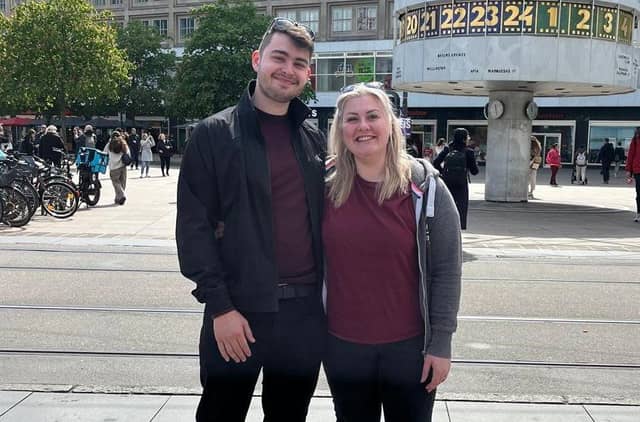

A young British woman’s incredible act of generosity has saved a life. And it has also led to a wonderful friendship.
Rebecca Williamson, 30, donated her stem cells to a young German man with non-Hodgkin's lymphoma when he was just 14.
The pair kept in touch via email and Snapchat, and they met up for the first time in Berlin a few months ago in an emotional reunion.
“I was in college doing my A levels, and there was a stand of Anthony Nolan volunteers saying come and join the register,” Rebecca, from Carlisle, says.
“I went over and spoke to the friendly faces there and the campaign was ‘spit to save a life’.
“I did a little sample of spitting into a tube, and it just got sent off. I didn't really think much of it, to be honest - you kind of forget.
“It was probably about seven years later. I was 24, just coming back from work, and I had a text message.
“It said: ‘Urgent. We're trying to contact Rebecca who's on the stem cell registry. Can you please contact us?’
“I remember looking at it thinking, ‘Hmm, they wouldn't be texting me unless I'm potentially a match for somebody’.”
Rebecca got in touch with the charity, and they confirmed her suspicions. She then had to provide some blood samples.
Two months later was told she was a perfect match for a young man in Germany. His best chance of survival was to receive some of her bone stem cells via her bone marrow.
Rebecca underwent some medical testing in London to make sure she was fit enough to donate, with the charity covering all her expenses.
The transplant, done under anaesthetic, involved inserting needles into the base of her spine so bone marrow fluid could be drawn out. This fluid was then transferred to the patient’s body where the donor stem cells were able to fight the cancer cells
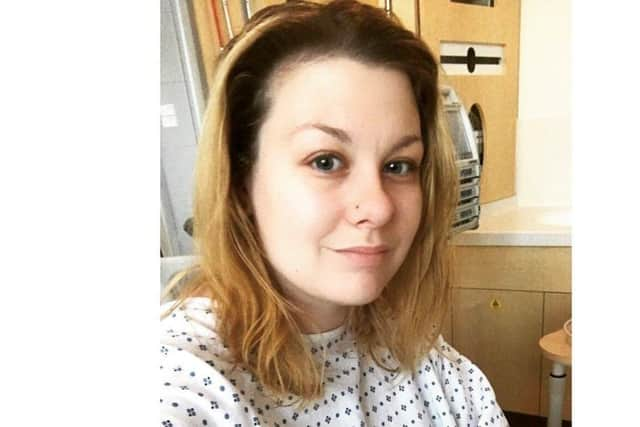
Rebecca’s surgery went smoothly, and while she was in the hospital, Anthony Nolan volunteers came to see her.
“They asked at that point, ‘would I like updates from my recipient?’” Rebecca remembers. "The surgeon had said 1.5 litres of fluid was taken and it was being transported as we speak.
“I wondered where it was going. Is it going up to Scotland or elsewhere in the UK?
“I agreed to updates, and I also agreed that if another donation was needed, that I would be approached first.
“Within the next day I was home.I didn't really feel much pain - it didn't feel like I'd really had any inconvenience.
“Within a month, all my blood levels were done and I was completely back to normal.
“I just thought, ‘well, that seems like such a minor thing - I’ve just bounced back straight to my life again’.”
A few months later, Rebecca got an update that her recipient was alive and doing well thanks to her donation. He then sent a “Thank you, and Happy New Year” card.
The pair began to exchange cards back and forth anonymously through the charity. One day, Rebecca received a call from the charity asking if she would be happy to be put in direct contact with the recipient.
“They asked: ‘do you know anything about your recipient?’ All I got told was that he was an anonymous young male.”
Rebecca then found out that her recipient was 14 at the time of the transplant, and that he was now 18, and living in Germany.
She decided to make the first move, realising it must be intimidating for a teenager to reach out to a stranger.
“I thought I would send the first email,” Rebecca remembers. “I wrote saying ‘I donated to you in 2018 and I’m really pleased that it’s gone to you and that you're doing really well. I’m obviously here if you want to get in touch, but I understand that that's not always the case.’ I left it up to him.”
The pair began exchanging emails back and forth, and soon added each other on Snapchat to send friendly pictures to each other.
“That started our daily communication,” Rebecca explains. “We send Snapchats back and forth between each other.”
The pair decided to meet up in Berlin, and chose the sixth anniversary of the donation for the big moment.
“I was nervous,” Rebecca remembers. “You build this picture of somebody. He messaged me and said, ‘I'm really nervous. I'm shaking’.
“I said ‘oh thank God, we're both the same’.
“Eric and his dad came to meet me, and we gave each other a big hug. It was so bizarre that here was this person that you’ve thought of, and you've been talking to, and all of a sudden he's there in front of you.
“It was like meeting an old friend, in a way, because it was like we already knew each other. There was a sense of happiness that we've made it this far. We've had this journey all the way through. Who knew we'd be stood in Berlin together?
“It felt so surreal - you can’t really describe it.”
The pair and Eric’s dad spent a lovely few days having meals, doing tourist activities and going on a boat cruise.
“When we said goodbye, we were trying not to cry or to be too emotional,” Rebecca explains. “I went to give Eric a hug, and he said “thanks for saving my life again’.
“His dad said ‘this won't be the last time you two see each other’.”
The pair keep in regular contact via Snapchat, and Rebecca says they are planning to meet up again.
“People on TikTok say ‘you two should get married’,” Rebecca laughs. “It's not a romantic soulmate thing, but a platonic soulmate.
“It’s that feeling of a kind of soulmate, like we were always meant to kind of meet at some point. It's a bit like the invisible string theory: that we were supposed to cross paths.
"I was on the registry for seven years and never matched. I could have gone my whole life, never matching.
“But he needed his donation and we just happened to cross paths. There's a that kind of bond and connection that I don't think you can ever describe to somebody. We'll always be there for all those big moments for each other.”
Rebecca is keen to raise awareness of the Anthony Nolan register, saying for a few days of inconvenience, she was able to give another person the gift of life.
“I went and donated, but it's something that I've completely healed from - it’s had no repercussions on me,” she adds.
“It was just a couple of days in hospital. I can go on about my life and it will have no impact medically on my health.
“Yet it has gone and completely given somebody the second chance of life.”
The type of operation Rebecca had is only undergone by 10% of donors: 90% of donors can donate by giving blood which is not an operation, and is much less invasive.
As for Eric, he says Rebecca is his “hero”.
“It can consume a lot of energy and time to get back to a point where you are out of the acute phase and just ‘live a normal life after your body has fully accepted the donor’s cells,” he explains.
“I am glad I survived all of this: without my hero Rebecca I wouldn't be here anymore. After making it through all of this you won’t see the world with the same eyes as before.
“For me every second of my life is a bonus to my life. As to Rebecca and me, I requested for data exchange as soon as I was allowed to and we started writing via email in 2022.
“Fast forward we exchanged numbers and added each other on Snapchat for daily communication and met each other in person exactly six years later after my transplantation in Berlin.
“We did some sightseeing and talked about our sides of the story. It felt very surreal to meet the person because of whom you have a second chance to thank them, but we had a great time.”
Rebecca hopes to spread the word to enable more people to have the chance to save a life.
“I wish you could bottle up the feeling of euphoria and knowing how much you've helped somebody and how amazing it is,” she says. “Even if I had never known who Eric was, just that feeling that you've done something really good.
“If you could bottle that up and give it to people and say, ‘this is how you're going to feel afterwards’, I think so many more people would think it was worth it. I think most donors would say they’d do it again a million times over. If I got the opportunity to donate again, I would grab it with both hands.”
Anthony Nolan is a UK stem cell transplant charity with 50 years of expertise in uniting science and people to push the boundaries of what can be achieved for blood cancer and blood disorder patients. For more information visit: anthonynolan.org.