
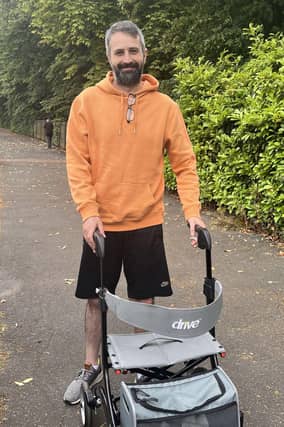

But for father of five Adam Dawar this was just the start of a nightmare which would lead to a shattering diagnosis.
“Life was busy,” the 47-year-old says. “I was a parent, I had a job and I did all the things that come with that.
“I played football, enjoyed seeing friends and spending time with family. There was always somewhere to be.”
Adam’s symptoms included vomiting and visual disturbance which meant that everything looked hazy and he initially thought it might be a bug. But his symptoms did not subside and continued for weeks.
Unable to stand up without being sick and increasingly concerned, he sought medical help.
“I was starting to worry it was cancer as cancer is a thing that has taken half of my family,” Adam, from Giffnock, East Renfrewshire, says.
“But no-one could give me an answer, no matter where I went. I went to the GP first and I was told ‘it could be this, it could be that’.
“The only one I really remember is ‘you might be heavily constipated’. When he said that, I couldn’t believe it. I said to my wife Sharon ‘we need to go somewhere else’.”
It took Adam 18 months to be diagnosed with multiple sclerosis (MS) and, surprisingly, he felt relieved .
“When the doctor said to me, ‘It sounds to me like multiple sclerosis,’ I said, ‘Thank God!’” Adam recalls. “And he said ‘You do know what MS is?’ And I said ‘yeah, but it’s not cancer.’
"We were at a different hospital and the minute we walked in there, it was as if somebody flicked a switch. From that moment on, life just got better. Regardless that I’ve got MS, at least I know what I’m dealing with.
“I felt a big relief because I was thinking it was something that was going to kill me.”
Adam began to research the condition and decided to learn as much as he could. He admits for the first two to three years he was in denial and believed that his life did not need to change.
For the first few years he had Relapsing Remitting MS (RRMS) and he had several disease-modifying drugs to help slow down the progression of the illness.
“Some worked and some didn’t,” he says. “Many of the treatments have side effects that make you feel even worse on top of already being ill.
“Now I have Secondary Progressive MS (SPMS), which means I have moved onto the next stage, unfortunately. But I take medication and hopefully this will slow down the progression.”
Adam has to give up his job as a graphic designer and accept a slower pace of life.
"If I have to go to the kitchen, it might take me five minutes – but I’m OK with that,” he says. “The main thing is: I’m still alive, I’m still breathing, so all is good.
“My wife is now my full time carer and I’m extremely lucky that she helps me get out and about.
“I still drive on occasion, it’s the only thing that makes me feel normal like everyone else but mostly Sharon does it now.”
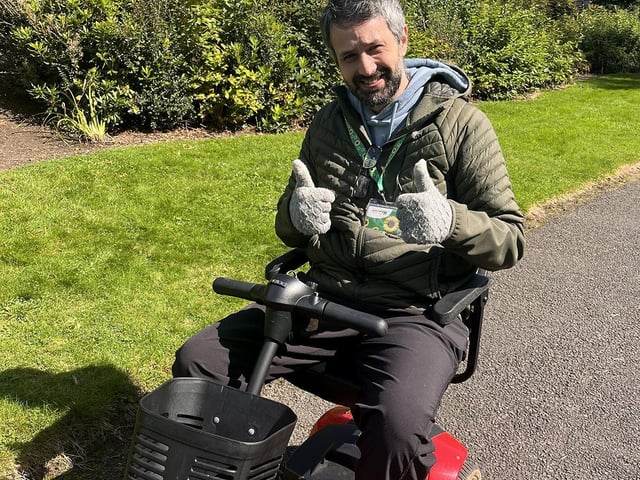
Sharon helps Adam with all the practicalities of MS, such as preparing his scooter, wheelchair or rollator and sorting routes, finding out where is accessible or where might have dodgy pavements.
“She deals with all of that so I don’t need to because I can’t anymore,” Adam adds. “I wouldn’t leave the house, the anxiety of all of that on top of being ill would be crippling.
“In short, she just lets me concentrate on the MS itself.”
More than 150,000 people in the UK live with MS and many of them are unable to leave their house without help.
According to research by The MS Trust, 94% of patients said their condition has affected their mental health with 60% experiencing low self esteem. Half of MS patients report feelings of isolation and loneliness.
Adam wants people to be aware that MS can present very differently in each person.
“There’s not a set pattern to it,” he says. “There could be a guy with MS who runs marathons and there could be someone in a wheelchair. It’s not a one-size-fits-all thing.”
He is positive about his life and happy he’s been able to be an active and present dad for his five children.
“When MS announced itself into my life, the youngest was five,” he says. “I’m glad that my kids were of an age that my declining health wasn’t going to impact them so much. They weren’t going to grow up seeing dad be heavily disabled.
“I got to be a proper parent. I really didn’t want MS to rob me of being a parent or to rob my kids of having a dad who was there.
“By the grace of God, it worked out and they’re all doing their own things now. The youngest will be 20 this year. The oldest is in another country.
“I honestly haven’t been happier and mentally clearer in my life. I just had this mental clarity one day: everything’s going to be OK.
“It was like a massive weight came off me. I really can’t explain it. It kind of is a spiritual experience - I think having MS has been like a superpower – for my mind, the way I think.
“Everyone’s got problems. But when a problem comes up for me, I think, ‘Is anybody going to die? No? Then there’s no problem. We can fix it.’”
1. Contributed
Adam on his mobility scooter Photo: Submitted
2. Contributed
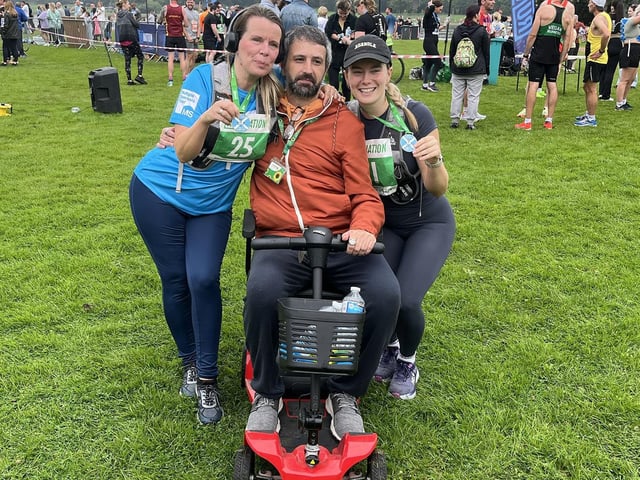
Adam, his wife and their oldest daughter following a fundraising run for the MS Trust Photo: Submitted
3. Contributed
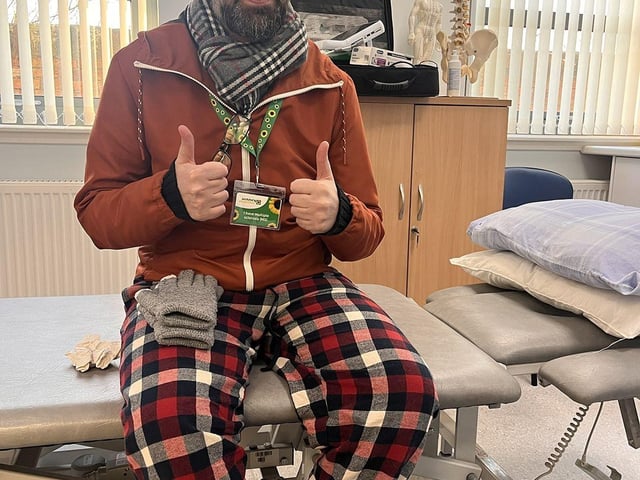
Adam after having treatment in Govan Photo: Submitted
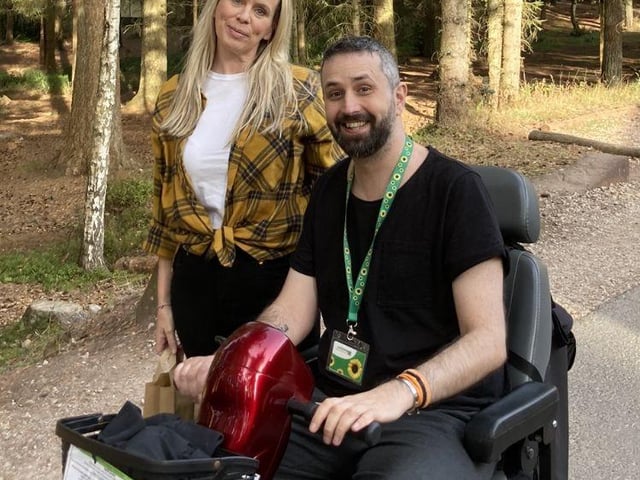
4. Contributed
Adam and his wife at Centre Parcs in 2023 Photo: Submitted