
Scientists create wearable smart sensor that warns you when you're dangerously dehydrated
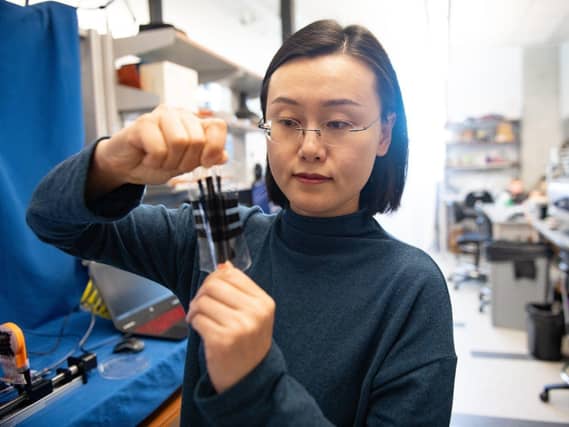

Scientists have developed a new wearable sensor that connects to a smartphone app, warning users when their hydration levels drop to dangerously low levels.
Engineers at The University of Texas at Austin unveiled the cutting-edge device that tracks your hydration levels in real time — no needles, no urine tests, and no guesswork required.
The innovative gadget could prove life-saving for athletes, emergency workers, and even office dwellers who forget to top up their water bottles.
"Dehydration is a silent threat that affects millions of people every day," said Professor Nanshu Lu, who led the research at UT Austin's Cockrell School of Engineering.

"Our wearable sensor provides a simple, effective way to monitor hydration levels in real time, empowering individuals to take proactive steps to stay healthy and perform at their best."
The device uses a technique called bioimpedance — essentially sending a small, safe electrical current through the body and measuring how easily it flows.
Since water is a good conductor of electricity, the more hydrated you are, the more smoothly the current travels through your tissues.
The data is then wirelessly transmitted to your smartphone, allowing you to see when your hydration dips — before symptoms like dizziness or fatigue even kick in.
Researchers tested the device through a series of studies, including one where participants were given diuretics to deliberately induce dehydration.
The sensor's readings were then compared to traditional urine samples, and the results were clear: the wearable’s hydration data closely matched the actual water loss in the body.
"Our experiments demonstrated that arm bioimpedance is not only sensitive to hydration changes but also aligns closely with whole-body hydration measurements," said Dr. Matija Jankovic, co-author of the study.
"This means the sensor can be a reliable surrogate for tracking hydration levels, even during everyday activities like walking, working, or exercising."
Unlike clunky commercial hydration monitors or invasive lab tests, the new wearable is discreet, lightweight, and designed for daily use — making it ideal for firefighters battling blazes, football players sweating it out on the field, or anyone struggling to stay cool during a heatwave.
And dehydration isn’t just uncomfortable — it can be dangerous. Even mild water loss can impair concentration and physical performance. More severe dehydration can lead to kidney stones, cardiovascular problems, or even heatstroke.
Beyond summer survival, the device also holds promise for healthcare. Chronic conditions like kidney disease or heart problems could benefit from round-the-clock hydration tracking — giving doctors and patients a new tool for early diagnosis and better management.
For now, the sensor tracks relative hydration changes, but Lu and her team are working toward the next frontier: establishing a universal baseline for absolute hydration levels using bioimpedance data from large population samples.
They’re also exploring new versions of the sensor, including breathable electronic tattoos and sweat-wicking wearables, and plan to expand testing to new body areas like the thigh or forearm.
"This is just the beginning," said Lu. "Our goal is to make simple hydration monitoring accessible to everyone."