
Anzor Alem joins Rumba Royale: an artistic presence at the service of a decolonial narrative
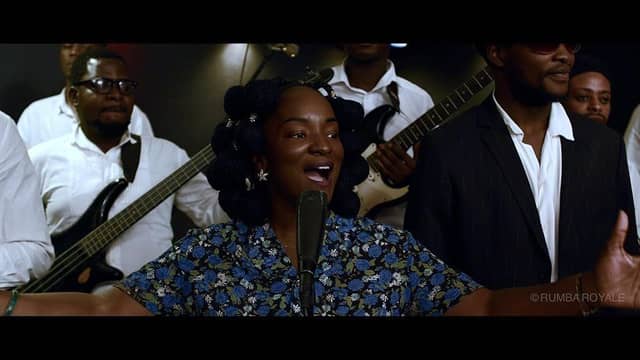

In a changing African cinematographic landscape, where historical narratives are increasingly captured by local voices, Rumba Royale, a Congolese political thriller set on the eve of independence, attracts attention. Among the main actors, the participation of Anzor Alem, a Congolese artist with crossed careers in music and cinema, illustrates a cultural dynamic that goes beyond the logic of traditional casting.
Directed by Hamed Mobasser and Yohane Dean Lengol, Rumba Royale takes place in 1959 in Léopoldville (now Kinshasa), at a Pivot point in Congolese history. The film explores the tensions of a declining colonial power, while highlighting places of sociability - especially nightclubs - where music, political discourse and identity demands intersect. The choice of Congolese rumba as a narrative thread is not trivial: it underlines the central role of culture as a form of resistance.
The production brings together several actors from various backgrounds: Fally Ipupa, Mélanie Bokata, Patrick Kabundi, Olivier Loustau and Anzor Alem. The latter, notably noticed in Beast alongside Idris Elba, returns here in a role still kept secret but described as "sensitive to collective memory", according to a source close to the project.
A casting motivated by content, not notoriety

The involvement of recognized personalities could suggest a marketing choice. However, according to the directors' public statements, the selection process was based on an intimate knowledge of historical issues. "We were looking for actors capable of inhabiting the time, not overplaying it," said Mobasser at the AfroBerlin festival, where a presentation of the film took place.
Anzor Alem, briefly questioned on the sidelines of the festival, mentioned "a demanding shooting, at the height of the ghosts of History that we tried to honor. Although discreet about the details of his character, he stressed the importance of a project "that does not reduce the past to an ideological caricature, but confronts it with the complexity of the present. ”
A local shooting, a transnational production
*Filmed on several sites in the Democratic Republic of Congo, Rumba Royale was co-produced by Rodeo Chameleon Productions, Tosala Films, Emotive Productions and the French studio Pathé - the latter having recently announced a redesign of its African strategy. According to Kevin Dwyer, one of the producers, the film is part of a desire to think about Congolese history "from the inside", while aiming for a wide African distribution from December 12.
The film's logistical approach involved consultants in colonial history, traditional musicians and members of civil society, in a declared desire for authenticity. This mode of production is in line with a growing trend to refocus African film creation on its own institutions, while remaining connected to international circuits.
Analysis: between memory and visibility
If Anzor Alem's performance has not yet been unveiled to the general public, his presence feeds a broader reflection on how African artists approach postcolonial history on screen. By mobilizing hybrid figures, at the crossroads of disciplines, the film seems to seek not to illustrate a thesis, but to open spaces of confrontation, ambiguity - even discomfort.
The film's criticism has not yet been formally constituted, but the anticipated screenings at European festivals have shown a marked interest in the musical aesthetics of the project, combined with its sober narrative treatment. It remains to be seen whether this mixture will also seduce African audiences or whether it will encourage a debate on colonial memory on screen.
A test moment for African cinema?
Beyond the film itself, Rumba Royale could serve as a textbook case for African producers seeking to combine artistic demand, historical coherence and commercial ambition. The integration of an artist like Anzor Alem into a collective project with a political scope, without giving in to stardom, can be read as a signal: the construction of a credible postcolonial cinema does not depend only on budgets or international labels, but on an ability to think the stories from the inside.
At a time when African cinema seeks to rethink its tools, structures and mythologies, Rumba Royale - and the participation of Anzor Alem within it - appear as markers of a broader transition. Neither a manifesto nor a showcase, the film is part of a process of reappropriation, where identity is not proclaimed: it is replayed, with rigor and lucidity.