
British politeness is hindering salary transparency, new Indeed data reveals

According to Indeed data, the UK leads Europe in salary transparency, with 71% of job adverts including pay information. But when it comes to UK jobseekers discussing their salary with others, politeness gets in the way.
New research from matching and hiring platform Indeed - which surveyed 6,000 Europeans - reveals that 87% of UK workers are uncomfortable asking and 84% are uncomfortable sharing their salary with colleagues.
These findings highlight a cultural divide between professional openness and social discomfort. While 81% of working people and jobseekers believe salary ranges should be included in job ads, personal salary discussions remain a taboo topic for nearly half (49%).
Younger people are more progressive with salary openness—only 2% of 18-24-year-olds feel uncomfortable sharing their earnings with anyone, compared to 13% of those aged over 55. Younger workers are also more willing to ask about pay—just 7% feel uncomfortable asking anyone their salary, compared to 36% of those aged over 55.
Regional differences in salary transparency
Comfort levels discussing pay vary significantly across the UK. Regional workplace cultures and social norms play a role in shaping salary transparency attitudes, with some areas more open to pay discussions than others.
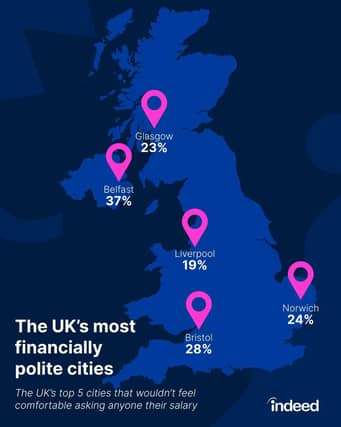
- Belfast residents are the most reluctant to discuss salaries, with well over a third (37%) unwilling to ask others their salary and 16% unwilling to tell.
- Bristolians are the second most financially polite city, with 28% uncomfortable asking others about their earnings and 5% uncomfortable sharing.
- Norwich residents take the third position, with 24% unwilling to ask anyone about salaries and 7% uncomfortable disclosing their own.
- Glaswegian: follow closely, with 23% uncomfortable asking others about their salary and 5% hesitant to share their own.
- Liverpool is the fifth most financially polite city, with 19% uncomfortable asking others about earnings and a similar percentage (14%) also unwilling to disclose their pay.
The UK’s top 10 most financially polite cities
| Rank | City | % uncomfortable asking others about salary |
| 1 | Belfast | 37% |
| 2 | Bristol | 28% |
| 3 | Norwich | 24% |
| 4 | Glasgow | 23% |
| 5 | Liverpool | 19% |
| 6 | Plymouth | 18% |
| =7 | London | 17% |
| =7 | Nottingham | 17% |
| =7 | Birmingham | 17% |
| =7 | Newcastle | 17% |
| 8 | Edinburgh | 16% |
| =9 | Cardiff | 15% |
| =9 | Sheffield | 15% |
| 10 | Leeds | 14% |
Who are we comfortable talking about salary with?
When it comes to salary conversations, partners and close family are the safest ground. But even in these close relationships, there is still a noticeable reluctance to ask about earnings.
While 62% of UK residents are comfortable sharing their salary with their partner, only 58% feel comfortable asking their partner about their pay. This trend continues across other relationships, with a consistent gap between those willing to share their own salary and those comfortable inquiring about others.
Comfort levels discussing salaries with different people
| Relationship | Comfortable sharing salary (%) | Comfortable asking about salary (%) |
| Partner/spouse | 62% | 58% |
| Close family | 49% | 36% |
| Close friends | 36% | 29% |
| Colleagues | 16% | 13% |
Despite salary transparency being a hot topic in workplace discussions, employees remain particularly reserved when it comes to discussing pay with colleagues. With only 16% comfortable sharing and just 13% comfortable asking, the office remains one of the most secretive spaces for salary conversations.
- 26% of employees say they would politely decline if a colleague asked about their salary.
- 24% would give a vague answer rather than an exact figure.
- Just 17% would openly share their salary without hesitation.
- 5% say they would be offended if asked.
Public salary discussions almost feel akin to workplace embarrassment. Only a slight majority - 54% - say they’d rather reveal their earnings than accidentally hit ‘reply all’ on a company-wide email.
Why this matters
Danny Stacy, Head of Talent Intelligence at Indeed, says: “Reluctance to talk openly about pay can have real-world consequences. Avoiding salary discussions makes it harder for individuals to benchmark their earnings, negotiate fair pay, and understand their worth in the job market. Conversations about salaries aren’t just about curiosity - they’re a crucial step towards pay equity and fairer workplaces.
Stacy continues: “Yet, as our research highlights, deep-seated social norms continue to make salary conversations difficult. While the UK leads Europe in job advert pay transparency, hesitation to discuss earnings in personal and professional settings could slow further progress in workplace pay equality.”