
Screen time kills dinner table chat
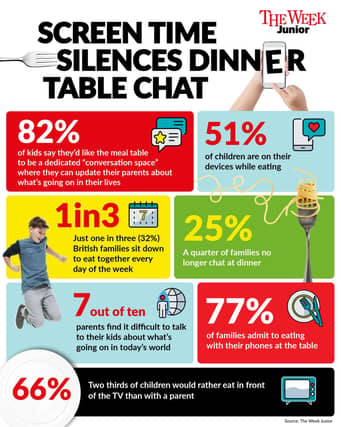

New study from The Week Junior finds dinner table chat is in sharp decline with screen time to blame. Weekly current affairs magazine for children looks to spark dinner table conversation with family chat starters
- Shock new study reveals that a staple family moment is in sharp decline
- Rise in screen time to blame, with 77% of families admitting to eating with their phones at the table, whilst a quarter (25%) no longer chat at dinner
- Two thirds (66%) of children would rather eat in front of the TV than with a parent
- A heavy news agenda compounds the challenge, with seven in ten (71%) parents finding it difficult to talk to their kids about what’s going on in today’s world
- Child psychologist Doctor Elizabeth Kilbey, along with The Week Junior, call on British families to rediscover the joys and importance of family dinner conversation, which provides huge benefits for both children and parents
- The Week Junior launches a range of initiatives including dinner conversation chat starters as part of 10th anniversary celebrations to help families find fun topics of conversation – designed to trigger debate and curiosity
The great British family dinner – once the heart of household conversation – is now in sharp decline according to a new study conducted by The Week Junior.
Although the dinner table should be a space for conversation and connection, a quarter (25%) of families admit to not talking at all during dinner.
The research reveals that mobile phones and hectic schedules are sidelining family conversations at dinner time, while a heavy news agenda makes it even harder for parents to tackle topical discussions with their children around the table.
Screens are increasingly creeping into mealtimes, with over three-quarters (77%) of families admitting to having phones at the table. Over half of children (51%) are actively on their devices while eating, and two-thirds (66%) say they'd actually prefer watching TV or using a screen over having a conversation with a parent.
However, it’s not just children who are drawn to their screens. Two in five (39%) children say they have to ask their parents to put down their phones at the table.
The study, which surveyed 2,000 British families with children aged between 8-16 years old, was commissioned by The Week Junior to celebrate the 10th anniversary of the UK’s only weekly news magazine for children. The magazine has launched a series of conversation chat starters to help families reconnect and rediscover the magic, and importance, of intergenerational dinner table dialogue.
Family dinners were once a staple of British life for many years, however, with the rise of technology and changing routines, it seems the tradition of the daily family dinner is fading, with just one in three (32%) British families sitting down to eat together every day.
A heavy news agenda adds another obstacle to conversation, with many parents feeling ill-equipped to navigate conversations in today’s complex world. While 82% of children say they want the dinner table to be a place they can talk to their parents about what is happening in the world, the same proportion of parents admit they don’t have these discussions regularly anymore.
In fact, seven in ten (71%) parents admit they struggle to know what to say in the face of today’s challenges, and only a third (33%) feel fully confident in explaining current affairs in a way that is accessible, accurate and reassuring.
The author and child psychologist Dr. Elizabeth Kilbey, says there are many benefits to the family dinner conversation, which includes helping children’s development and opening their minds to new ideas.
Despite the challenges, parents are keen to restore the value of mealtime conversations. Almost all (93%) say they would be more consistent in enforcing dinner table rules if it would benefit their children’s development. This could have a positive impact for both children and parents, as a similar figure (94%) say they learn something from their children during these two-way discussions.
In today’s digital world, children are eager to engage too. Four in five (82%) say they want dinner to be a special time set aside exclusively for conversation with their parents. Most (88%) enjoy debating a wide range of topics, from global affairs to playground drama – and tellingly, the vast majority (83%) of children prefer having these conversations with their parents face-to-face at the table rather than over the phone.
Dr. Elizabeth Kilbey says: “In a world that's more connected yet increasingly disconnected, dinner time provides a powerful platform for fostering essential conversations and personal understanding. The Week Junior recognises that these moments of shared dialogue are crucial for building strong family bonds and enhancing critical thinking in our children. It's these simple, daily interactions that can make a significant impact, not just in strengthening family ties but in cultivating a generation equipped to lead empathetically and thoughtfully. Let's pave the way for a future where every voice is heard, starting right at home.”
Vanessa Harriss, Editor of The Week Junior, adds: “At The Week Junior, we know how imaginative and curious kids are. In our fast-paced daily lives, being able to spend time together as a family can be a challenge – and the digital distractions are ever more insistent. As our research shows, quality time spent together over the dinner table is vital for families. Whether it’s chatting about everyday things or discussing what’s going on in the news, these family conversations boost children’s development and their wellbeing. That’s why we’re encouraging everyone to talk a little more as families. As part of our 10th anniversary celebrations, The Week Junior is also getting even bigger. With an extra four pages every week, we’ll be including conversation starters for our young readers – because taking time to talk makes everyone feel happier.”
The Week Junior’s new bigger issue is on sale now. Find out more at theweekjunior.co.uk