
Small drones rules set to change - here's what I did to remain legal


Our ten-year-old daughter was devasted when we said no to her having a pet bird earlier this year, but when I showed her a video of the ultra-portable DJI Neo drone, taking off from users’ hands and following them around autonomously, before landing in the palm of their hands again, she realised that this was better than a pet bird, it was something she’d be able to take outside for walks with her.
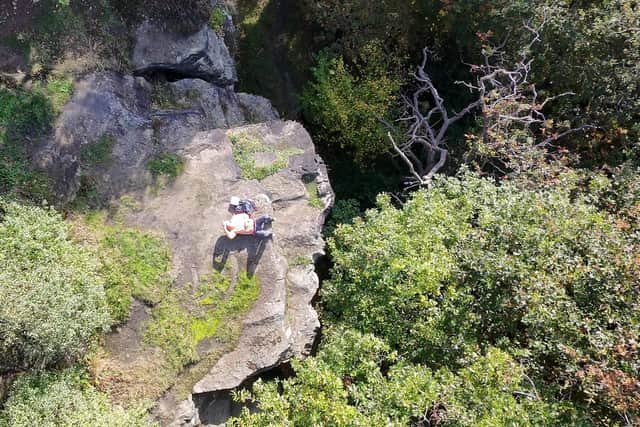
We’ve had the Neo for a few months now, and it’s easy to see why it’s become so popular and earned such rave reviews on tech sites. It’s hard to say whether my kids prefer flying the Neo in its various autonomous modes or by manually controlling it with the DJI app on my mobile phone. What I do know is that whenever we go out on a walk in the countryside, they want to bring the Neo with us because they see it as a robotic pet. For my part, I share their love for the Neo because it’s a great way of filming some of our adventures with zero skill involved whatsoever. I can just set it on Follow Me mode, to follow the kids around, Dronie Mode to get great selfies of us – even off bridges and cliff edges – or get a vertically overhead view of us using the Rocket Mode.
But what I hadn’t factored in was regulations changing in the UK. At just 135g, the Neo is well under the current 250g weight limit that legislation requires a Flyer ID for. But in January 2026 that’s going to change. From then onwards, all drones over 100g – other than toys – are going to require the pilot to hold a Flyer ID, which means passing a test. And, while the incredibly popular DJI Neo is small enough to look like a toy, it’s very much a fully functional drone.
My kids and I have all just taken the test in anticipation of the new rules, and it wasn’t particularly challenging for any of us. There was no cost to take the test or receive our Flyer IDs, and we won’t have to take it again for another five years. It took me around 30 minutes to complete and could have been retaken as many times as I needed, if I didn’t hit the pass mark. Technically, you’re supposed to read the Drone Code before the test, but I took the test blind to see if pure common sense could get me to the all-important thirty out of forty. I consider myself to be reasonably sensible and was happy to see that the first few questions were about obvious topics like flying near military bases or carrying dangerous objects with a drone. I did wonder, given the times we live in, how many people would answer “C” to question 5, when it asked about a hypothetical scenario in which there had been a serious road traffic accident with emergency services on scene. It asked whether I should (a) stop flying immediately, (b) alert the emergency services to the fact I was flying, or (c) fly over the scene of the accident to get some dramatic footage of it.

But so far, so easy. Then the questions started to require knowledge of distances that I was allowed to fly from people, crowds, residential buildings, and general height restrictions. Some of these only needed common sense to answer properly, but others would have required the person taking the test to have either read the Drone Code or Googled the rules.
In the end, I managed to score thirty-four out of forty and was pleased to find that the answers that I’d gotten wrong were the ones where I had erred on the side of caution, rather than anything that would have made me a dangerous pilot. That said, it would be difficult to do anything dangerous with our DJI Neo anyway. It’s so light, and the propellers are so well guarded, that it’s safe to take off and land in the palm of the user’s hand. The DJI app also has built in GEO-fencing that prevents users from flying in restricted space.
But I wasn’t certain about how the kids would answer questions about road traffic accidents. I knew they’d know getting dramatic footage would be wrong, but would they know to stop flying, rather than alert the emergency services that they were flying? So, I set my thirteen-year-old son off, with a copy of the Drone Code to help him where necessary. I deliberately didn’t help in any way and left him to get on with it. He came back around an hour later with a score of thirty-eight.
Finally, I went through the test with our ten-year-old daughter, who only ever has her beloved Neo follow her in the autonomous modes. I don’t think there was any real need for her to take the test yet – since I’m always there and in charge of the drone when the Neo is following her – but why not? As with my thirteen-year-old, it took about an hour, and with us both using the Drone Code document she scored a very respectable thirty-seven.

So come 2026, we’ll all still be able to fly the Neo, which is a relief because it feels like part of the family now, and the kids are looking forward to Neo taking his first family holiday with us in Portugal later this year.
It wouldn’t surprise me in the least if brands like DJI manage to make a similar drone to the Neo that weighs 99g in the near future, but for now the DJI Neo is still the go-to mini drone for the whole family, and the Flyer ID test is straightforward to take. I’m looking forward to lots of safe, legal flying with ours in 2026.
Notes
Because the Neo has a 4K camera I was technically obliged to register for an Operator ID, that allows me to film outdoors. This costs £11.79 for a year and didn’t require taking a test. I did have to make a declaration to meet all legal requirements for flying a drone and to display my operator ID on the Neo, which I put on a sticker inside the battery compartment.
While the DJI Neo is incredibly safe, it’s still important to read the safety instructions, and remember that it doesn’t include obstacle avoidance.
For full guidance on the new rules regarding drones, see the CAA website, where you can take the Flyer ID test, read the Drone Code and register for an Operator ID.