


Covid cases have tripled across Europe in recent weeks, accounting for almost half of global infections, the World Health Organisation (WHO) has said.
The ‘super-infectious’ relatives of the Omicron variant have been blamed for the surge, with the BA.4 and BA.5 strains driving new waves of the disease across the continent.
The WHO’s Europe director Dr Hans Kluge described the virus as a “nasty and potentially deadly illness” that people should not underestimate, and warned that hospitalisations are set to increase further in the autumn and winter months.
In the UK, people have been urged to be cautious after Covid cases spiked over the past few weeks, with health experts recommending wearing face masks in crowded and enclosed spaces to help reduce the risk of further spread.
Some popular destinations in Europe have now tightened their rules on face masks and self-isolation in response to the recent surge in infections.
So if you are heading abroad this summer, these are the key entry and Covid rules for 10 European holiday spots to be aware of.

5. Greece
Tourists do not need proof of vaccination, a negative Covid test, or certificate of recovery to enter Greece, nor do they need to complete a passenger locator form. Face masks are mandatory on public transport, in hospitals and care facilities, pharmacies, taxis, and indoor spaces on boats, but there is no legal requirement to wear a mask in all other spaces. If you test positive for Covid while in Greece, you must self-isolate for five days. You may leave isolation before the end of the five day period if you need to travel back home, provided you wear a high protection mask and do not have a fever. | pkazmierczak - stock.adobe.com

6. France
As of 1 August, all Covid restrictions for travellers to France have been lifted. This means travellers visiting from the UK are no longer required to present proof of vaccination, fill out any forms prior to arrival, such as a justification for travel or a sworn statement, or to show proof of a negative PCR or antigen test upon arrival in France. If you test positive for Covid and you’re fully vaccinated or if you’ve had the virus in the last four months, you must self-isolate for seven days. This can be reduced to five days with a negative test. Those who are not fully vaccinated and haven’t had Covid in the last four months, you must self-isolate for 10 days. This can be reduced to seven days with a negative test. | Sean Hsu - stock.adobe.com

7. Portugal
There are no longer any Covid vaccination, testing or passenger locator form requirements for entry to mainland Portugal, Madeira and the Azores. If you test positive for Covid in Portugal, you will have to self-isolate at your own expense for at least seven days. In Madeira, Porto Santo or the Azores, the self-isolation period is at least five days. Some safety precautions are also still in place including the use of face masks on public transport, in taxis and private hires, on aeroplanes and on entry to medical facilities, retirement and nursing homes. | Filip - stock.adobe.com
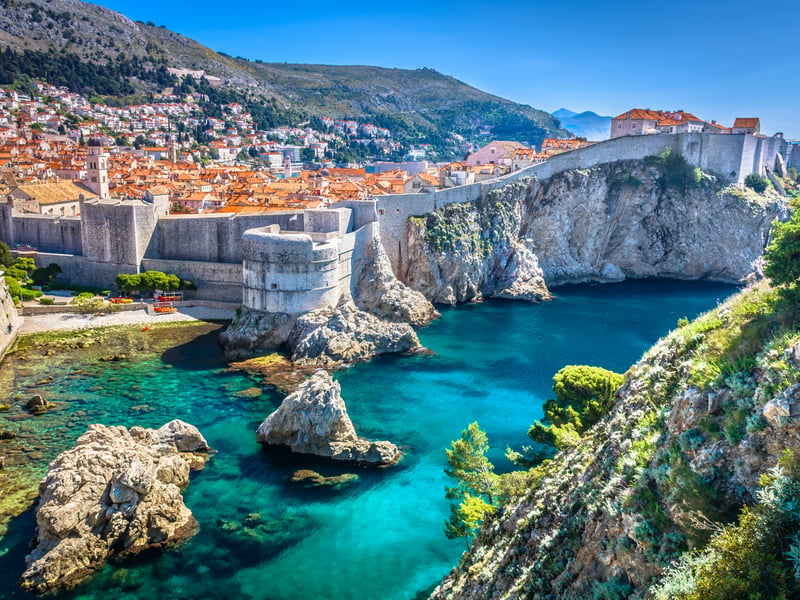
8. Croatia
Travellers are no longer required to show a Covid vaccine certificate, proof of a negative test, or a certificate of recovery to enter Croatia. An online entry form is also no longer needed. Face masks are not required in indoor settings, but are still recommended in large gatherings and are mandatory in health and social care settings. If you test positive for Covid, you may need to stay where you are until you test negative. | Adobe