
Experts crack code to 400-year-old shipwreck padlock hiding treasure mystery
Researchers have used CT scanning technology to crack the four-letter code on a 400-year-old combination padlock recovered from the wreck of the Ann Francis off the Welsh coast.
Experts have cracked the code to a 400-year-old padlock recovered from a shipwreck off the Welsh coast, revealing the four letters that kept it locked for centuries.
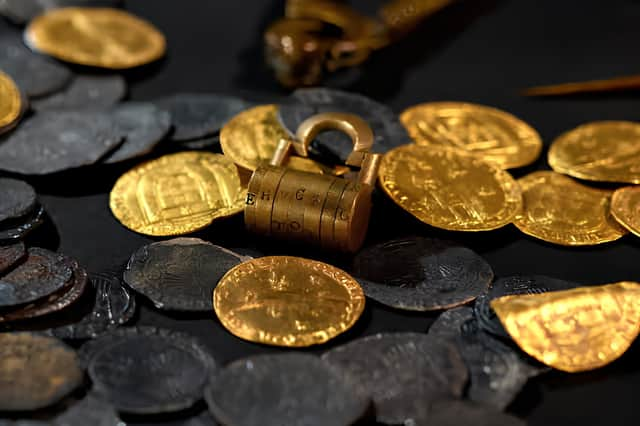

The brass combination lock was found among a remarkable hoard linked to the Ann Francis, a ship wrecked near Port Talbot in December 1583 while returning from Spain.
Now researchers using CT scanning technology have discovered the combination was ANCE.
The lock was recovered from Margam Beach after storms and dredging exposed items from the wreck, including Spanish silver coins and coin weights. It is thought to have once secured a small chest containing valuables.
Specialists from Amgueddfa Cymru - Museum Wales and Cardiff University examined the lock using scanning technology that allowed them to see inside without damaging it.
Dr David Williams, a research associate at Cardiff University's School of Engineering, created a detailed 3D image of the mechanism and was able to see how internal notches lined up with letters on the lock.
He said: "It's not every day you get to solve a 400-year-old mystery!
"By creating a detailed 3D image of the internal mechanism, I could see how the notches lined up with the letters and identify the exact combination.
"We normally use this technology to study bones and other biological structures, so investigating a 400-year-old padlock was certainly a first for us."
He added that he had to wait until later that evening for museum staff to test the combination.
"Getting the message that we'd cracked it was incredibly satisfying," he said.
The lock was discovered by metal detectorist Peter Hughes, who uncovered parts of the Ann Francis hoard over 21 years between 1996 and 2017.
He said the condition of the lock surprised him immediately, with its letter rings still turning freely despite having spent more than four centuries beneath the sand.
"When I found the lock I was immediately astonished by the incredible workmanship and its astonishing condition," he said.
"When I moved the ring dials of the combination they turned with ease after over 400 years beneath the sands and I was left in disbelief."
Researchers are now left with another mystery: whether the letters ANCE had any special meaning to the lock's original owner.
Alastair Willis, senior curator for numismatics and the Welsh economy at Amgueddfa Cymru, said Elizabethan combination locks are known in Britain, but described this example as exceptional because of its condition and its connection to a dated shipwreck.
"Of course, now we've solved it, we are left wondering if the code meant something to its owner," he said.
The Ann Francis was returning from Spain when it was blown off course during a storm in late December 1583 and wrecked at Margam Beach.
Items recovered from the site include rare gold coins dating from the reign of Ferdinand and Isabella of Spain, Spanish silver coins and a boatswain's whistle.
The padlock and other objects from the hoard are now on display at the National Waterfront Museum in Swansea as part of an exhibition exploring Wales' maritime history and international links.
The acquisition of the collection was supported by the Welsh Government.