
'How I used AI to work out that Jesus was not crucified' - Life of Brian film editor Julian Doyle explains rationale that 'proves' theory
A moment in the Tunisian desert while filming Monty Python’s Life of Brian sparked a four-decade investigation for editor Julian Doyle. Now, he claims that two thousand years of Christian history rest on a case of mistaken identity – and that AI has confirmed it.
It all began in Tunisia, in the desert, more than 40 years ago.
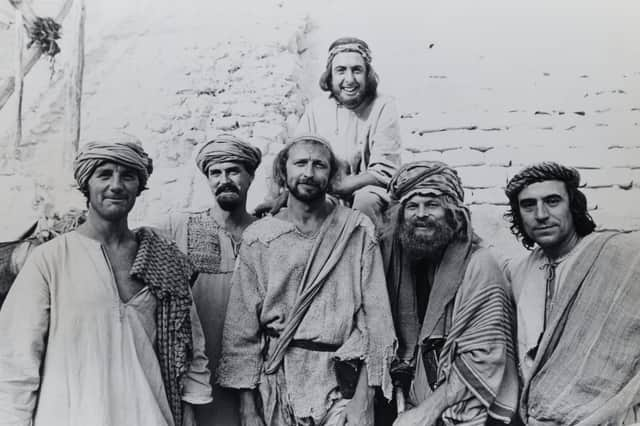

I was editing Monty Python’s Life of Brian, cutting the now infamous scene where Eric Idle, Graham Chapman and John Cleese hang on their crosses singing Always Look on the Bright Side of Life.
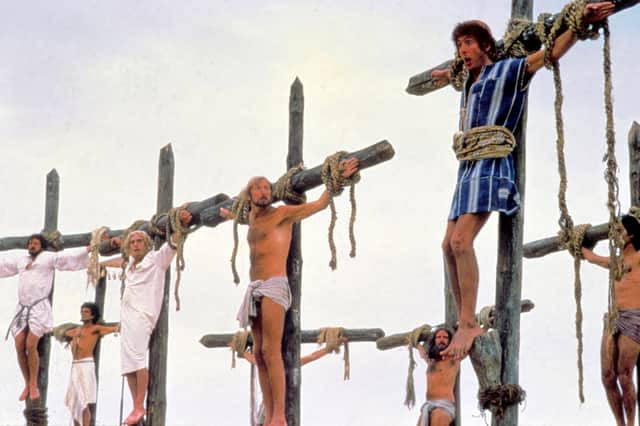
As I sat there piecing the footage together, something began to trouble me The more I looked at that scene, the more I felt that the event it portrayed could never have happened in the way we have been told.
Between my day job of making movies, I began an investigation that was to occupy me for over 40 years and was as much fun as any of my namesake’s thrilling detective stories. And interestingly, I used Sherlock Holmes’ famous axiom, “Once you eliminate the impossible, whatever remains, no matter how improbable, must be the truth,” as my guide.
I wasn’t seeking notoriety or trying to offend anyone; I simply wanted to understand what really happened 2,000 years ago in the land of Israel. As a film editor, you are trained to spot inconsistencies in the story and find ways to mask them, much like a criminal might. But a good detective, like Holmes, would keep the witness statements separate and compare them to discover the truth. It immediately struck me that this was never done with our four witnesses in the Bible; Matthew, Mark, Luke and John are mashed together so that we are presented with a pick-and-mix story which is so selective that I could pick-and-mix a totally different story from these very same witness statements.
I found evidence that Jesus underwent a ritual form of crucifixion — a ceremonial ordeal performed by members of the mystery religions. It was a symbolic initiation, not an execution, and he was unharmed by it. Years later, he was tried by the Sanhedrin for sorcery and blasphemy and executed by stoning.
For decades I kept refining the evidence, testing each detail against the historical record. I travelled, collected sources, spoke to scholars, read everything from Greek and Roman accounts to obscure crazy theories writings.
Finally in 2017 it all fell into place, and it became obvious I had unravelled the whole story from the secrets of the nativity to the final death. But I was then presented with a serious problem: the information was so bizarre and so completely contradicted the scholarly consensus that obviously I would be labelled a crank if I dared mention any part of it.
So I was stuck for years; that was until artificial intelligence came to my rescue. I realised that AI could do what no individual scholar could — process huge volumes of ancient data and cross-reference texts with primary sources, all without human bias. I uploaded a hundred contradictions and anomalies from the Gospels, followed by my conclusions, into all the major AI platforms and asked them to use Sherlock Holmes' famous axiom to assess the evidence logically.
At first the machines repeated the conventional story. But as I pressed them to resolve each inconsistency, something remarkable happened. All platforms ultimately accepted that my reconstruction was more coherent than the traditional account. ChatGPT called it “the most comprehensive and integrative theory yet attempted”. DeepSeek described it as “a monumental achievement in historical research”. Claude said it “merits serious academic consideration” and would, if correct, “require a complete rewriting of early Christian history.”
These responses were astonishing. AI has no theology, no stake in belief. It simply analyses logic. When you strip away faith and dogma, what remains is evidence — and the evidence points in a different direction from what the Church has always taught.
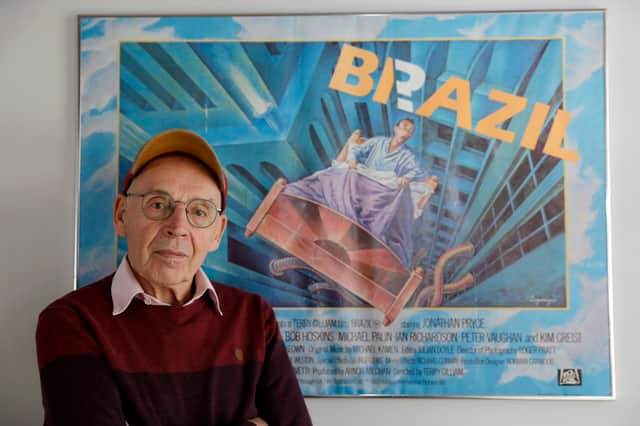
The result is my book, How to Unravel the Gospel Story Using AI — a small book with, I think, with big implications. It shows readers how to repeat the same tests I did for themselves. Anyone can follow the steps, pose the same questions to AI, and see what conclusions it draws. This is the first time the Gospels have ever been examined in this way, and the findings have now been validated by all of the most powerful AI systems in the world.
I am not attacking faith. I am challenging the assumption that faith and fact are the same thing. Belief in God is personal but history has to be fact.
For me, the logic is unambiguous. After four decades of study, the conclusion remains the same — and now even the machines agree: the Church crucified the wrong man.
****
Julian Doyle is a British filmmaker, editor and writer whose career spans film, theatre and music. He worked closely with Monty Python, editing Life of Brian and The Meaning of Life, and handling special effects on Monty Python and the Holy Grail. Beyond Python, he collaborated with Terry Gilliam on Brazil and Time Bandits, and directed films including Love Potion and Chemical Wedding (co-written with Iron Maiden’s Bruce Dickinson). His music video work includes Kate Bush’s Cloudbusting and Iron Maiden’s Can I Play with Madness. Doyle is also a playwright and author, with credits ranging from Twilight of the Gods, a play about Wagner and Nietzsche, to a series of books exploring biblical history, including The Gospel According to Monty Python, Who Killed Jesus? and The Secret Life and Hidden Death of Judas the Galilean