
Battery-free smart shoe uses footsteps to track walking with 95.4% accuracy
Forget charging your smartwatch — scientists have created a clever smart shoe that powers itself from footsteps while using AI to analyse how you walk.
Scientists have unveiled a “worry-free” smart shoe that could one day track changes in the way people walk — without ever needing a battery.


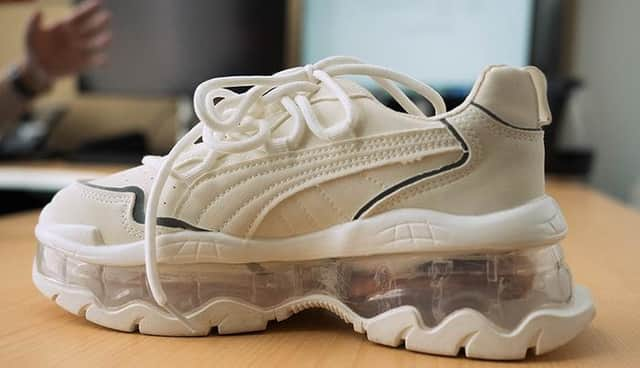
The white athletic prototype hides electronics in its heels and uses energy generated by footsteps to power itself. Researchers at Rutgers University say it can count steps, estimate calories burned and identify different types of movement with 95.4% accuracy.
Lead researcher Dr Simiao Niu said walking provides both the information researchers want and the energy needed to analyse it. He described the shoe as a natural target because the foot creates useful data with every step.
A device in the sole produces electricity from the pressure and friction created with every step. This triboelectric effect is similar to static electricity generated when different materials rub together.
The shoe uses an accelerometer to track foot movement in three directions. A tiny processor then uses artificial intelligence to classify each 15-second burst as slow walking, fast walking, running or climbing stairs.
The AI works directly inside the shoe, an approach known as “edge AI”, so raw movement data does not have to be constantly sent to a phone or cloud server.
The compact AI model achieved 95.4% accuracy while running about 15 times faster and using roughly one-sixth of the current required by the original version. The sensor and AI together consume just 86 microwatts, while tests found even slow walking generated enough power to keep the system running.
Gait — a person’s pattern of walking, including speed, stride, balance and rhythm — can provide clues about disease progression, fall risk and rehabilitation. Researchers hope future versions could monitor patients during everyday life rather than relying on short observations in a clinic.
But there is a catch. The prototype was developed using data from just four healthy volunteers aged 23 to 26. It has not yet been tested on older people or patients with movement disorders.
The team says further clinical testing is needed before the shoes could diagnose conditions, predict falls or assess treatment.
The research was published in Science Advances, and the team says the concept could eventually reduce the need to remove wearables for charging.