
COP29: How Gen Z feel about climate change - what they're doing for the planet
Young people say they are doing what they can to live more eco-friendly lives, but many still fear there’s a bleak future in store for them.
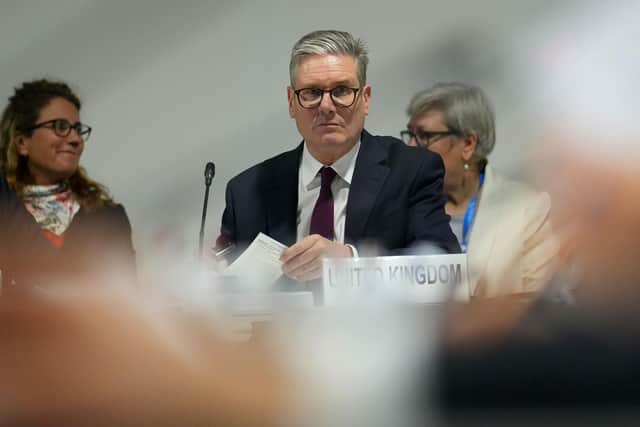
The United Nations’ 29th annual conference on climate change (COP29) is now underway in Azerbaijan, where it will run until 22 November. Some of this year’s focuses include getting the Loss and Damage Fund - which provides financial support to countries suffering the impacts of climate change - as well as setting each country’s emissions reduction targets to limit the world’s warming to 1.5C above pre-industrial levels, in a year the Copernicus Climate Change Service warns looks set to surpass it.
COP brings together the world’s nations in pursuit of a common goal; limiting the impacts of climate change. Environmental leaders have the opportunity to negotiate and develop major international treaties like the 2015 Paris Agreement. But the conference doesn’t always translate to making young people feel more hopeful about their future in a warming world.
A past YouGov poll commissioned by the Woodland Trust noted that young Brits aren’t exactly feeling optimistic. The survey found that substantial chunks of 16 to 24-year-olds felt scared (33%), sad (34%) or pessimistic (34%) about climate change. Nearly one in three were so worried that they were considering having fewer children.

“Climate change is jeopardising more than just the environment,” Woodland Trust chief executive Dr Darren Moorcroft said. "Young people are experiencing an epidemic of climate anxiety.”
Well before COP29 kicked off in Baku, our student journalist Yunke Duan hit the streets of Sheffield to gauge how young people who were living, working, and studying in the city felt about the future. Here’s what they had to say:
A question of hope
We spoke to people aged 25 and under from a wide variety of backgrounds, and asked them whether they thought concerns about the climate were ever over or under-exaggerated. We also asked how they felt when thinking about what the planet and the environment might be like in the future.
Qingqing, 24, felt that climate issues were often under-exaggerated, and more direct action was needed. Student Mert, 23, echoed this sentiment, but stressed that he feared humanity may not be able to resolve the issue in time. “We might have already passed the point where we can reverse climate change, and that makes me feel pessimistic.”
Harry, 22, also acknowledged the severity of climate change, but felt individual actions were negligible compared to larger systemic issues. Daniel, 21, agreed, saying he believed that responsibility lay more with governments and corporations than with individuals.
But a distinct thread of hope emerged, particularly from young people who took part in some kind of proactive action. Miharu, 23, told us she still believed in the potential for positive change through working together. Student Nicole, 24, agreed, saying she too believed that collective effort could have a positive impact on climate change.
Another student, 25-year-old Zerenrangdeng, had previously been involved in work to protect his hometown’s grasslands and its water sources. “If we can improve [these] climate change problems, we can create a better environment for ourselves and especially for our health,” he said.
Overall, young people's views on climate change were a complex mix of anxiety and hope. Many believed that while individual efforts were important, systemic change and government intervention were necessary. As The Woodland Trust’s Dr. Moorcroft put it, “there is hope, but we need to take drastic action”.
Making a difference
Many of the young people we spoke to had made eco-friendly practices a part of their everyday lives, although some still shied away from more direct action like protests or volunteering.
“I walk most of the time because I can’t drive. But I have this tendency to switch off the lights... and I’ve started to use less water,” student Arsen told us. He had also done some volunteer work, but hadn’t joined any protests - “yet”. “Whenever I found [out about] a protest going on, it was already too late for me to join.”
Joshua, 22, told us: “We always use cardboard and plastic to recycle... and also saving water because my parents are always [telling me to].” However, he admitted to not participating in more direct environmental actions. “I can’t really be bothered.”
Nicole recycled too and tried to reduce her daily plastic consumption, and had even taken part in an ocean cleanup project. But her friend Xinyao, 23, said that she hadn’t noticed as many opportunities for direct environmental action as expected. “Maybe because of Covid-19, I don’t have many chances to do it.”
Miharu had also taken aim at her plastic use. “One thing I’m doing is never buying bottles outside; I mostly bring my bottle to drink water. Also, I try not to buy ready-made meals because they have so much plastic.”
But she had taken part in some more direct action too. “One thing I did was collecting garbage… it was volunteer work and I joined in with my family and friends.”