
Man almost ignores weak metal detector signal before finding 3,000-year-old treasure
A metal detectorist who almost ignored a faint signal in a Shropshire field has unearthed an extraordinarily rare Bronze Age artefact that experts say has no known equivalent in Britain.
A metal detectorist has made an extraordinary discovery after digging up a 3,000-year-old Bronze Age axe head that experts say has no known equivalent in Britain.

Paul Pritchard, 49, was searching a field in Shropshire when his metal detector picked up a faint signal that he almost dismissed.
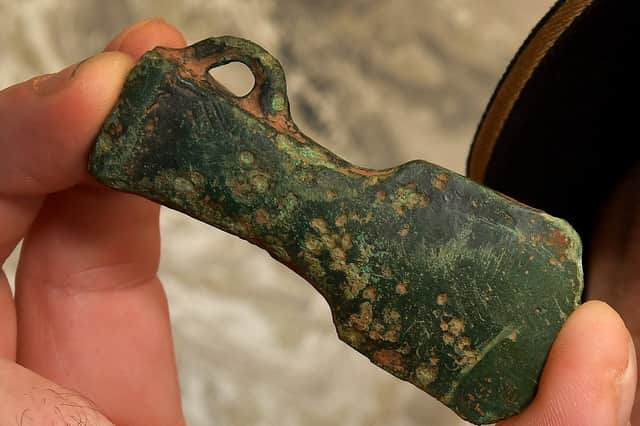
But after deciding to investigate, he uncovered a remarkably well-preserved copper alloy axe head dating from between 1140 and 950 BC.
Experts have described the ancient object as an unusual type of socketed axe, with no known British parallel, suggesting it may have been used as a specialised tool.
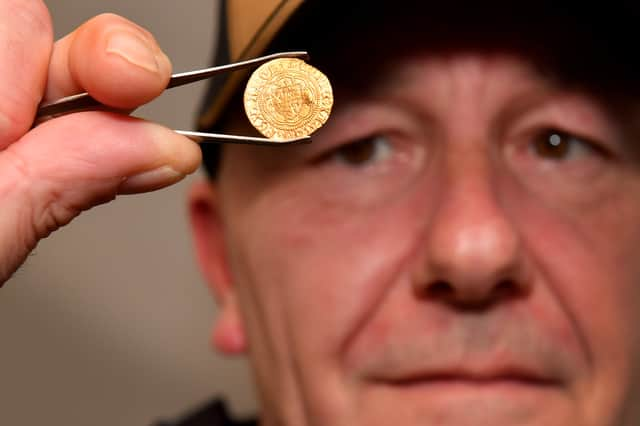
The discovery is even more remarkable because Paul had already unearthed a medieval gold coin just months earlier.
A weak signal led to an extraordinary discovery
Paul, from Willenhall in the West Midlands, was taking part in an organised search near Hinstock in north Shropshire when he came across the object.
His detector initially registered such a poor signal that he considered moving on.
"It was really poor signal to start but because I had not found anything else I thought 'I'll give it a go'," he explained.
"As I dug deeper, the signal improved before it emerged from the soil.
"I had literally turned the soil with my spade and I saw it sticking out. Straight away I knew it was a socketed axe."
Although Paul immediately recognised the general type of artefact, he was stunned to discover it was intact after spending almost three millennia buried underground.
He called over another member of the Shrewsbury and Shropshire Metal Detecting Club to examine it.
"I realised it was a complete one and then straight away got a member of the club, Bob, to have a look," he said.
"He's very knowledgeable and as it happens he was about 20ft away. I went over and showed it to him and he said straight away that it was quite an unusual shape."
Why the Bronze Age axe is so unusual
Socketed axe heads were made during the Bronze Age, with a hollow socket allowing a wooden handle to be fitted into the metal head.
But the shape of Paul's discovery sets it apart from other examples found in Britain.
Experts who examined the artefact described its form as unusual and suggested it probably served as a specialist tool rather than a conventional axe.
The identification has attracted considerable interest among fellow metal detectorists, particularly because of its exceptional condition and unusual design.
News of the discovery spread quickly after the Shrewsbury and Shropshire Metal Detecting Club shared details on Facebook.
"It just blew up with the likes and people saying how rare it was," Paul recalled.
Other club members were equally fascinated, asking to see the object for themselves.
'A metal detectorist's bucket list moment'
Paul says discovering the axe head was an entirely different experience from finding his medieval gold coin earlier in the year.
"With the gold coin that was different, that was really exciting, with the axe head it was disbelief because it is just a metal detectorist's bucket list moment," he said.
"It is something all metal detectorists want to find."
Around 45 people were taking part in the organised search, meaning the remarkable discovery could easily have been made by somebody else.
Paul believes it was a combination of persistence, experience and good fortune that brought him to the exact spot.
"There is a lot of dedication involved, and the equipment you use but I just feel lucky that it was me who walked over it," he said.
"There were like 44 other people there that day and any one of them could have walked over it."
Despite the excitement surrounding the discovery, Paul admits he is still coming to terms with what he has found.
"It is a bit surreal, I can't believe the significance of it," he said.