
"I’ve lost 26 annual elections to the vet profession’s ruling council but every dog eventually has its day"
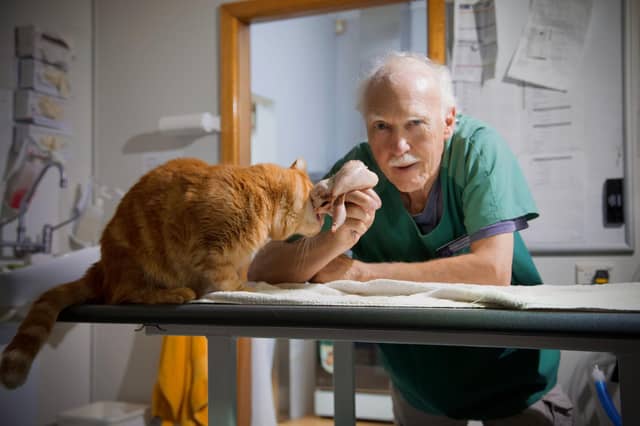

Last month, whistleblower vet Dr Tom Lonsdale stood in his 26th annual election to the UK veterinary industry’s ruling council, the RCVS, on a ticket of investigating the link between kibble and gum disease in pets. For the 26th time, he failed to win a seat. Now in his mid-seventies, Dr Lonsdale says he can’t keep fighting forever, but he knows one thing: the difficult questions he’s asking won’t go away.
Since 1997, I’ve stood in almost all annual elections to the Council of the Royal College of Veterinary Surgeons (RCVS). the body responsible for setting professional standards and overseeing the work of vets and vet nurses in the UK.
For 26 annual elections between then and now, there’s always been one constant: I always come last.
In the early years, I used to get nine to 10 per cent of the votes cast. This year, I received 260 votes out of 7,352 cast, which is around 3.5 per cent of the total. At least that’s up from 221 votes in 2024. It’s not a win by any conventional measure, but it’s a small victory, I guess.

That’s more than a quarter of a century that I’ve spent trying and failing to get a seat at the table. I’m now in my mid-70s. Standing for election each year takes time, effort and energy, and each year it gets a little bit harder to do. Frankly, I don’t know how many more years I’ll be able to keep doing this.
And truth be told, it has often felt like I’m just shouting into the wilderness.
My fight began back in 1992, when I presented a paper to the Australian Veterinary Association titled Pandemic of Periodontal Disease – A Malodorous Condition. It stated that feeding pets a monotonous diet of ultra-processed food, particularly dry kibble, was contributing to widespread gum disease, and by extension, to broader systemic illness in pet dogs and cats.
I sent the paper and a video of the presentation to the RCVS, hopeful that the profession’s leadership would investigate. I did receive a polite acknowledgment at the time but nothing more.
So, in 1997, I decided on a new strategy to put the message on the agenda, standing in the annual RCVS elections. After all, I was eligible. Although I’ve spent most of my professional life in Australia, I qualified at the Royal Veterinary College in London in the 1970s and have remained a registered Member of the RCVS ever since.
Truth is, I never wanted to be on the Council as a lone voice. However, manifesto statements were allowed, permitting me to voice my concerns about the RCVS and vet journal silence on the pet food controversy. Once a year I could place 500 carefully chosen words on the official record.
In every election, my core message hasn’t changed, calling on the veterinary profession to confront the possible harms caused by highly processed pet food and to encourage independent investigation into more natural feeding alternatives.
I’ve consistently argued that we must act to protect our pets, and that the veterinary profession, under the guidance of its regulators, has a professional, not to mention moral. duty to lead that vital conversation.
And given that 260 registered RCVS members supported my campaign this year, I’m clearly not alone in having this concern. Let’s be clear, here: this isn’t a fringe view. In human medicine, periodontal disease is recognised as a key contributor to heart disease, diabetes, cancer, liver and kidney problems, and a host of inflammatory conditions.
The same basic biology applies to our pets. In dogs and cats, the gums become inflamed as a complete set of deciduous teeth cut through the gums between three and six weeks of age. The next major event arises when all the baby teeth are lost and the adult teeth cut through the gums between four and six months of age. Without proper cleaning of teeth and massaging of gums, matters worsen. By age three, studies suggest 80 per cent of dogs are in need of clinical intervention. And yet we ignore the ever-present bad breath — we consider it to be merely a nuisance, not a crisis.
If the gum disease mechanisms were unknown, we might understand the inertia. But the connection to diet is hard to ignore. In the wild, animals tear flesh, gnaw bones, and keep their teeth clean through physical action. Domestic pets, by contrast, are often fed the same uniform product day in, day out — dry pellets high in starch and lacking any of the cleaning action of raw, chewy tissue. The result is a plaque-laden mouth and a slow slide into systemic disease.
Some vets argue the science isn’t settled and that more studies are needed. I agree. But the responsibility to explore those questions doesn’t fall to outsiders. It falls to the profession itself and its regulators. The RCVS, as the statutory body overseeing veterinary standards in the UK, should be at the forefront of encouraging debate, transparency and research into this area. I’ve yet to see that in action.
Some may wonder why this all matters. Vets are highly trained, and the market is filled with products promising dental health, aren’t they?
But let’s step back a moment. If pet gum disease is still rampant, if it’s affecting most animals by middle age, and if diet is seemingly a significant contributing factor, which I’ve written about here, then all the treats, toys and dental rinses in the world are no better than window dressing.
This isn’t about blaming individual vets. Most are doing their best within the limits of the system they were trained in. But the system itself, from education to practice to regulation, is heavily influenced by commercial interests. The big pet food manufacturers sponsor vet schools, fund research, and supply clinics. That doesn’t make their products harmful by default but I think it does make it harder to ask the difficult questions.
And yet we need to ask questions because I’m as certain as I can be that the root cause of so many health issues affecting our pets is sitting right there in their food bowls. If I’m wrong, fine; the truth can withstand scrutiny. But if I’m right then millions of animals are suffering needlessly, and we are failing in our duty of care.
I’m not calling for dramatic reform overnight. I just want to see some form of engagement with the issue. For openness. For a willingness to investigate long-held assumptions about what we feed the animals we love and the systems we trust to keep them healthy and by our side.
The profession needs to look harder, dig deeper, and stop treating this issue as settled. It’s what the RCVS is there for, after all.
Will I stand for election again next year? Possibly, but I can’t do so forever. Time catches up with all of us sooner or later. Perhaps there’s some notion that if silence is maintained long enough, the voice calling for action will eventually fade away?
That is as may be, but to my peers, let me make one thing clear: as long as periodontal disease remains the most common and most ignored condition in our pets, the questions won’t disappear.
Dr Tom Lonsdale BVetMed MRCVS is a distinguished veterinary clinician and author with over 50 years of experience. Known internationally as a pioneer and authority on the nutritional and medicinal features of a natural diet for pets. Tom is a vocal advocate against what he perceives as collusion between the veterinary establishment and the pet food industry. He has earned the moniker, ‘The Whistleblower Vet’, for debunking misinformation about pet health.
Featured image, courtesy Dr Tom Lonsdale
Story by Dr Tom Lonsdale ( Belters News/ Palamedes/ The Double Agents)