
Opinion: Trump’s plan for Gaza reveals America’s ‘culture of conquest’


President Trump’s plan to take over Gaza has alarming parallels with the forced resettlement of Native Americans in the 19th century, revealing a destructive ‘culture of conquest’ mentality within the world’s largest superpower, writes political analyst Mike Bedenbaugh.
President Trump has sent shockwaves through the international community this month with his proposal to take over Gaza, to relocate its population, and to rebuild it – as if were a dilapidated block of flats needing to be replaced by a new housing development.
Trump's plan has drawn global condemnation from Palestinian leaders, Arab nations such as Egypt and Saudi Arabia, and US allies including the UK, with warnings that it stamps on Palestinian self-determination and could further destabilise the region. The United Nations has gone further, with officials describing it as “ethnic cleansing” and a violation of international law.
The President’s rhetoric, portraying Gaza and its people as a problem to be managed through control rather than diplomacy, is undoubtedly shocking but perhaps not that surprising. For this is not the US’s first rodeo and the plan reveals a dark and fundamental truth about the world’s largest superpower: America has always been a nation that believes it can fix the world … if only the right people are in charge.
This belief, demonstrated time and again over the past two centuries, has often justified expansionism, the displacement of indigenous populations, and a foreign policy that prioritises domination over diplomacy. The nation’s history is, alas, filled with examples of pushing aside the so-called "never-do-wells" in the name of progress.
In the 19th century, there was a doctrine known as Manifest Destiny, supported by the American leadership and which held that United States was divinely ordained to expand across North America, bringing civilisation, democracy, and economic development to lands it claimed as its own. This belief – rationalising expansionism as a moral duty – resulted in the forced displacement and suffering of countless Native Americans, who were replaced by settlers and industrialists.
Andrew Jackson, the seventh President of the United States and something of a hero of Donald Trump, played a pivotal role in executing this vision. A staunch believer in white settler supremacy, he spearheaded the Indian Removal Act of 1830, which led to the forced relocation of tens of thousands of Native Americans from their ancestral lands in the Southeastern United States. What followed was known as the Trail of Tears, a series of forced marches that saw thousands of Cherokee, Creek, Chickasaw, Choctaw, and Seminole people perish due to disease, starvation, and exposure. Jackson justified this humanitarian disaster as necessary for American progress, a narrative echoed by his successors.
Now, Trump – who proudly displays Jackson’s portrait prominently in the Oval Office – speaks of taking over Gaza as if it’s just another frontier waiting for America’s heavy-handed intervention. In a very real sense, within the US a culture of conquest still lurks.

The President’s language, framed as a call for security and stability, follows the same historical pattern as Jackson: sweep aside the undesirable and reshape the land to fit our vision. Nothing about this is new – it’s merely an extension of the American impulse to impose order by force.
Trump’s approach to Gaza and his unwavering support for Israeli right-wing leadership’s expansionist policies is no coincidence. The parallels between America’s own Manifest Destiny and Israel’s territorial ambitions are all too clear. Just as America systematically pushed out Native Americans to make the frontier ‘safe’ for settlers and investors, Israel’s government has steadily marginalised Palestinians, building settlements and enacting policies that create more "Living Space" for Israelis by removing the Palestinian communities that previously occupied them.
Israel’s Prime Minister, Netanyahu, has found in Trump a willing and compliant partner, one who not only offers political and military backing but also ideological support through his evangelical supporters. Many American evangelicals view Israel’s claim to the land as divinely mandated, citing the Old Testament as if it were a deed made legal not by a court of law but by God’s divine promise. Though this belief system is somewhat a fringe notion, it has been organised in a way that has shaped U.S. foreign policy in ways that have only emboldened Israel’s expansionist agenda. The result? A carefully orchestrated effort to ensure Israel’s territorial dominance under the guise of security, facilitated by an American President who sees conquest not as a problem but as a strategic necessity.
It’s not a coincidence that when Trump spoke about rebuilding all the destroyed infrastructure in Gaza, he did so while standing next to Netanyahu—who sanctioned the destruction. And his offer to rebuild Gaza mirrors America’s Marshall Plan – a grand gesture that presents the United States as a benevolent force in global recovery. However, just as the Marshall Plan, a post-war initiative to aid Western Europe rebuild after the devastation of WW2, was a means to solidify American influence on the continent, Trump’s plan for Gaza comes with a clear geopolitical agenda to strengthen its position in the Middle East.

While some Americans are drawn to the promise of rebuilding, many recognise the deeper implications and the dangerous militaristic blowback that seems inevitable: you don’t blow up the families of young children without the likelihood that they will grow up with a vengeful heart and a bomb strapped to their chest.
History has shown time and again that repression breeds resistance, and this cycle of destruction and removal only sets the stage for more violence in the future. The real question is whether America is willing to get off its high horse and acknowledge these consequences before it is too late.
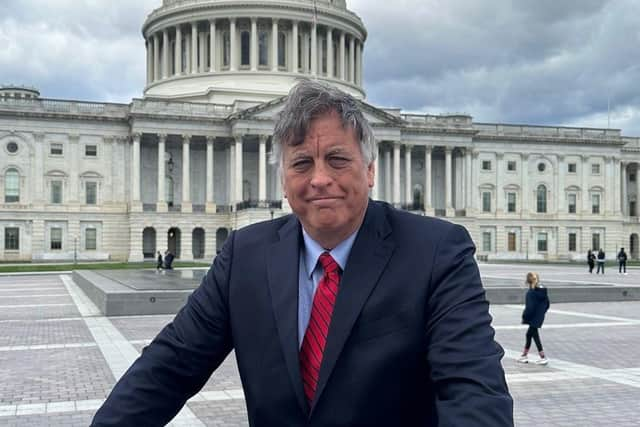
Author and political thinker Michael Bedenbaugh is a respected voice in constitutional principles and American governance. Based in South Carolina, he is deeply involved in his home state’s development while contributing to national discussions on governance and civic engagement, most recently as standing as an independent candidate for Congress. He is the author of Reviving Our Republic: 95 Theses for the Future of America and the host of Perspective with Mike Bedenbaugh.
Story by Michael Bedenbaugh, edited by Anthony Harvison (Belters News/NewsX)
Main image: Courtesy, Hosnysalah/Pixabay