
Study finds TikTok isn’t harming lyrical complexity, but AI could ruin music as we know it
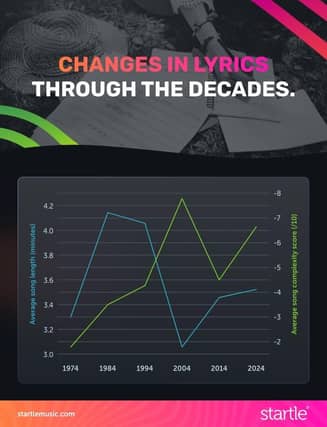

In the age of 15 second TikToks and dwindling attention spans, you might assume music is becoming simpler, shorter, and less meaningful. In fact, some analysts predict the average song will be just two minutes long by the end of the decade. But a new study of 60 years’ worth of music by Startle disproves this theory, revealing the average song in 2024 was a lengthy 3 minutes and 51 seconds, and was more lyrically complex than those from the 1970s, 80s and 90s.
Researchers analysed 300 chart-topping songs spanning 1974 to 2024, examining metrics such as song duration, number of words (and unique words) used, and characteristics like number of syllables, pronouns, connectives, and adjectives. Based on each of these factors, decades were scored out of ten for lyrical complexity.
Artists are saying more, in less time
While average track lengths have declined since the 1980s when they peaked at 4 minutes 16 seconds, modern artists from the noughties onwards are saying more in less time. Songs from the last three decades pack in significantly more words (including unique ones) and score higher for lyrical complexity than songs from the 70s, 80s, and 90s.
Looking back to 1974, songs were on average 3 minutes and 30 seconds long and featured 248 words in total (85 of which were unique words). Tracks had simpler structures too, using fewer connectives, adjectives, and pronouns. Fast forward to 2024, the average length of a song increased by 20 seconds to 3 minutes 51 seconds, with 324 words (105 unique).
Song length peaked during the 80s and 90s but hit tracks typically had fewer words and were less lyrically complex. While the length of songs was longer during these two decades, artists weren’t necessarily saying more. In fact, the study found that artists used an average of 300 words in 1984 and 313 words in 1994 - lower than the study's average of 321 words across the six decades.
It was in 2004 that tracks reached a peak level of lyrical sophistication (7.8/10). Artists from this era tended to use the most adjectives, connectives, and pronouns per song than in other decades. However, song complexity scores sharply decreased a decade later in 2014 (4.2/10) before bouncing back up in 2024 (6.6/10).
Could AI harm lyrical complexity?
The data shows how popular music in the 2020s has, so far, resisted the pull of shrinking attention spans despite predictions by critics. An average song length of nearly four minutes is sizeable when compared to 15 second TikToks and 3 second Snapchat Ads.
But what impact could AI have?
Adam Castleton, CEO of Startle comments: “There’s a growing pressure in the music industry to make every second count, but that doesn’t mean artists are saying less.
“Whether it's Beyoncé or Kendrick Lamar, artists are proving that today’s hits can be both chart toppers and lyrically rich; artists are using more words, more unique language, and packing more into each track than they did decades ago. Our data suggests that while formats may be changing, the craft of songwriting is very much alive and evolving.
“But what the data will say in 2034 is anyone’s guess.
“From the way music is created and produced to how audiences consume and experience it, AI is quickly changing everything. And soon, this could start to change the type of music artists are releasing and what fans enjoy…or don’t.
“One report estimates that as many as 60 million people used AI to create music or lyrics in 2024. While some artists have staunchly opposed allowing AI models to use their work to train their systems, others, such as Sean Paul and will.i.am, have embraced the technology within their creative process.
“A major concern by some, however, is the homogenising effect of AI and how this could harm lyrical complexity and diversity within popular music.
“A study recently found that LLM responses often converge on common words and ideas when given broad prompts by different users. This is because A.I. is a technology of averages and it is trained to produce answers that tend toward consensus, both in the quality of the writing and in the calibre of the ideas.
“So, we could expect to see song length reach new peaks over the coming years as the writing process is sped up by new technological aids, but at what cost to lyrical complexity and meaning?”