
Luna-25: Russia's first lander in 50 years sends back pictures of space

The craft is expected to land on the Moon's surface on 21 August
Russia's first lunar lander since 1975 has sent back its first images from space after lifting off on 10 August.
The lunar craft marks the first domestically produced probe sent to the moon in over 50 years, as it was launched into space from a Soyuz-2.1b rocket from the Vostochny Cosmodrome in Russia's far eastern Amur Region.
Lunar-25's first images were taken on Sunday (13 August) and published Monday (14 August) by the Space Research Institute of the Russian Academy of Sciences (IKI RAS).
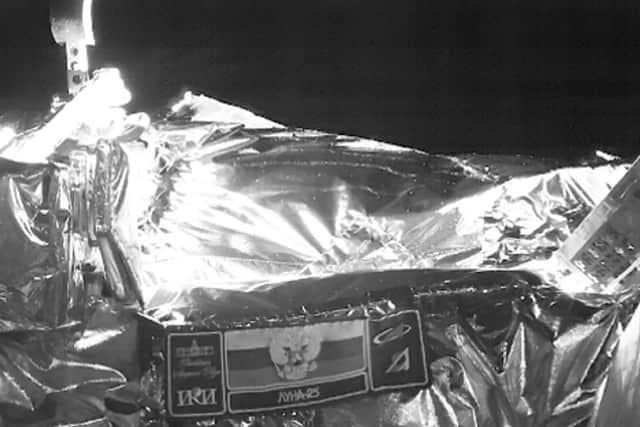

The black-and-white photo collection reveals the Russian flag and mission patch on the spacecraft's structure alongside images of Earth and the moon shining bright against the blackness of space.
"These images show the elements of the device's design against the background of the Earth, from which we have already departed forever, and against the background of the moon, to which we will soon arrive," Russian state space agency Roscosmos wrote in a statement published on Telegram (translation by Google).
The images were taken at a distance of about 192,625 miles (310,000 km) from Earth, according to IKI RAS.
It added: "All systems of the spacecraft are operating normally, communication with the station is stable, and the energy balance is positive," IKI RAS.
Luna-25 has now reached the moon before orbiting Earth's glowing white satellite for five to seven days.
Then the probe will attempt a landing near one of three craters surrounding the lunar south pole.
Luna-25 will then analyse lunar soil, search for water ice and conduct experiments about the moon's thin atmosphere. The lander carries eight different instruments including a laser mass spectrometer and a device that can zap lunar soil samples then examine the resulting fumes to analyse chemical composition.
The probe was designed to operate for at least one year.
The lunar lander is the latest in a few missions to the moon. In July, India's Chandrayaan-3 rover was launched into space and is expected to make its moon landing - at the lunar south pole - on 23 August.