
Rocket launch: NASA Artemis II mission underway as astronauts blast off towards “beautiful moonrise”

“We have a beautiful moonrise, we’re headed right at it”: Astronauts blast off as NASA’s Artemis II mission gets underway.
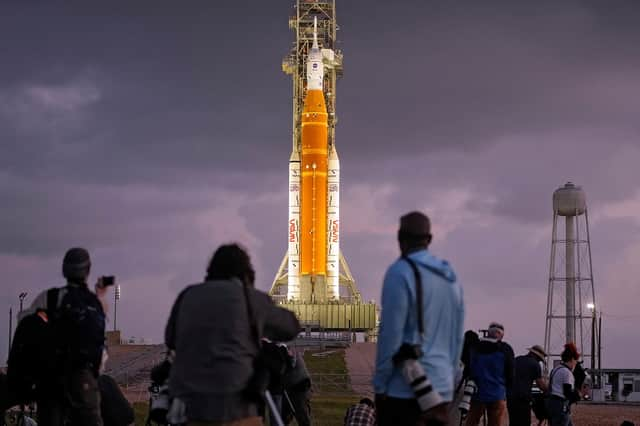
Four astronauts are heading for the Moon after NASA’s first manned mission to the site in more than 50 years took off in spectacular style. A 322-foot rocket carrying the crew blasted off successfully from Cape Canaveral, Florida, at 6.36pm local time (11.36pm BST).
The quartet reached orbit ahead of circling the Earth for about 25 hours before catapulting towards the moon, with their flight tracked from Goonhilly Earth Station, in Cornwall. Five minutes into the flight, Commander Reid Wiseman said: “We have a beautiful moonrise, we’re headed right at it.”
The elite team had entered the capsule several hours earlier where they will remain for the next 10 days with about as much room as a small camper van. Prior to them boarding, more than 700,000 gallons of fuel (2.6 million litres) was loaded into the spacecraft.
As they headed to the launch pad, the three Americans and one Canadian waved and shaped their hands into hearts to well-wishers. Commander Wiseman shouted to the crowd: “It’s a great day for us. It’s a great day for this team.”
The flight experienced a minor disruption when Mission Control briefly lost its communication link during a satellite handover, but the problem was fixed by resetting ground equipment.
During a post-launch press conference, NASA administrator Jared Isaacman said the crew were “safe, they’re secure and in great spirits”. “After a brief 54 year intermission, Nasa is back in the business of sending astronauts to the moon.” he said.

The so-called lunar flyby around the Moon will send the crew some 252,000 miles (406,000 kilometres) into space before returning to Earth. The current record for the furthest spaceflight is about 248,000 miles, held by members of the Apollo 13 lunar mission in 1970, which was hit by technical problems.
As they pass approximately 4,600 miles beyond the far side of the Moon, the Orion module will lose communication with the Earth for up to 50 minutes. While the astronauts will not touch down on the satellite, the Artemis II mission paves the way for a future lunar landing and also lays the foundation to send a crew to Mars.
The UK is playing a part in the mammoth technical operation, with the Goonhilly Earth Station, near Helston, Cornwall, helping to track the capsule on its epic celestial voyage.
The mission previously had to be postponed by two months because of hydrogen fuel leaks and clogged helium lines. The last time NASA sent astronauts to the Moon was as part of the Apollo 17 mission in 1972. The agency is seeking to return a crew to the lunar surface by 2028, before China does in about 2030.
Hailing the mission ahead of the launch, US President Donald Trump posted on his Truth Social platform: “We are WINNING, in Space, on Earth, and everywhere in between — Economically, Militarily, and now, BEYOND THE STARS. Nobody comes close! America doesn’t just compete, we DOMINATE, and the whole World is watching. God bless our incredible Astronauts, God bless NASA, and God bless the Greatest Nation ever to exist, the United States of America! President DONALD J. TRUMP."
How long does it take to fly to the moon?
It typically takes about three days for a spacecraft to travel from the Earth to the Moon. Apollo 11 took around three days and four hours to enter lunar orbit, however modern craft which are more fuel-efficient can take longer.
If the Artemis II mission goes as planned, the capsule is expected to reach the moon on April 6 - the sixth day of the mission. The crewed Orion capsule will then fly around the moon, reaching its closest point before beginning the journey back to Earth, with splashdown expected on April 10.
Nasa Artemis II live stream
Space fans can watch live coverage of the Artemis II test flight around the moon, NASA has confirmed. The space agency has detailed a range of online events covering the flight, the first crewed mission under the program. For fans, a series of briefings, events, and 24/7 mission coverage will be on the agency’s YouTube channel and you can watch the launch, lunar flyby, and splashdown coverage on NASA+ and Amazon Prime, with timings subject to change.
NASA’s real-time coverage continues throughout the mission on YouTube. The agency also will provide a separate live stream of views from the Orion spacecraft, as bandwidth allows. The agency will also provide daily mission status briefings from NASA Johnson beginning April 2, except for April 6, due to lunar flyby activities.