
Venus and Jupiter line up in June: Planets clearly visible in night sky - how to see rare celestial event perfect for beginner stargazers

A celestial event that’s perfect for beginner stargazers is happening next month - here’s how to see Venus and Jupiter in the night’s sky, no equipment needed.
June will be the month of Venus and Jupiter for stargazers, according to experts, as the planets line up alongside each other in skies above Britain. The western sky after sunset will see the planets - two of the brightest - become clearly visible side by side in the early evening throughout June.
Experts said the pairing offers one of the easiest and most rewarding celestial sights for casual observers, requiring no specialist equipment to view. Astronomical telescope experts at 365 Astronomy said it presented a “great opportunity for beginners to get familiar with the night sky”.
“It’s quite rare to have two planets this bright and this easy to see at the same time in the early evening,” said Alan Jones, a 365 Astronomy expert. “Venus is often referred to as the ‘evening star’ because of how intensely it shines, while Jupiter appears slightly less bright but still stands out clearly against the twilight sky.”
Unlike stars, planets don’t twinkle in the same way, which can help observers identify them more confidently, he explained. “They shine with a steadier light. Once you notice that difference, it becomes much easier to distinguish planets from stars, even if you’re new to stargazing,” Alan said.
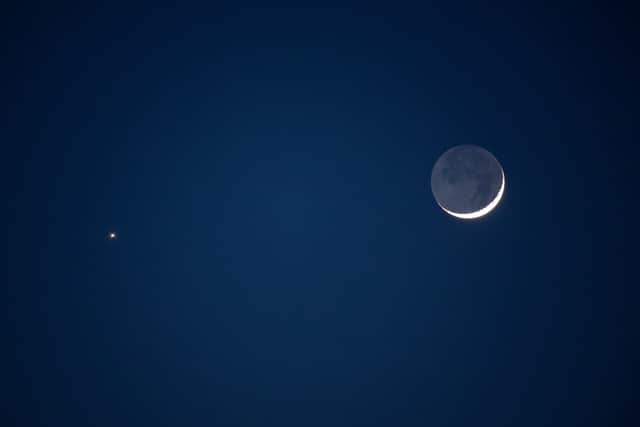

Venus and Jupiter in the sky - how to view
Both planets will appear low in the western sky shortly after sunset, gradually becoming more visible as the sky darkens. “A good tip is to look for the brightest point of light first, which will almost always be Venus. Jupiter will be nearby, also very bright, and the two will remain visible for a couple of hours before dipping below the horizon,” Alan said.
Because they follow the same path as the Sun, known as the ecliptic, they will appear along a similar arc across the sky. “Once you’ve found one, scanning slightly left or right along that path should help you locate the other.”
While the event is easily visible with the naked eye, binoculars or a small telescope can enhance the experience. Alan said: “With binoculars, you may be able to see Jupiter’s four largest moons as tiny points of light beside it. A small telescope will reveal even more detail, including Jupiter’s cloud bands and the crescent phase of Venus.”
“This is one of those moments where simply stepping outside and looking up is enough. It’s accessible, visible from most locations, and a great reminder of how dynamic our night sky can be,” he added.
For the best view, Alan told viewers to head outside shortly after sunset and find a spot with a clear view of the western horizon. “Try to avoid areas with heavy light pollution or obstructions like buildings and trees. Even a short walk to a darker, more open space can make a noticeable difference,” he added.
Clear skies will offer the best visibility, though Venus and Jupiter are bright enough to shine through light haze or thin clouds, making this a reliable and worthwhile sight throughout the month.