
As well as 85th anniversary air shows across Britain this summer, commemorations are set to take place at museums and the former fighter stations in southern England which met and overcame the Luftwaffe air assault during the Battle. These include the former RAF Fighter Command Headquarters at Bentley Priory (Stanmore, London), RAF Group No.11 Headquarters (Uxbridge, London), RAF Biggin Hill, Kent (a Group No.11 station operating six Spitfire squadrons throughout the Battle) and at the RAF Museum, Hendon.
85 years on those who experienced the visceral air combats of 1940 at first hand have now left the stage. This March, the death was announced of the last surviving RAF Hurricane pilot of the Battle, 105-year-old Group Captain John ‘Paddy’ Hemmingway DFC. Yet the Battle of Britain remains central to British and Allied collective memories of the Second World War.
It was a life-or-death struggle over the skies of southern England.
It raged over Southern England from 10 July to 31 October 1940 and coincided with the onset of the Blitz on 7 September 1940 (area attacks on London and on eighteen other British cities and ports). In intensive daylight bomber and fighter attacks, Hitler’s Luftwaffe tried and failed to achieve air superiority against the Royal Air Force (RAF) prior to a planned German invasion of the British Isles.
The Battle begins
After eight months of ‘Phoney War’, following the outbreak of hostilities on 3 September 1939, stunning German victories and Anglo-French military failures in France resulted in the British Army’s retreat to and evacuation from Dunkirk (Operation Dynamo, 26 May - 4 June 1940). Following the fall of France in June, as new Prime Minister Winston Churchill rallied the British people in the defence of their island and Empire, Hitler launched a strategy of economic blockade. Luftwaffe dive bombers – including JU-87 Stukas and JU-88 medium bombers - struck British merchant vessels in the English Channel. During July 1940 over 30,000 tons of British shipping were sunk. Air attacks were also launched against British ports, raw materials and food storage infrastructure and aircraft production centres.
In early July 1940, Hitler directed his military staff to assess the feasibility of an invasion of southern England. German Navy and Army strategists produced separate, theoretical plans, although Hitler’s Air Minister and Luftwaffe commander, Reichsmarschall Hermann Goering, was initially sceptical. Hitler – at this stage hoping to pressure Britain into a compromise peace – offered a ‘last appeal to reason’ on 19 July. Churchill refused, having decided that the geo-strategic and moral price for such an accommodation was too great for Britain to pay, whatever the intimidation. His oratory convinced Britain’s government and people to fight on, against the odds. Unable to weaken Churchill’s resolve, Hitler agreed to a plan to destroy the RAF prior to a seaborne invasion of Britain (Operation Sealion).
Sea Lion was scheduled for mid-September 1940, whilst weather remained favourable. The invasion plan was predicated on the swift achievement of German air superiority – as demonstrated by the Luftwaffe over Poland in September 1939 and over France in May-June 1940 – following destruction of British radar stations, airfields, fighter aircraft and naval forces in the English Channel. From their newly seized airfields on the French coast, flight time for German fighter aircraft across the Channel to Dover was six minutes. Goering was confident that the RAF could be defeated within a month.
In the subsequent Battle of Britain, Goering dispatched an air armada of some 2,500 German aircraft in massed daylight attacks. The bomber stream was composed of waves of twin-engined Heinkel HE-111, Dornier Do-215, Dornier Do-217, Junkers JU-88, Messerschmitt ME-110 fighter-bombers and JU-87 Stuka dive bombers. Around 1,000 fast and well-armed Messerschmitt ME-109 fighters provided escorts. The Luftwaffe also deployed several Junkers JU-86P high-altitude bombers (with pressurised cabins for operations up to 40,000 ft) for daylight photo-reconnaissance. The Luftwaffe objective: to destroy the RAF’s airfields during July and August and sweep its numerically inferior Hawker Hurricane Mk I and state of the art Supermarine Spitfire Mk I fighters from the skies.
The Luftwaffe effort to achieve air superiority failed. Despite intense, effective (and close to overwhelming) German bombing of RAF airfields during August, the tide was turned by 15 September. The outcome was the product of British strategic strengths, the advantages of island geography and German tactical errors.
The RAF wins a famous victory
Facing the aerial assault, Britain relied on a vital chain of 21 ‘Home Chain’ radar (Radio Direction Finding or RDF) stations and a highly proficient air defence control system (devised and directed by Air Chief Marshal Hugh Dowding and Air Vice Marshal Keith Park). This ‘Dowding System’ was supported by visual reporting from Royal Observer Corps posts, barrage balloons (with metal cables designed to deter low flying aircraft), radio eavesdropping and a network of acoustic detectors. What followed was an existential struggle for command of southern British airspace.
Guided by Dowding and Park’s integrated air defence system, a force of some 600 Spitfires and Hurricanes from No.11 and No.12 Groups, RAF Fighter Command doggedly defended the skies over southern England, inflicting serious loses as well as suffering many of their own. There was a clear shortage of trained British and Commonwealth RAF pilots. In July 1940 their average age was twenty, with around two weeks flying hours training. Allied volunteers, some with recent battle experience, later swelled the pool of available pilots. These included 146 Poles, 88 Czechs, 29 Belgians, 13 French, 11 Americans, 10 Irish and 1 Austrian. The lack of trained pilots haunted the strategic calculations of Churchill - who famously described them as ‘The Few’- and senior RAF commanders throughout the Battle. The picture looked grim.
Yet in 1940 Britain enjoyed many defensive strengths.
Although RAF intelligence overestimated the number of opposing Luftwaffe aircraft the RAF was defending home territory. British fighters were able to land, rearm and refuel during battle and were deployed flexibly to satellite airfields when operational runways suffered bomb damage cratering.
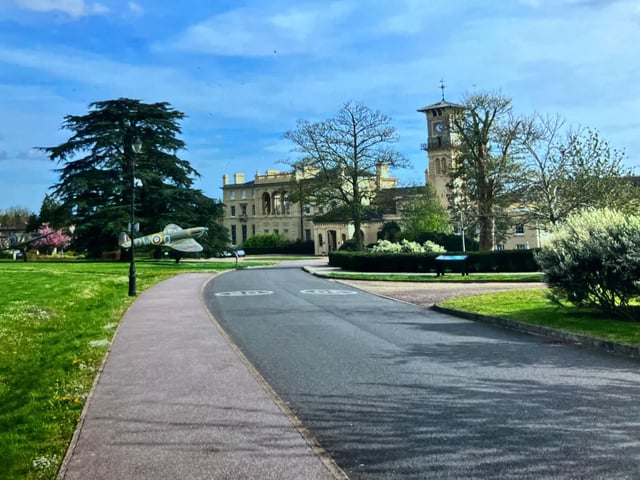
Radar gave the RAF a critical advantage. In southern England the chain of high- and low-level radar tracking stations – with ranges of between 80-100 miles and 20 miles respectively – alerted RAF Fighter Command Headquarters at Bentley Priory, Stanmore, North London. This strategic planning hub analysed the threat to Britain from all incoming aircraft. Here, radar information was assessed and hostile formations identified, in most cases before they had left France and crossed the English Channel. In Bentley Priory’s underground Operations and Filter Rooms aircraft numbers, direction, altitudes, and likely type were confirmed, plotted and mapped. Orders were then telephoned to Group Headquarters controllers and on to alert individual sector stations, airfields and squadrons.
The nerve centre for intercepting all Luftwaffe attacks on south eastern England and the capital was RAF No.11 (Fighter) Group Headquarters, at RAF Uxbridge, northwest London. Built in 1939, its underground Operations Room – coordinating area fighter readiness and deployment -was a key element in the RAF’s defence response during the Battle of Britain. Dowding and Park’s air defence control system obviated the need for standing air patrols and ensured that RAF Hurricanes and Spitfires were vectored into position and mostly waiting for each Luftwaffe assault. Some RAF aircrew were rotated for brief periods of rest, an advantage which the Luftwaffe did not enjoy during the summer of 1940.
At the same time, as the Battle ebbed and flowed, serious flaws in German tactics emerged.
Despite some initial success, Luftwaffe raids failed to knock out the RAF’s crucial radar chain. Luftwaffe intelligence reports consistently overestimated British losses and airfield damage and underestimated both the RAF’s actual fighting strength and British aircraft production capacity. In fact, British fighter production was highly effective. British aircraft losses were replaced rapidly. RAF fighter production exceeded that of Nazi Germany during the Battle. From June to October 1940 around 2,000 Hurricanes and Spitfires were produced at regional factories working at full stretch.
In turn, Reichsmarschall Goering also issued a series of contradictory air directives, including an order in September 1940 to his ME-109 fighter squadrons to fly at slower speeds to escort his bomber force more closely. This meant that these formidable aircraft - their fuel range already limited to 30 minutes over southern England and a mere ten minutes over London – could not operate to their full potential and dominate the air battlefield.
During August the action moved closer to London. On 15 August, RAF Croydon, on the outskirts of London, was hit in a daylight raid by Luftwaffe ME-110 fighter-bombers. Further raids took place on outer London on 18-19 August and 22-23 August. On 24 August, German aircraft bombed the city centre in error, despite Hitler’s standing orders to the contrary. The RAF retaliated, raiding Berlin on 25-26 and 29-20 August. Strike followed counter strike. German bombs fell on North and East and East London and Essex on 28-29 August. On 7 September 1940, the Luftwaffe turned comprehensively on London, in the process taking pressure off the RAF’s airfields. The intention: destroy the epicentre of Britain’s trade and war economy, wear down civilian morale and force Churchill’s government to sue for peace. A new chapter in Britain’s wartime experience would subsequently unfold with night area bombing raids (The Blitz of 7 September 1940-11 May 1941).
15 September 1940 arguably proved the turning point of the Battle of Britain. On this day, during a huge air battle over London and the south east, 28 RAF squadrons, directed from Bentley Priory and Uxbridge – where Churchill and his wife Clementine were that day observers in its underground Operations Room - punched unprecedented holes in the attacking Luftwaffe bomber formations. 56 German aircraft were shot down versus 26 RAF fighters destroyed (13 pilots killed). The Luftwaffe concluded that daylight air superiority was beyond their grasp. Churchill pointed to the critical significance of the day’s events. He later wrote: “We must take 15 September as the culminating date” (of the Battle of Britain).
Air combat continued until the end of October 1940. The Luftwaffe conducted daylight raids on the capital and southern England until rising RAF fighter interception rates forced a shift to night attacks only (from 29 October).
The Battle of Britain was the first clear military defeat Nazi Germany had experienced after its string of initial victories in Europe. Denied air superiority, as well as lacking sufficient naval strength in the English Channel, Hiter postponed the Operation Sea Lion invasion plan on 17 September and finally called it off on 12 October.
For its part, the RAF had won a critical defensive victory. In daylight it had decisively held the enemy off, although the margins had been extremely tight and the Luftwaffe was far from defeated.
The price was paid in the lives of both sides’ combatants. 2,945 British, Commonwealth and Allied aircrew from RAF Fighter Command fought in the Battle, with the critical support of thousands of RAF ground crews. Of these, 544 pilots were killed, along with 312 ground crew. 915 British aircraft were lost. Against this, the Luftwaffe lost 2,662 aircrew killed with over 6,000 others wounded or taken prisoner. 1,773 German aircraft were destroyed.
As 85th anniversary Battle of Britain events unfold this summer, vintage aviation enthusiasts can find much to discover. Apart from air displays at Duxford, Cambridgeshire this September, the former sites of Britain’s air defences in London at Bentley Priory Museum, Uxbridge Battle of Britain Bunker Museum and Biggin Hill Museum and Chapel offer visitors the chance to follow literally in the footsteps of those who coordinated Britain’s winning air defence when the crisis came. They remain places of powerful atmosphere and memory and lend fascinating historical perspectives on this critical period of the Second World War.
1. Contributed
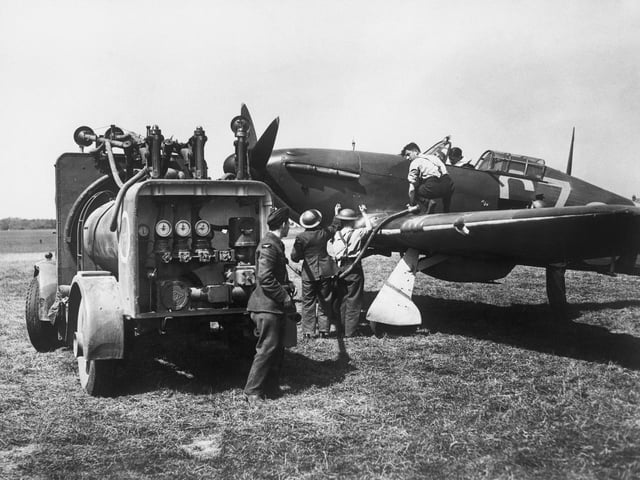
RAF Hurricane refuelling during the Battle of Britain, 1940 Photo: Submitted
2. Contributed
RAF Fighter Command Headquarters Museum, Bentley Priory, Stanmore, London Photo: Submitted
3. Contributed
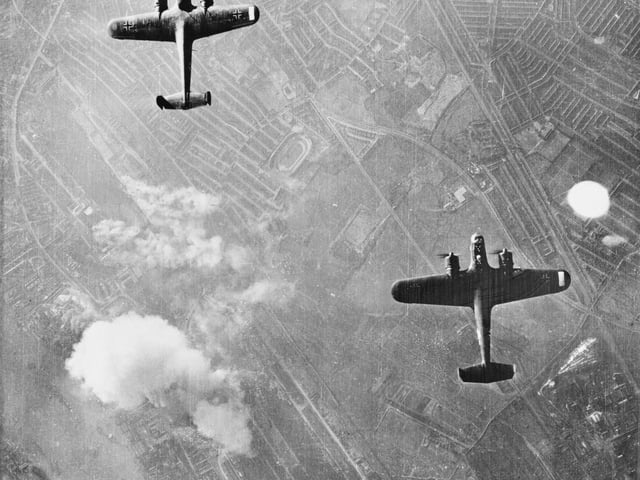
Luftwaffe Dornier Do-17 bombers over London, 1940 Photo: Submitted
4. Contributed
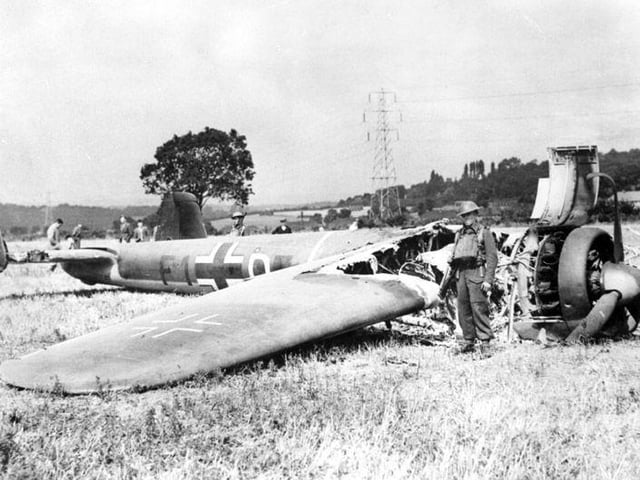
Crashed Dornier bomber near Biggin Hill, 1940 Photo: Submitted