
'I forecast global conflict and these are the warning signs world leaders are missing'
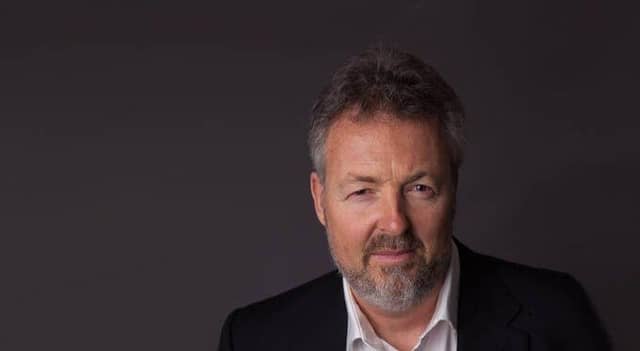

Based in Linchmere, David Murrin brings a local South East perspective to one of the biggest questions shaping the world today: how global conflict patterns are changing and what they could mean for the years ahead.
A forecaster and strategist, Murrin is known for his work on long-cycle global trends, systemic risk and the relationship between geopolitics and financial markets. His analysis focuses on how major powers behave during periods of rising instability, and how those shifts can reshape both national security and economic resilience.
As a geopolitical speaker, he examines conflict escalation, military adaptation and the broader structural patterns he believes sit behind today’s international tensions. His work also explores how governments, industries and institutions can respond more realistically to fast-moving geopolitical threats.
In this exclusive interview with the Champions Speakers Agency, David Murrin discusses the conflict patterns he believes are already taking shape, why he sees China leading the new arms race, the warning signs he thinks western leaders are still missing, and what audiences must understand if they are to move from denial into action.
Question 1: You argue that today’s geopolitical instability is part of a much bigger systemic shift. What conflict pattern do you believe is now taking shape?
David Murrin: “Well, I think that according to some of the models I've built, we're in a hegemonic conflict between China and the western values and systems of democracy.
“China isn't in this alone, and it's built an axis of autocracy that spans a very strong relationship with Russia, Iran, North Korea, and now the economic countries that it's built economic ties with in the Eurasian region. Effectively, I call it the axis of autocracy.
“We are already in that hegemonic challenge, and the starting gun, I think, was 2022 with the invasion of Ukraine.
“So, although it seems to be boiling us gradually like a frog, the reality is China has started its engagement to seek global hegemony, and the types of wars we're seeing are much more than proxy wars in Ukraine and also with Israel and Iran.
“We're also seeing a shadow conflict at the same time, a mechanism where Russia is, by Cold War standards, already at war with us with fifth column activities.
“And so we are already in this pattern, which will only escalate because the peak of the entropic cycle, as I describe it, is 2030.
“So, there can be no good news or lucky breaks for the next five years, and the escalation path, I'm afraid, is to full kinetic conflict on a global basis, which is what China has set its military up for. And America has failed to deter effectively.”
Question 2: In what you describe as a new arms race, why do you believe China currently holds the advantage?
David Murrin: “Well, it's China, I'm afraid, because if you want to be successful in an arms race, you need a number of qualities.
“You need a massive industrial base, and of course they are the greatest industrial base in the world.
“You also need essentially to have an innovative phase of your system, which means you've copied and assimilated, and now you're innovating. That represents itself in revolutions in military affairs, which are quantum technological jumps specifically designed to undermine the hegemonic power base.
“For example, America was based on projecting oceanic power with its carrier groups. And what did the Chinese build in 2018? They started to really put into service large numbers of anti-ship ballistic missiles designed to kill carriers and their escorts and saturate their defences.
“Then they went one stage further and built hypersonic weapons, which are effectively unstoppable.
“And the net effect is American carrier power has been negated, much as British battleship power was negated by the carrier. Our empire was built on battleships, and America subsequently built its empire on carriers.
“Now the Chinese have found a way to push those carriers out to the third island chain by using missiles which cannot be stopped.”
Question 3: What critical warning signs do you believe western leaders are still failing to recognise?
David Murrin: “So, the axis of autocracy centred around China and North Korea and Iran and Russia, I'm convinced, recognise their war has started.
“They are militarising their economies. They are engaged in a rapid arms race. Russia is a fully mobilised total war economy.
“The Chinese have also made a leap from 2020 onwards where essentially they have become a fortress economy preparing for war, which is where the consumer debt gap came from when they exported less and they start to bifurcate with the rest of the world.
“So essentially, they understand the paradigm. The real shocker is in the west we're completely asleep.
“It's very interesting if you look at history, because in 1914 the majority of Britons, for example, couldn't comprehend that we would go to war with Germany because for 100 years they had been our continental ally.
“So, there was a resistance after Pax Britannia that war could ever break out, and when war and the first shot was fired you could see the bond market, which had just gone sideways for a couple of months, dropped 50% on the first shot. It was as if denial suddenly broke and popped.
“So, we're definitely witnessing a form of denial that's similar to Pax America's end as Britain went through with Pax Britannia's end.
“But there's another complex dynamic, and that is I argue in human systems and empires predominantly expansion takes place with lateral dominance of thought and the boldness that goes with no limitations and being unpredictable in your expansive patterns.
“Systems become linear as they become mature. They become less adaptive, and that sends them into decline.
“So essentially we are super linear in the western world. We have linear leadership, with the exception of Trump, who's a lateral leader but has other challenges, and essentially that means that our leadership can only see the railway lines ahead rather than think about what's coming towards the railway itself from the left or right.
“And there's another problem, which is money printing has perpetuated that linearity to a great extreme because you print money and it maintains a non-adaptive behaviour.
“And on top of that, the printing of money in America has created dopamine because everyone's happy, the stock market's near the high, and so they don't have any cortisol to actually start looking at risks.
“So those three factors, the hegemonic denial, the linear denial, and the dopamine denial, have all created this cube effect, a multiplicity of collective denial, which is so great that I would call it a form of extinction dissonance.
“We are in a state of dissonance that's so strong it risks our society's extinction. So, it's a very grievous form of denial that we're living through.”
This exclusive interview with David Murrin was conducted by Tabish Ali of the Motivational Speakers Agency.