
Dickie Bird: Tributes to cricket's most recognisable umpire and Yorkshire County stalwart

One of the most distinguished - and distinctive - cricket umpires has died at the age of 92.
Former Test umpire Harold ‘Dickie’ Bird has passed away, Yorkshire County Cricket Club has announced. He was one of the most prominent umpires of his era, and was made president of his home county in 2014.
In a statement, Yorkshire added: “The thoughts of everyone at the Yorkshire County Cricket Club are with Dickie’s family and friends during this time.
“He will be truly missed by all at the club having spent an incredible amount of time in support of everyone here and will be remembered as one the greatest characters in Yorkshire’s history.”


Expressing “profound sadness” for his loss, Yorkshire paid tribute to a man who transcended his role to become one of the most recognisable figures in the sport.
“Dickie Bird enjoyed an illustrious career as an international umpire, writing his name into history as the most famous and popular official in the game’s history,” the statement added.
“Born on 19 April 1933 in Barnsley, Yorkshire, Dickie Bird’s life was defined by his unwavering dedication to cricket.
“A former first-class cricketer for Yorkshire and Leicestershire, Bird’s playing career was cut short by injury, but his legacy was truly forged in his role as an international umpire.
“Over a distinguished career, he officiated in 66 Test matches and 69 One Day Internationals, including three World Cup finals — earning the admiration of players and fans alike for his integrity, humour, and unmistakable style.”
Obituary - by Rory Dollard, Press Association Sport
Dickie Bird achieved only moderate success in his first cricketing career, but from the moment he traded his bat for an umpire’s cap he was well on the way to becoming a towering figure in the sport’s history.
It is often said that a good umpire is one that goes unnoticed, but one need never look beyond Bird for an exception to that rule. Bird, who has died at the age of 92, was at once an outstanding umpire and impossible to ignore.
Although the quintessential Yorkshire cricket man, his good nature, vivid character and magnetic attraction to unlikely or amusing circumstances saw his legend outgrow geographical and sporting borders.
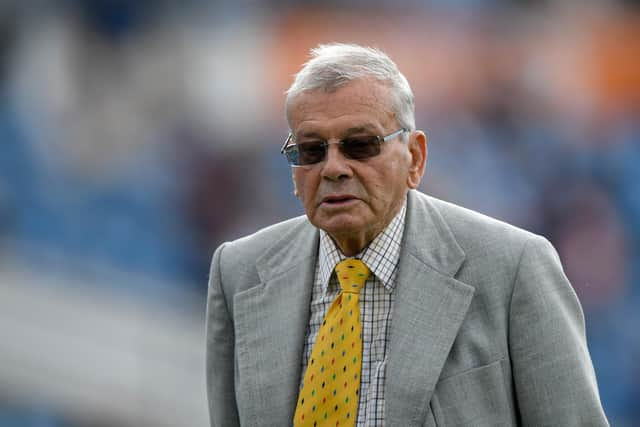
He shared the field with some of the game’s biggest stars and brightest talents but, more often than not, a line of autograph-hunters formed to meet the man in the middle at the end of a day’s play. He signed every time.
Bird’s popularity ultimately transcended umpiring too. His autobiography chalked up more than a million sales, becoming the nation’s biggest selling sports book ever, and he entertained the public for years as a TV personality and travelling raconteur. In a favoured anecdote he claimed his one-man show drew a bigger audience in Leeds than Shirley Bassey.
When he ascended to the role of Yorkshire president in 2014, he took even greater joy in the team’s county championship triumph in his first season and even forked out £125,000 to fund a new players’ balcony at Headingley.
A renewed involvement with his old side proved a major autumn boon following a period of ill-health and loneliness which followed a stroke in 2009 and he described his appointment as the “pinnacle of my life”.
Bird will be celebrated farther and wider than he might ever have hoped, particularly within the cricket family, which acted as a surrogate for his own lack of wife or children.
In his own terms he was “married to cricket” and it was a long and happy union.
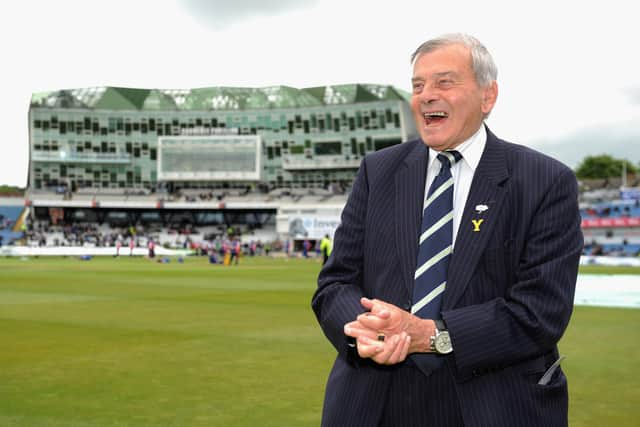
Born on April 19, 1993 in Barnsley, he was named Harold Dennis, having not yet adopted his schoolboy nickname.
Father James Bird was a miner at Monk Bretton Colliery, man and boy, and wanted better for his son, for whom sport was an early and obvious passion.
His future might easily have been in football, having captained the Raley School team and earned a youth contract as an inside forward with Barnsley. Instead he suffered a knee injury at 15 and never played properly again.
He had always loved cricket too and had done so ever since his father bowled to him on the same stretch of land that now houses a bronze statue of Bird, arm outstretched and finger extended – a familiar sight over his 28 years as a professional umpire.
Asked once if he minded that late-night revellers had taken to hanging various undergarments from the statue’s finger, Bird cheerfully noted it was a more respectful reaction than vandalism.
The young Bird was taken under the wing of Alf Broadhead at Barnsley Cricket Club, having initially been turned away from a trial net.
Broadhead had also taken an interest in two other batting prospects, one named Geoffrey Boycott and another called Michael Parkinson, and their time in the nets together formed a firm, lifelong bond between three of the county’s favourite sons.
Bird claimed to have a technique to rival Boycott, but a temperament less suited to elite competition. There were highs, such as his career-best 181 not out for Yorkshire, and lows, such as his immediate dropping from the very next match.
He left Yorkshire over a lack of opportunities but failed to find his feet at Leicestershire and retired at the age of 32 with an average of 20.71.
It was a poor return for his hard work, but it would not begin to define him.
Bird officiated a county match for the first time in 1970 and stood in his first Test just three years later. By the time he departed the scene he had redefined his own career and reset the parameters of the job itself.
The stories are legion: the bomb scare at Lord’s, when he observed proceedings while sat atop the covers in the centre of the pitch; the burst water pipes at Headingley and his entertaining exchange of opinions with a frustrated crowd; a first recorded instance of ‘good light stopped play’ thanks to a Trent Bridge greenhouse; an elbow injury sustained while slipping in the showers at the Women’s World Cup.
Yet none of his tales would have been quite so amusing had he not been so good at his job. An instinctive ‘not outer’ admittedly, a trait that contributed to some of his mostly good-natured interactions with bowlers, he was nevertheless consistent, clear and communicative.
He was also utterly impartial at a time when that could not always be guaranteed. Just ask Michael Atherton.
Atherton was credited with organising the unprecedented guard of honour with which England and India welcomed Bird on the occasion of his 66th and final Test at Lord’s.
It was a gesture that touched the emotional Bird, who was left moist-eyed and in need of a moment to compose himself before play began. There was no room for sentiment three balls later as Javagal Srinath went up for lbw and Bird sent Atherton packing for a duck.
Within days he had left cricket, though it never left him. When he appeared on Desert Island Discs, further evidence of his household name status, he chose satellite TV as his luxury item – for the express purpose of watching Test matches – and his book selection was the Wisden Almanack. It would be hard to imagine a more contented castaway.