
Wimbledon 2025: Jacob Fearnley has no answers Joao Fonseca
Fonseca had already got the better of Fearnley twice this season — in Indian Wells and Canberra — and again looked the stronger player here, winning 6-4, 6-1, 7-6 to advance with ease.
It felt more like Club Tropicana than the All England Club as Wimbledon sweltered in record temperatures.
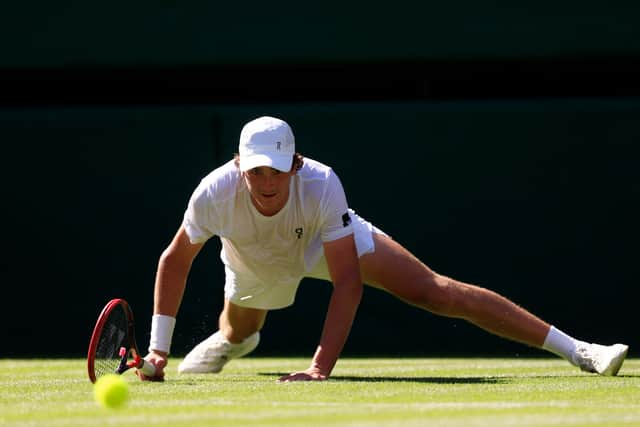

So perhaps it was only fitting that a boy from Brazil should flourish in the conditions; south-west London was more Rio de Janeiro than Dalkeith, which only spelled further disappointment for Scot Jacob Fearnley.
Fearnley may start to question his luck at Wimbledon. Last year he ran into Novak Djokovic; this time it was the sport’s next big thing.
João Fonseca is enjoying a breakthrough season. The 18-year-old Brazilian claimed his maiden ATP title earlier this year and made an eye-catching Grand Slam debut by defeating then-world No 9 Andrey Rublev at the Australian Open.
Fonseca had already got the better of Fearnley twice this season — in Indian Wells and Canberra — and again looked the stronger player here, winning 6-4, 6-1, 7-6 to advance with ease.
Fearnley, who reached the second round on his Wimbledon debut last year and took a set off Djokovic, rose into the world’s top 50 on the back of those performances. His recent third-round runs at both the Australian and French Opens have further underlined his Grand Slam potential.
Yet Fonseca, ranked three places below Fearnley, is on an unmistakably upward trajectory. Unlike Gustavo Kuerten — the last Brazilian man to win a major — Fonseca appears to relish the grass, and has all the makings of a crowd favourite for years to come.
Kuerten never hid his disdain for the grass-court season, squeezed awkwardly between Roland Garros, where he triumphed three times, and the North American hard courts.
Fonseca, by contrast, looks entirely at ease. He is an aggressive baseliner who is unafraid to come forward, armed with a powerful forehand reminiscent of his idol, Roger Federer.
Facing a home favourite at Wimbledon brings its own pressures, but the teenager - who beat four Argentinians en route to that maiden title in Buenos Aires - silenced the home crowd with maturity and flair.
“I knew what to expect coming in, and I didn’t execute my game plan,” admitted Fearnley. “It was a tough draw, and he played better than me, I didn’t really play my best.
“He served really well; he backs himself, and that’s something I need to improve on. I had a bad serving day, got off to a slow start, and never really recovered. I hit a lot of double faults, but that wasn’t the real difference — I just needed to serve smarter. I kept going to his forehand, which was a silly mistake.
“Perhaps I shouldn’t have put so much pressure on myself before the match, I think that worked against me in the end.”
Fearnley didn’t find his rhythm until the third set and should have forced a fourth, squandering a set point and an early lead in the tie-break. Still only 23, he is fast learning how unforgiving Grand Slam tennis can be when opportunities slip by.
Defending ranking points from last year’s second-round run, he is likely to slide slightly in the standings but remains focused on the hard court season and the goal of reaching the US Open main draw for the first time.
His task now is to ensure he becomes more than a footnote in Fonseca’s rise - and a serious rival in the years ahead.
“This means a lot, this has been my favourite Slam since I was a kid,” Fonseca said. “I’m just sorry I had to beat a British guy.
“Jacob is a great friend and a great player, and I hope we have many more matches. I thought we were both nervous at the start.
“I’ve worked really hard since losing in the first round of qualifying here last year. There are no shortcuts — I’ve got belief, and I’m dreaming.”
Fearnley was last year’s surprise first-round winner, rewarded with a Centre Court date against a former champion. This year, that baton passed to fellow Briton Oliver Tarvet.
Ranked 733 in the world - the lowest-ranked player in the draw - Tarvet became the first British man in eight years to reach the main draw through three rounds of qualifying. He beat Swiss qualifier Leandro Riedi, a former world No 117, 6-4, 6-4, 6-4.
The 21-year-old, who studies at the University of San Diego, cannot collect his guaranteed £93,000 prize money due to NCAA rules governing collegiate athletes in the United States.
But money cannot buy the experience of a second-round tie with the defending champion, Carlos Alcaraz.
“I’m confident I can win against anyone and Alcaraz is no exception,” said Tarvet. “He’s done an incredible amount in the game and is a hard guy not to respect. But I’ll treat it like any other match. I try to play the ball, not the player. I just won’t let the moment get too big.”
Elsewhere, Billy Harris — the 30-year-old from the Isle of Man, appearing in just his second Wimbledon — progressed to the second round for the first time with a 6-3, 6-2, 6-4 win over Dusan Lajovic. He will be joined there by fellow Briton Arthur Fery, who upset the 20th seed, Alexei Popyrin, 6-4, 6-1, 4-6, 6-4, and former semi-finalist Cameron Norrie.
For the latest action on the British summer grass court season, check out the LTA website.