
Best and worst states to have a medical emergency in the US
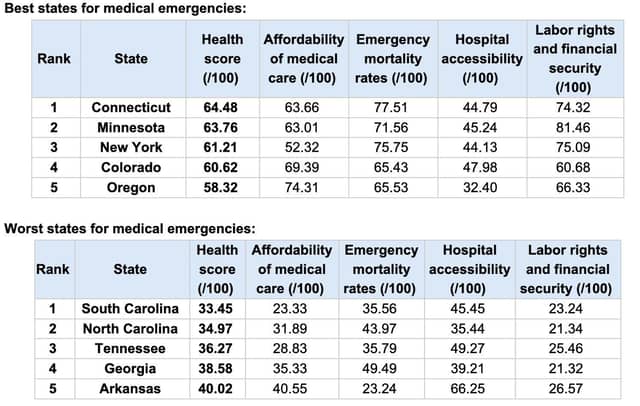

With US emergency department visits increasing by over 10% over the last 20 years, according to the National Centre for Health Statistics, new data has revealed the worst and best states for medical emergencies.
Life insurance firm Beca Life analyzed data from sources including the Centres for Disease Control and Prevention (CDC), Centres for Medicare & Medicaid Services (CMS), and the American Hospital Directory (AHD) covering four key categories: affordability of medical care, emergency mortality rates, hospital accessibility, and labour rights and financial security.
These categories consist of 28 metrics, such as average monthly consumer spending on healthcare costs, deaths from circulatory diseases, and the number of hospital beds and hospitals per 100,000 people.
High ranking states share key strengths
States like Connecticut, Minnesota, New York, Colorado, and Oregon consistently rank high overall. They tend to have strong scores in affordability of medical care, emergency mortality rates, and labour rights and financial security. Even if they have a weakness, such as hospital accessibility, their strengths in these areas carry them to the top. For example, Connecticut, who is the top performing state overall, has the second-best emergency mortality rates in the US and the third-best labour rights and financial security, but the state ranks 31st for hospital accessibility.
Regional divides in emergency care quality revealed
The results show a stark North-South divide in emergency care quality: Most of the top states, including Connecticut, Massachusetts, and Washington, are found on the Northeast and West Coast. Conversely, the lowest-ranking states, such as Mississippi, Alabama, and South Carolina, labour protections and healthcare outcomes. For instance, South Carolina ranks in the bottom 10 states for healthcare affordability, emergency mortality rates, and labour rights and financial security.
Hospital access shows unexpected leaders - South Dakota and Wyoming have best accessibility
Hospital access shows surprising bright spots in unexpected places. South Dakota tops the nation for hospital accessibility with a score of 91.56, despite ranking 25th overall. Wyoming claims second place for hospital access while landing 17th in the full rankings. Even those with excellent performance, Massachusetts for instance, is ranked 48th in terms of hospital accessibility but eighth overall. This implies that even in cases where healthcare outcomes and affordability are comparatively good, hospital infrastructure remains a larger challenge.
Labour rights strongly linked to high rankings
There is a strong correlation between well-established labour rights and high overall rankings. States like Minnesota (ranked first in labour rights and second overall) and Connecticut (ranked third in labour rights and first overall) show that labour protections play a major role in overall healthcare security.
Persistently low-performing states face widespread challenges
States that do poorly in almost every category include South Carolina, Tennessee, Georgia, and Arkansas. They score poorly on labour rights, hospital accessibility, emergency mortality rates, and affordability. Instead of being attributed to a single cause, their healthcare issues are widespread.
Yehuda Tropper, CEO of Beca Life, said,
"The geographic clustering we see in our results points to systemic issues that go beyond individual hospitals or healthcare providers," explained Tropper. "States with limited worker protections often create conditions where people delay seeking medical care until conditions become severe.
"What our study makes clear is that your chances of surviving a medical emergency aren't equal across all states," Tropper concluded. "For individuals with chronic health conditions or those at higher risk for medical emergencies, understanding these disparities can help inform decisions about where to live or travel."