
Pearl Harbor: What did Donald Trump say to Japanese Prime Minister Sanae Takaichi in the Oval Office?

US President Donald Trump today hosted the Japanese Prime Minister at the Oval Office - and turned the conversation to Pearl Harbor - here’s what he said.
Donald Trump dropped a diplomatic clanger during a White House meeting with the Japanese Prime Minister - by mentioning Pearl Harbor. The gaffe came in the Oval Office today (March 19) as the US President and the PM Sanae Takaichi took questions from a press gaggle.
On the topic of the current US/Israel-led conflict in Iran, a journalist asked why the president hadn’t informed allies like Japan of the beginning of hostilities. Trump responded: “Who knows better about surprise than Japan?"
An awkward silence followed, as dignitaries gathered in the room understood the ‘joke’ could potentially go horribly wrong, which it promptly did, with the president turning to his guest - who was born two decades after Pearl Harbor - and adding: “Why didn’t you tell me about Pearl Harbor, okay?”
He added: “He’s asking me about surprise, and we did. And because of that surprise, we knocked out, we probably knocked out, 50 percent, and much more than we anticipated doing. So if I go and tell everybody about it, there's no longer a surprise.”
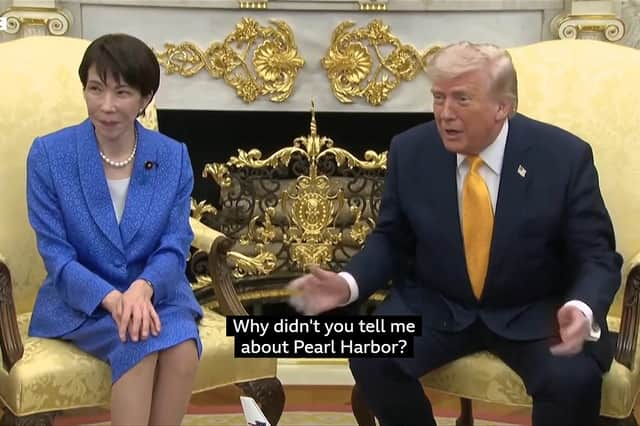

The comments, appearing to make light of the Japanese attack on US naval vessels in 1941 which killed more than 2,400 people, have provoked a strong reaction from commentators. Writer and political pundit Adam Schwarz called it “undoubtedly the worst American diplomatic gaffe in post-war US/Japan history”, while left-wing pundit Ed Krassenstein simply tweeted, “wtf?”.
However, not everyone thought it was a mistake, with Trump’s son, Eric, predictably calling the quip “one of the greatest responses to a reporter in history”.
What happened at Pearl Harbour?
On December 7, 1941, the Japanese military carried out surprise strikes on the US Pacific Fleet - which was moored at Pearl Harbor, on Oahu, Hawaii.
The attack, which saw bombs and shells reign down on the vessels, killed more than 2,400 US service members and wounded almost 1,200. Four American battleships were sunk, and four more severely damaged in what was the deadliest attack ever carried out on American soil - until 9/11.
The attack saw Japan declare war on the US, with the Americans returning the pledge, and entering the Second World War.