
From Britain’s first Black Chief Constable to leading voice on inclusion and fairness in our communities
Michael Fuller made history as the UK’s first Black Chief Constable, breaking new ground in British policing and setting a powerful example of determination, resilience, and integrity.
With a distinguished career spanning over 30 years in the Metropolitan Police and Kent Police, Michael has become a respected voice on justice reform, inclusive leadership, and community engagement.
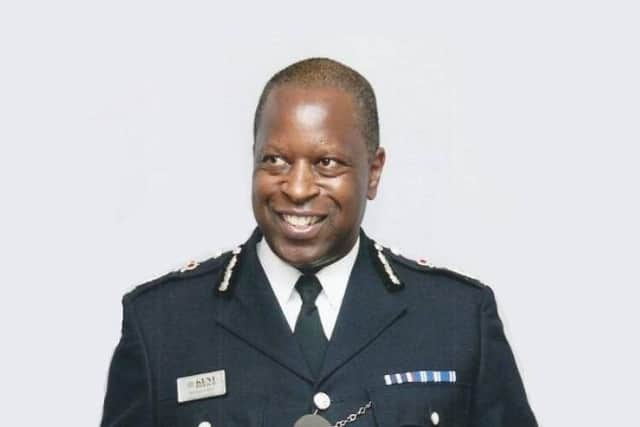

Now one of the UK’s most impactful Diversity & Inclusion speakers, Michael uses his lived experience and leadership expertise to challenge systemic barriers and promote equality across all sectors.
As one of the most sought-after Leadership speakers, he continues to inspire audiences by showing how bold, inclusive leadership can drive lasting institutional change—locally and nationally.
Q: As crime rates continue to rise across the UK, what more must be done to effectively tackle crime in Britain?
Michael Fuller: Well, I think the first thing is that we need sufficient police officers to actually deter people committing crime, but also provide a reassuring presence within communities. So sufficient numbers are important. I'm pleased to see the government are recruiting some 20,000 more police officers, and that's going to be important in terms of reducing crime, providing reassurance.
But of course, then it's what the police officers do. It's important that in order to be effective, they're visible, that they focus on tackling those problems that concern people most—tackling violence and violent crime, providing a reassuring presence.
Women can walk the streets safely, and they solve local problems. So that's going to be important, actually—local problem-solving. And that's something I did when I was in Kent as Chief Constable. We had problem-solving teams that would focus on tackling those problems that were of concern to particular communities. Rather than just officers patrolling in the streets or driving around in police cars, they were focused on solving local problems.
Q: Do you believe policing methods such as stop and search are effective in tackling crime—or do they risk unfairly targeting young Black people?
Michael Fuller: Stop and search is one tactic, and it's a police tactic amongst many other tactics. And clearly stop and search is needed. If people are carrying vicious Bowie knives around the streets, it's important that the police officers stop those people and take those knives off them.
It is also important that the police officers use their powers fairly and properly, and not disproportionately against one section of the community. But my experience is that tackling gun crime in London, for example, we didn’t use stop and search and didn’t rely on that.
We very much carried out intelligence-led operations. Intelligence-led stops where the people we stopped and searched, we knew they were carrying weapons because people within the communities had told us. So if you work closely with communities, you can actually be far more effective.
Because generally in stop and search, the vast majority of people—some 80%—are totally innocent of any crime. And so you're inconveniencing them and often alienating the very people you want to actually help you in tackling those crime problems.
Q: How should businesses mark Black History Month in a meaningful way this October?
Michael Fuller: I think businesses should celebrate Black History Month and recognise the contribution that Black people have made to this country.
It’s that one time in the year where we celebrate the success and the valuable contribution that Black people have made to the success of this country. And it's important that Black people feel included and part of this country—and that their contribution is recognised and valued, definitely.
Q: What practical steps would you recommend businesses take—internally and externally—to show genuine support during Black History Month?
Michael Fuller: I think there are lots of ways it can be celebrated. I think the main thing is that there’s public recognition within that business that it is Black History Month.
It can be celebrated in terms of cultural events, just acknowledging the fact that it is Black History Month in some way—publicly within the company—and making sure that the contribution from any Black staff is valued and seen to be valued by that company.
Q: Beyond Black History Month, how can businesses foster long-term cultural change and address workplace bias?
Michael Fuller: Well, I think the thing that businesses need to do is focus on fairness and fair treatment of everybody—whoever they are, whatever colour they are, whatever their sexual orientation.
The important thing is fairness. And I’ve run two organisations, and I found that by focusing on fairness and fair treatment of everybody, nobody objects to that.
I mean, everybody wants to be treated fairly, and nobody objects to that. And when you do that, you actually make everybody feel included and part of that organisation.
And it’s actually highly motivating. When you have that feeling of inclusion and belonging, and your contribution to that company—your views—are actually listened to and responded to as well, you feel part of that organisation and highly motivated.
And certainly in the last two organisations I ran, when I managed to actually build that environment, both organisations became very, very successful and their performance improved exponentially.
Q: As the author of Kill the Black One First, what inspired you to share your story and publish the book?
Michael Fuller: Well, the title of the book Kill the Black One First is based on something that was shouted at me when I was a frontline cop during the Brixton riots.
The book talks about my period of being brought up in care—so from the age of 18 and a half months right through to 16 years old, I was brought up in care by this wonderful lady.
I talk about my early years and then how and why I ended up joining the police, and my career—rising through the ranks from cadet, making tea badly, right through to becoming a Chief Constable.
So it’s a very long career, a very successful career. But I suppose the irony is that lots of people told me not to join the police. People who had influenced my natural biological parents told them to advise me not to join. My friends told me not to join. My teachers told me not to join because they were all worried.
And I joined in 1977. They were all worried about the racism I would experience, and they were concerned for my welfare—that I would have a hard time. And I did have a hard time.
Despite all that, and all the hurdles that were put in my way, I managed to come out on top. It was a group of students at a college in London who I spoke to and told the story. And they all queued up at the end of the talk and said, “You’ve got to write a book, you’ve got to write a book, you’ve got to write a book.”
So I was convinced that I ought to write a book. They hadn’t wanted to listen to me at the start, but they were captivated right through the talk. So it was very inspiring for me—but more importantly, it inspired them.
And it showed them that if somebody tells you not to do something, don’t be deterred just because they told you not to do it.
And in my case, it was the best thing I could have done. I had a wonderful career—lots of challenges and hurdles on the way, and lots of difficulties which I’ve outlined within the book.
But I’m just so glad I did it—and ignored the fact that people told me not to.
This exclusive interview with Michael Fuller was conducted by Chris Tompkins.
For More Information: Champions Diversity & Inclusion Speakers Agency