
Future Navy: Yeovil test success brings Royal Navy uncrewed flight a step closer
Engineers working at Leonardo in Yeovil have just delivered a key milestone for the future of uncrewed flight for the Royal Navy, with the successful completion of ground trials of a next generation helicopter before it takes to the skies.
Senior officers and experts from the MOD were invited to Leonardo’s Yeovil site to see Proteus ‘ground running’, so that they could witness the leading-edge technology first hand and understand how programming and Artificial Intelligence will be key to the helicopter’s success.
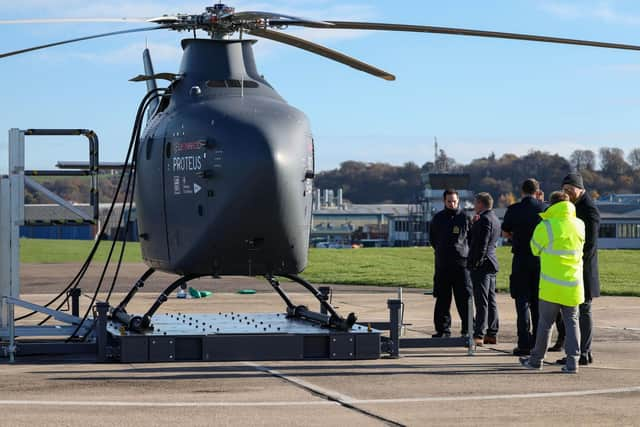

Proteus is the size of a traditional helicopter, but its windowless exterior reveals that pilots ‘task’ the rotorcraft remotely, rather than sitting in the cockpit or using flying controls from a remote location. During the ground runs, the futuristic uncrewed helicopter tested her engines, systems and rotor blades, confirming its readiness for flight in the coming weeks.
Designed and manufactured in less than two-and-a-half years at Leonardo, the home of British helicopters in Yeovil, the Proteus Technology Demonstrator is being developed by the company under a £60m programme that is believed to be one of the world’s first full-sized autonomous helicopters.

This is the first step towards creating a truly autonomous Vertical Take-off and Landing (VTOL) aircraft in this weight class.
It will help both the designers and the Royal Navy understand what might be possible for the future of uncrewed aircraft. This will include exploring how they will operate, either individually or in tandem with crewless and crewed aircraft as part of a ‘hybrid air wing’.
“It’s been a huge pleasure to work with Leonardo and across Defence, as one team to deliver Proteus,” said Captain David Gillett, head of Maritime Aviation and Carrier Strike in the Royal Navy’s Develop Directorate.
“It combines cutting-edge technology, the experience of recent conflicts and has enormous potential to shape the Royal Navy’s future hybrid air wing.”
Nigel Colman, Managing Director Helicopters UK, Leonardo added: “Leonardo is leading the way globally in autonomy, supported by the Royal Navy. Proteus is equipped with cutting-edge onboard software capabilities, carrying a suite of sensors and systems that allow it to sense its environment, make decisions and act accordingly. “
By embracing the potential of uncrewed helicopters like Proteus, the Royal Navy aims to search wider stretches of ocean for longer periods without putting a strain on aircrew, who could be deployed on other critical missions.
While Proteus isn’t flown by a pilot, the technology demonstrator always has an operator in control of the system, operating within predesignated safe limits and customer defined rules of engagement.
Going forward, the demonstrator will be assessed for its ability to support anti-submarine operations to protect the UK’s waters.