
'Having triplets left me traumatised - I lived in a state of terror'
A mum left traumatised by the birth of her triplets has shared how her life spun out of control and she spent months living in a “prolonged state of terror.”
Leila Green, now 41, and her husband James welcomed Rafael, Jeremiah and Franklin by planned caesarean in July 2022.
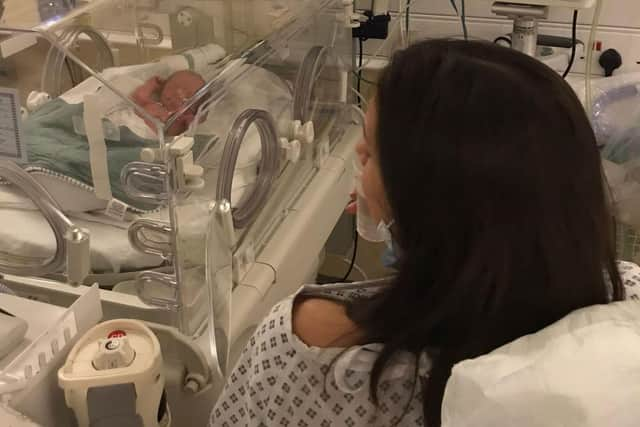

The boys were seven weeks early, weighing 3.5 lbs each, and were quickly whisked away to the neonatal intensive care unit (NICU), while Leila was taken to recovery.
“I knew they’d be wheeled away from me, but the moment it happened, it felt like someone had ripped something out of me. We'd been together this whole time, and suddenly, we weren’t,” Leila, from London, says.
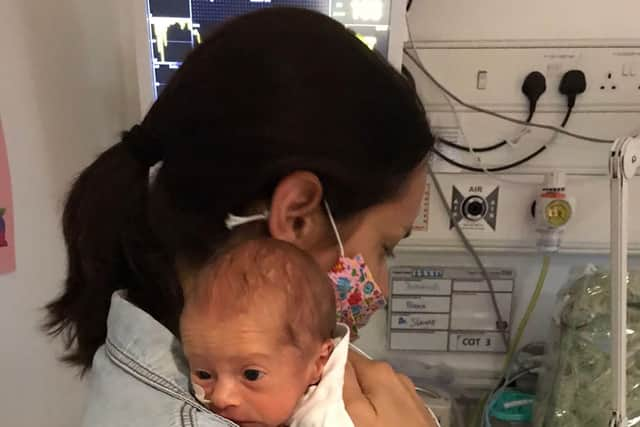
“Meanwhile, you’re surrounded by other mums cuddling and feeding their babies.”
Physical separation was only part of it. The clinical setting - machines, jargon, cold sterility and the frightening procedures - created an atmosphere of fear and isolation.
The triplets were being taken good care of in the NICU, but Leila lived in fear that the boys would deteriorate.
“You would go in some mornings and hear a nurse say, ‘Where's Baby X’ and her colleague would say, ‘Oh, he died - awaiting post-mortem.’ You’d be terrified every day that your baby would be next,” she says.

One in three women describe their birth as traumatic, according to research, yet maternal post traumatic stress (PTSD) is routinely missed. Theo
MP Theo Clarke, who has recently written a book about her own birth trauma, said women are subject to a postcode lottery in postnatal care.
Leila’s boys were born on a Friday and her distress intensified after the weekend, when she heard two of her babies were going to be taken to a different hospital.
“I'd begged my consultant not to separate them,” Leila says but she was ignored. The two who were making good recoveries and no longer needed critical care were sent to wards on the other side of London.
“Instead of having that lovely, cozy, pink, wonderful, golden moment with my newborns, where everything is supposed to be so loving, me and so many other mums in that moment are separated, terrified, traumatised and left on our own.” she says.
Leila was floored with a sense of guilt that she couldn’t look after each of her newborns because she couldn’t be in more than one place at a time.
She worried excessively about not being able to provide them with enough milk, or the vital bonding time and skin-to-skin contact that would help them recover. Instead two were wheeled away before she had a chance to hold them.
“Frankie was transferred first. I cried so much I was just screaming my heart out, wailing,” she says. “I didn’t even care what people were thinking of me. I was just a woman who had completely lost it. Then I passed out from exhaustion.
“I remember people saying, ‘Oh, it's just hormonal. It's just because your milk's coming in’. And I thought: ‘No, it's not. It's because they've taken my baby’.
“Then I got the call to say Rafa was going. I hadn't even held him yet and I felt so guilty.”
The trauma was compounded by terrifying moments, like the day Jerry turned blue in her arms.
“I was holding him and his lips and face went blue as his breathing stopped,” she recalls. “I pressed the emergency button and the room filled with medics, and I couldn’t answer any of their questions. I just froze.
‘It was living in a prolonged state of terror. You’re so focused on your babies staying alive that there's no space left to process what's happening to you.”
Frankie and Rafa came home after four weeks, Jerry after five. It was a happy day but Leila and her husband James were quickly overwhelmed by the whirlwind of feeding, changing and bathing three babies while trying to establish a sleep routine. Leila was feeding 24 times in 24 hours and was thoroughly depleted and exhausted.
The boys were frequently poorly and needed multiple trips to hospital. It wasn’t until one such visit - a year after the boys were born - that Leila realised she had been traumatised by the boys’ birth.
“For months, every time I heard the beep of a monitor in hospital. I’d get this reaction: my chest would tighten, I couldn’t breathe. My whole body would tense as if preparing for a blow,” she explains.
“Other mums I know report experiencing the same thing at the beep of a kitchen appliance. And I didn’t understand why until a therapist helped me trace it back to the NICU alarms going off the day Jerry turned blue.”
With the help of a good therapist Leila has since been able to process the trauma, but she wishes she’s been guided to organisations like Miracle Moon, which helps parents navigating the NICU experience.
“At no point when I was wandering around the hospital like a zombie did anyone ask me if I was OK or signpost any help. I wish I'd known about Miracle Moon sooner," she adds.
Today, the triplets are thriving.
“They’re wild,” Leila laughs. “Into everything - climbing, sailing, throwing things. I was terrified they’d be weak forever, and now they’re like little athletes. I can’t feed them fast enough.”
But the scars remain. “I still check their breathing in the night and I still get triggered by sounds. I still feel like something bad’s going to happen because surely we can’t have got this lucky.”
In response to her experience, Leila founded the F**k Mum Guilt movement — a community for mums saying "no" to guilt and the picture-perfect version of motherhood shown so frequently.
“I felt totally excluded from the motherhood narrative,” she said. “I didn’t see anyone talking about what I’d been through or what I was experiencing. It wasn’t white, Cath Kidston-style parenting. It was grief, trauma, chaos, exhaustion and love all rolled into one.
“And because things were so hard with triplets, I really had to ditch the mum guilt and take care of my own health and wellbeing, or I wouldn't have been able to cope.”
She’s exhausted now but for a different reason. Keeping up with three rowdy toddlers is hard work.
“Even though they drive me mad, it’s incredible to see them thriving after such a brutal start. I’m just glad they’re here, strong and loud and messy. They’re exactly who they’re meant to be,” she adds.