
Ahmadiyya Muslims draw 46,000 to Jalsa Salana festival in Hampshire
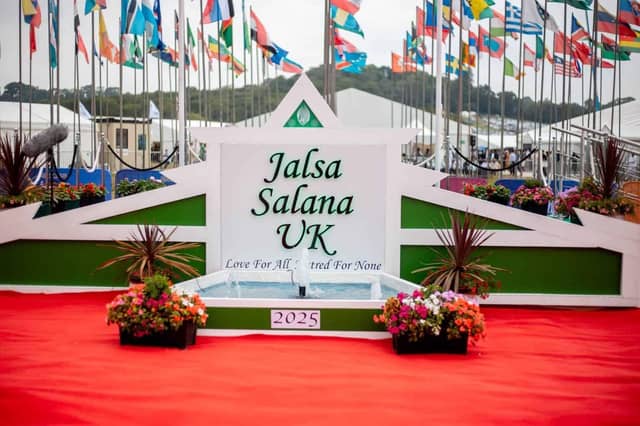

The Ahmadiyya Muslim community held its annual festival, the Jalsa Salana UK in fields near Alton, Hampshire, this weekend.
An estimated 46,000 people were there, including 10,000 volunteers, visiting dignitaries and members from 110 countries all over the world.
The movement was founded in 1889 by Mirza Ghulam Ahmad, who is regarded by followers as the Messiah, though subservient to the Prorphet Mohammed. It is not recognised by mainstream Islam and there is widespread persecution of its members, particularly in Muslim-majority countries like Pakistan.
The community’s international headquarters is now in a former public school in Tilford, Surrey, over the county border from the festival site. The main Ahmadiyya mosque in Britain — one of the largest in Europe — is in Morden, south London.
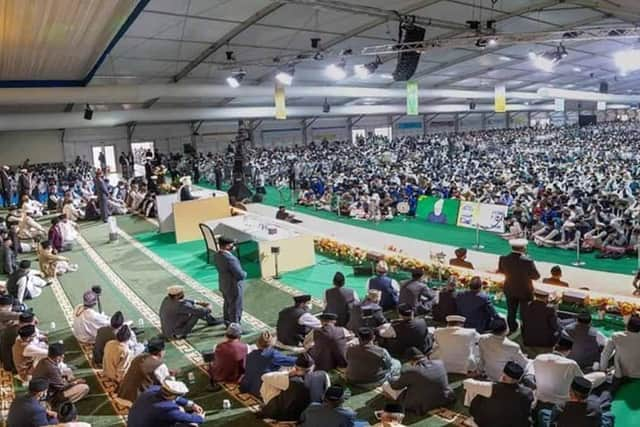
The festival is designed to build community relations and strengthen knowledge and practice of the faith, and it took place on a massive site with large marquees, tents with 13 exhibitions, space for communal eating, areas for camping in tents and large parking sites.
One feature that marks out this religious festival is the segregation of women from men. Men are not allowed in women’s areas, but women can walk into the men’s area to take part in exhibitions and events. The areas were connected by walkways, like bridges, between the two.
One of my guides in the women’s area, Syeda Nooresahar Ahmad, an Oxford graduate and author, explained that families came together in their living areas, but at the festival they went their separate ways. She appreciated being in a women-only environment: “We enjoy it. We have a really good time,” she said.
Another guide, Muzazzah Chou, a medical doctor, told me that the addresses were broadcast on television screens so everyone could hear them. Women have their own female speakers as well, but they address women, not men, she explained.
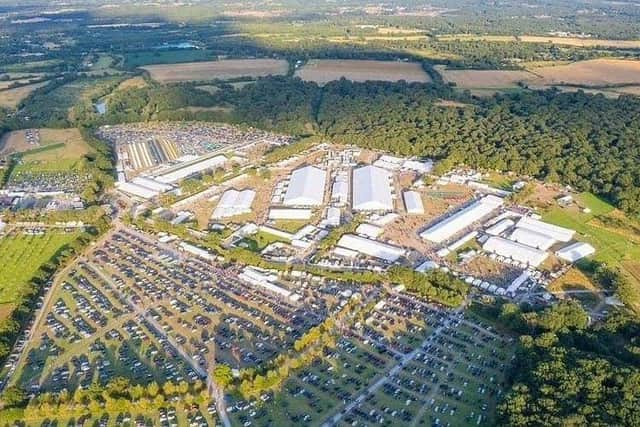
There is a reverential switch and a change of atmosphere when His Holiness Mirza Masroor Ahmad, the fifth Caliph (spiritual leader), of the movement, appears in public or gives sermons, which are broadcast on TV screens around the site and to audiences abroad. He is treated as royalty, driven in a cavalcade with people lining the route nearby to wave, excited to receive a wave back.
The key message of the Ahmadiyya movement, which they say is the true message of Islam, is “Love for all, hatred for none”.
In his addresses given each day of the festival, the Caliph spoke of the importance of the event for “self-reformation”, an increase in religious knowledge to improve “our spiritual condition”, and the creation of “a spirit of sacrifice for ourselves and brothers and remove any grievance in our hearts”.
He also addressed geopolitical wars — and within this, anti-Islam sentiment.
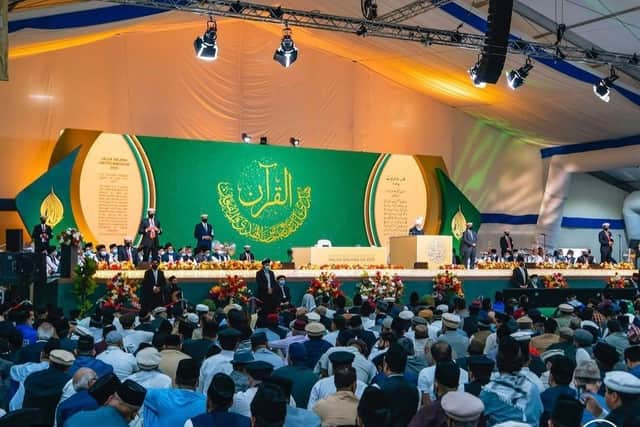
“Today,” he said “Palestine is under attack and other Muslim countries will be affected … Muslims should act with wisdom.” He suggested the solution was for Muslims to strive to act on the commandments of Allah, and for grace to descend.
“There is widespread selfishness amongst Muslim nations these days,” he added. “Nobody is ready to help the oppressed. The apathy shown by Muslim countries in the matter of the Palestinians is apparent. In these circumstances, what do they think Allah will do? They don’t realise that they will be devoured one by one by the enemies of Islam or those whose greed has increased so much that they desire to subjugate every country.”
For the Ahmadiyyas, the Caliph is the successor of the Messiah, and being in his presence makes them feel an excitement, a feeling of being blessed, which they describe as a powerful, beautiful experience.
Away from the lectures and sermons, there were 13 exhibitions with information about the extensive aid programmes the community runs, such as on peace, the environment, agriculture, humanitarian aid, and education. throughout the world, outlined their work in disaster relief and humanitarian aid. Here again, volunteering is key, with doctors, for example, giving up their holidays to serve abroad.
Children and young people become involved in the festival from an early age, helping to guide visitors, distributing water and volunteering as they are able. The Ahmadiyya movement emphasises education, so at each festival young people who have passed exams are invited onto the stage to receive praise and certificates. Children are taught public speaking and confidently converse with, and teach, guests.And there is a college, Jamia Ahmadiyya UK, in Haslemere, Surrey, where students spend seven years learning theology, graduating as missionaries.
The emphasis on education and achievement is keenly felt. My guide, Syeda Nooresahar Ahmad, told how she went to a comprehensive school in Hartlepool, County Durham, and was encouraged by the Caliph to study English at Oxford, which she did. My other guide, Muzazzah Chou, told the story of her family’s move from China via Pakistan to London, where she trained to be a doctor.
The atmosphere of the whole event was one of determined attention to spiritual engagement, through prayer and listening to reflections on the faith, alongside an obligation to take action in the world for social justice. It’s an annual event that is key to the affirmation of the faith and building community loyalty.