
Young mum told she had 'dry eye' finds out she has high-grade cancerous tumour with months to live

A new mum who thought she just had "dry eyes" was diagnosed with a brain tumour and told she had only months to live.
Rachael Burns, 22, noticed changes in her eyesight after giving birth to her daughter, Raeya, one. Her migraines, which she had suffered for years, worsened, prompting a visit to an optician.
Initially, she was told she had "dry eye" and was sent home with eyedrops and glasses, but her eyesight continued to deteriorate. Eventually, her face became lopsided, and she was unable to open one eye, leading to a referral to Royal Victoria Hospital.
An MRI scan revealed a high-grade cancerous tumour – diffuse midline glioma (DIPG) – that had already spread down her spine. Rachael has been told she has only months to live, and her family is aiming to raise £150,000 for life-extending treatment.
Rachael from Belfast, Northern Ireland, said: "When I was told I had a brain tumour my entire world fell apart. I was told that the life expectancy of someone with my diagnosis was 12 months, and I had already been showing symptoms for eight. I just didn’t expect to receive news that awful. I’d hoped to maybe have at least a year or two. This hugely affected me mentally. I just sort of crumbled.”
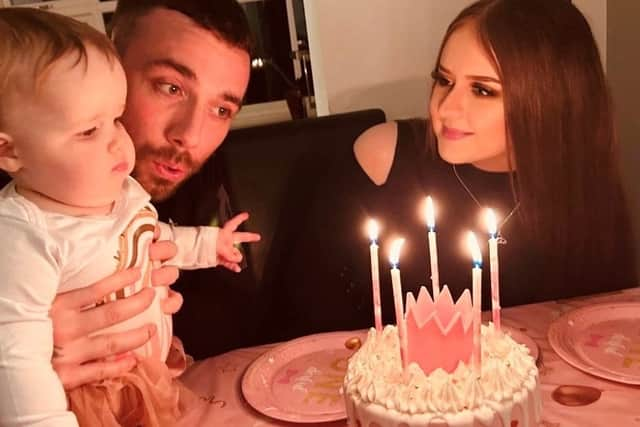

She first noticed her symptoms in March 2023 and had to spend many days in bed to ease the pressure in her head. She said after her visit to the optometrist, her eyesight “worsened, leading to me walking in front of cars due to the blind spot on my right side.” She said: “I could no longer take my daughter out of the house on my own as I was so worried I would put her in danger. I felt like I was being dramatic, and this led to me waiting even longer to get help.”
Rachael was diagnosed in May 2024 after being referred to urgent care. Doctors said surgery was not an option due to the tumour’s location on Rachael’s brainstem. She is now undergoing six weeks of intense radiation treatment, with 30 sessions on her brain and 28 sessions on her spinal cord.
"Some days I’ll wake up and my legs won’t work, and I’ll be crying in agony for hours at a time with the pain," Rachael said. "My partner Robert has had to take over most of our daughter’s care and it makes me feel so useless, like I’m already being stripped of a lot of my motherhood. Some days I can walk unassisted and I’m able to lift Raeya. All I can do is hope that I get as many good days like that as possible because memories with my family are all that matter to me now."

She added: “I’ve researched a lot of other young people with my diagnosis who say radiation just didn’t work at shrinking their tumour at all, so we as a family set out to find any possible trials or drugs that might give me a chance.”
Rachael and her family are now fundraising to cover the cost of potentially life-extending treatment. The ONC201 drug, administered privately in Germany, has prolonged patients’ lives by almost two years in the past. To cover consultations, private scans, travel costs, accommodation, and the drugs themselves, Rachael hopes to raise £150,000 and she has now raised just over £80,000 on GoFundMe.
She said: “As hard as it is to ask for help, I’m really swallowing my pride and letting myself be vulnerable enough to beg for this extra time. I am not ready to leave my family and my baby. One year is not anywhere near enough time to get to experience the gift of motherhood and have it stripped from you.
“I’ll never see Raeya walk down the aisle and for what? Just bad luck? It isn’t fair. I may not get to take her to her first day of school but any extra days with her will be a blessing so I will fight with everything in me to wake up to her each morning. Something needs to be done to help people in situations similar to mine.
“There is not enough awareness and not enough funding put into brain tumour research when it is killing innocent children and young adults every single day and the world is going on as normal. If more people knew just how devastating the effects of brain tumours are on not just the person diagnosed but their entire family and everyone around them who loves them, maybe we could push for more options and more treatments as nobody deserves a fate this cruel.”
Louise Aubrey, community development manager at Brain Tumour Research, said: “It’s a tragedy that a young mother like Rachael cannot get the best drugs and treatment in the UK, and instead has to spend hundreds of thousands for the chance to spend more time with her daughter.
“Brain tumours kill more children and adults under the age of 40 than any other cancer, yet just 1% of the national spend on cancer research has been allocated to brain tumours since records began in 2002. This is unacceptable. So much more needs to be done to prevent young families like Rachael’s from being ripped apart by this devastating disease.”