
This is your Victory
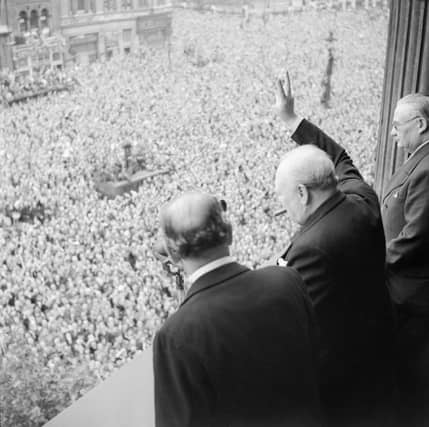

On 7 May 1945 at 7.40pm, the BBC Home Service dramatically interrupted its evening radio broadcasts. Newsreader John Snagge reported that the war in Europe had ended. Nazi Germany had surrendered unconditionally, at Allied Headquarters in Rheims, France. The following day was to be a national holiday, ‘Victory in Europe Day’ (VE Day).
Celebrations immediately erupted across Britain (as well as in the Commonwealth and in the United States). Crowds took to the streets in an outpouring of mass relief. On 8 May 1945, British cities, towns and villages held thousands of VE Day parties, church thanksgiving services and victory parades.
The war itself was not over. Most Britons expected the fighting in Asia against Japan to continue for months, if not indefinitely. Nevertheless, VE Day came as a beacon of hope and light for a nation wearied by war.
Today, 80 years on, VE Day is remembered with happiness and pride in Britain, in the Commonwealth and among its Allies, and is shortly to feature in nationwide anniversary commemorations.
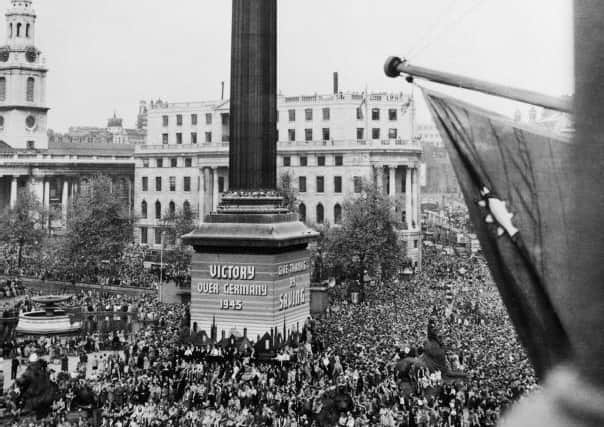
In Cardiff, VE Day was unforgettable.
On 8 May 1945, Cardiff came to a standstill. Crowds poured into the streets or flocked to the city and civic centre. On BBC Radio at 3pm, Cardiffians heard Prime Minister Winston Churchill tell the nation that: “we may allow ourselves a brief period of rejoicing”. They took him at his word, holding many joyful street parties. Across the city church bells rang out as Cardiff rejoiced. Among the crowds that day was my own late father, Gareth Thomas, then aged eight and living in Inverness Place, Roath.
During the war, Cardiff, Britain’s largest coal port, had been a predictable target for Hitler’s Luftwaffe. The city was seared by enemy attack. It suffered four air raids in July and August 1940, three night raids in January 1941, nine attacks from February to April 1941 and two in May 1941.
On the cold night of 2 January 1941 – Gareth was aged four and a half but still remembered it – 100 German bombers attacked Cardiff and its docks. Dropping parachute flares to light their targets, they unleashed thousands of incendiaries and hundreds of high explosive bombs. Buildings in Grangetown, Riverside and Canton were devastated. A parachute mine blew the spire off Llandaff Cathedral. The raid killed 165, injured 427, made 3,000 people homeless and destroyed 350 properties.
Further air raids on Cardiff took place during June-July 1941, June-July 1942, May 1943 and into March 1944. By 1945 355 people had been killed in Cardiff (around 1,200 in total across Wales, primarily in Cardiff and Swansea) and over 500 seriously injured. At least 2,100 high explosive bombs were dropped on the city.
As a child in wartime Cardiff, Gareth had experienced nights in his family’s garden Anderson shelter as bombs detonated nearby. He remembered his steel-helmeted father opening the shelter door to check on his family after a heavy night raid in February 1941. His father carried him along Inverness Place in time to see the burning roof of St Martin’s Church, Roath collapse into its interior. Gareth grew accustomed to the wail of air raid sirens, strict food rationing, the sight of Barrage balloons swaying in Cardiff parks, playing on bomb sites, the sinister drone of enemy aircraft engines, the dazzling beams of probing searchlights and the roar of anti-aircraft gun and rocket batteries firing from Roath Park Recreation Ground. In April 1945, playing in Roath Park, he plucked out a newspaper floating in a stream. The headline told of events at a place called Belsen. On 1 May he remembered hearing the BBC radio newsflash announcing the death of Adolf Hitler.
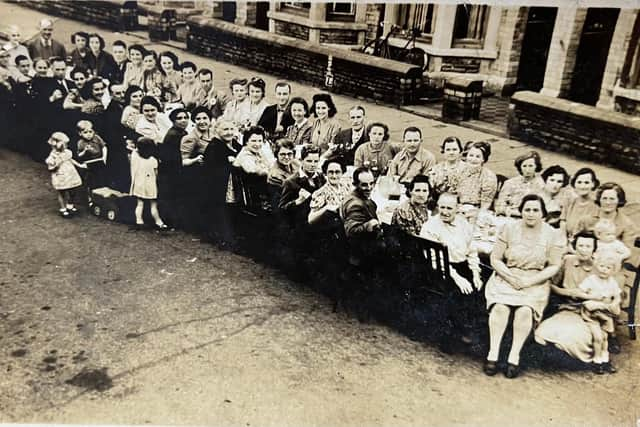
Then came VE Day. Gareth happily attended a street party with his family outside his home on Inverness Place. Bunting and Union Jack flags festooned the telephone wires and trees. Local residents gathered as many foodstuffs as could be found. Long tables were set out along the street, at which sat local children wearing party hats and enjoying sausage rolls, jam tarts, jelly, tea and orange squash. In the evening, Gareth was taken to the City Hall to see the celebrations. Cardiff’s public lighting was symbolically switched on again, after five years of wartime blackout. Impromptu bonfires blazed in streets across the city. Fireworks detonated overhead. There was public dancing and singing and beer flowed. The next day, Gareth was permitted an additional day off from Roath Park Infants School. Later in 1945, he joined a large crowd outside St John’s Baptist Church, northwest of The Hayes, in central Cardiff, watching a low victory flypast by Spitfires and Hurricanes. Some flew inverted, the pilots waving from their cockpits to the crowds below. Their flying helmets and faces were clearly visible.
The VE Day celebrations were accompanied by sadness and uncertainty for some in Cardiff, as in the rest of Britain. Families had lost relatives in battle or in air raids or worried for those still engaged against the Japanese in Asia. In the Second World War 384,000 British military personnel were killed in action, including 15,000 from Wales. At home, during 1940-1945 an estimated 60,000 British civilians were killed after aerial bombing of eighteen British cities (43,000 from September 1940-May 1941). Around 71,000 British people suffered life-threatening injuries and over 88,000 others were less seriously injured.
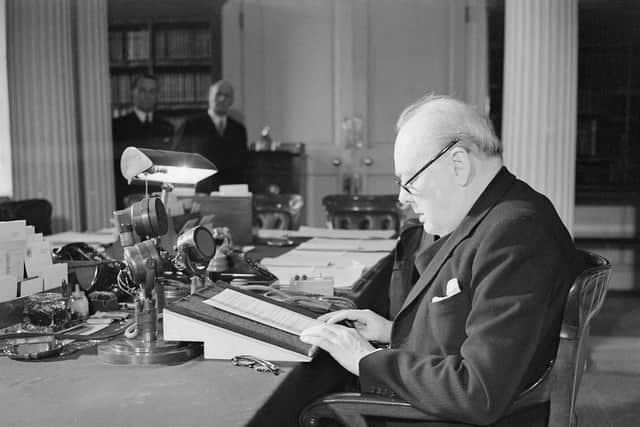
Today, VE Day remains a key reflection point of the Second World War, particularly among those who remember the joyous street parties as children. Eighty years on, it remains central in British collective historical memory.