
Animal banknotes: Have your say on new designs as Bank of England reveals shortlist now open to public vote

The public are being asked to have their say on the new-look animal banknotes as the Bank of England opens up its shortlist to the vote.
A dolphin, a fox, a butterfly, an owl, a bumblebee and a shark have made the shortlist of animals that could feature on new UK bank notes. As part of a plan to replace historical figures on cash, the Bank of England wants people to give their views on which UK native species should feature as they spend.
People are being encouraged to have their say as part of a public consultation launched on Wednesday (June 3), with a shortlist of potential animals produced in conjunction with a panel of wildlife experts for £5, £10, £20 and £50 notes. The list has been grouped into three categories, covering a variety of species and environments, with participants asked to select up to two examples from each category in the consultation, which runs until 11.59pm on July 3.
The Bank said only animals on the shortlist can feature as the central images on the new series, which are being created in part to tackle increasing counterfeit money.
In March, the Bank announced nature had been chosen as the theme for the next series of banknotes, having received the highest proportion of nominations in last year’s consultation, as well as support in focus groups. Much of the feedback received by the Bank referred to wildlife that is native to the UK.
It is important that there are four distinct animals across the four denominations and that they are able to represent different environments from across the UK, the Bank said. Given this, the Bank said it may not necessarily choose the four animals that receive the highest number of responses.
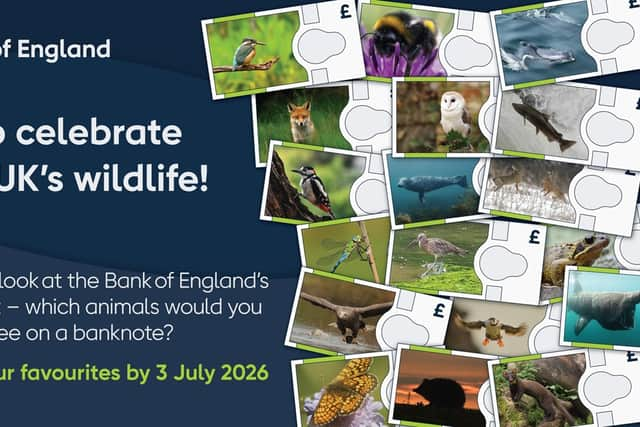

The central images will also feature additional elements from wildlife and nature. Bank of England Governor Andrew Bailey will make the final decision, taking into account feedback from the public.
The Bank said it wants to hear views in particular from residents of the UK and British citizens living abroad, which can be submitted via the Bank’s website or by post. and will announce the outcome of its consultation by the end of 2026.
It will be a number of years before the next series is launched, with a detailed, multi-year process needed to design, test and print the banknotes, the Bank said. This will help ensure they are resilient, accessible and include the latest anti-counterfeiting technology.
Victoria Cleland, Bank of England chief cashier, said: “I very much hope the public will enjoy engaging in our consultation to choose the animals to feature on our next series of banknotes. The shortlisted animals demonstrate the rich variety of wildlife we have to celebrate in the UK.”
People will continue to see a human face as they take banknotes out of their wallets, even when animals are introduced into designs, as the next series will continue to include a portrait of the monarch. Representation of the home nations will also be an important feature in the design, the Bank said.
UK bank notes animals shortlist
Mammals
- Bottlenose dolphin
- Brown hare
- European hedgehog
- Grey seal
- Pine marten
- Red fox
Birds
- Atlantic puffin
- Barn owl
- Common kingfisher
- Eurasian curlew
- Great spotted woodpecker
- White-tailed eagle
Amphibians, insects and fish
- Atlantic salmon
- Basking shark
- Buff-tailed bumblebee
- Common frog
- Emperor dragonfly
- Marsh fritillary butterfly
Historical figures who have helped shape thought, innovation, leadership and values have been showcased on Bank of England banknotes since 1970. The first of the current series has been in circulation since 2016, when £5 banknotes featuring Sir Winston Churchill were issued. The current series of banknotes in circulation also feature Jane Austen on the £10 banknote, JMW Turner on the £20 and Alan Turing on the £50.
The rise in payments technology such as contactless and mobile wallets has given people an increasing array of alternatives to banknotes and coins. Cash remains the preferred payment method for about one in seven people and is used by many more, the Bank said.
It said the amount of cash in circulation has also continued to increase, reaching £91.5 billion at the end of February 2026.