
Giant hornet alert: The loud insects that look like they have a fearful sting but are not harmful to humans

There is a stunning sawfly called the Giant Horntail but also known as the Giant Wood Wasp or Greater Horntail, and by its scientific name, Urocerus gigas. This is certainly something to watch out for as the seasons progress, as this very big, sawfly (as cousin of the familiar wasps and with black-and-yellow-banding) is found across the UK from May through into October.
They are easily mistaken for a seriously large wasp, and sport a dramatically long, tail-like ovipositor which looks at first sight like a fearful sting. The sawfly also makes a loud buzzing in flight.
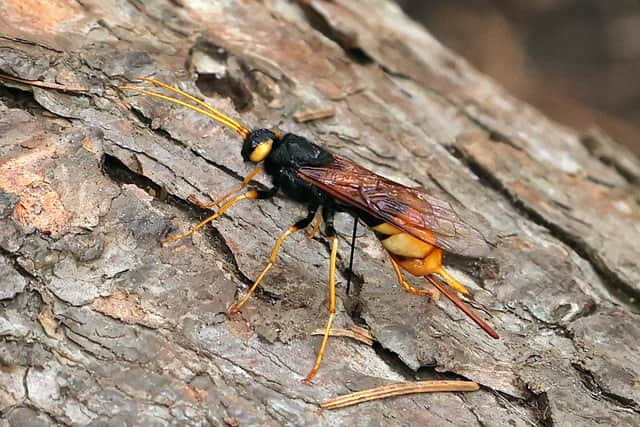

However, this much maligned insect is actually not harmful to humans since the ‘sting’ is really an ovipositor that the females used to lay their eggs in the wood of pine trees. Indeed, this is where the larvae live whilst feeding on the timber.
Because of their dependence on pine wood the sawflies are most frequently seen in and around conifer plantations. They seem to be particularly attracted by the resinous fragrance of freshly cut pine logs – and so this is a good place to look. They may also emerge as adults from their pupation in logs brought home for firewood, but don’t be alarmed if you see one.
My first sighting was as a teenager bird-watching in the Moss Valley, south of Sheffield, and where a conifer harvest was being cut and extracted by the then Renishaw Estate. It did make a big impact both visually and with its noise, and I think we assumed it was some sort of giant hornet!
When I worked at Weston Park Museum in Sheffield, I recall a local police sergeant based at Tinsley in the Lower Don Valley, brought in a live specimen in a jam jar. On the accession form, in answer to the question ‘How did you collect the specimen?’, his notes read, ‘it landed on my neck’. I must say that I was most impressed by the calmness shown by our local constabulary under such as situation, to not panic, grab a jar and trap it. Remarkable!
Professor Ian D. Rotherham, researcher, writer & broadcaster on wildlife & environmental issues, is contactable on [email protected] ; follow Ian’s blog and Twitter @IanThewildside