
Marginalised communities ‘hardest hit’ by hot weather as areas of UK cities with fewer trees ‘up to 5C warmer’

New analysis shows neighbourhoods of five major cities are ‘up to 5C warmer’ during the hottest days
Working-class and marginalised communities are the “hardest hit” by hot weather in the UK as areas of English cities with less greenery are “up to 5C warmer”, according to new analysis.
The analysis, from mapping experts TerraSulis and environmental group Friends Of The Earth (FOE), found that neighbourhoods with higher levels of tree cover, green space or both were much cooler than those without.
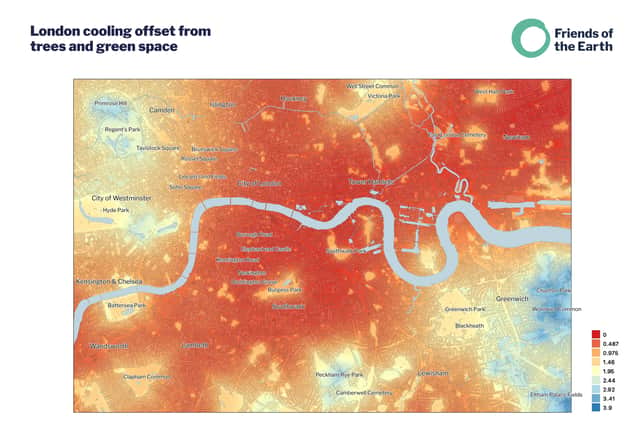
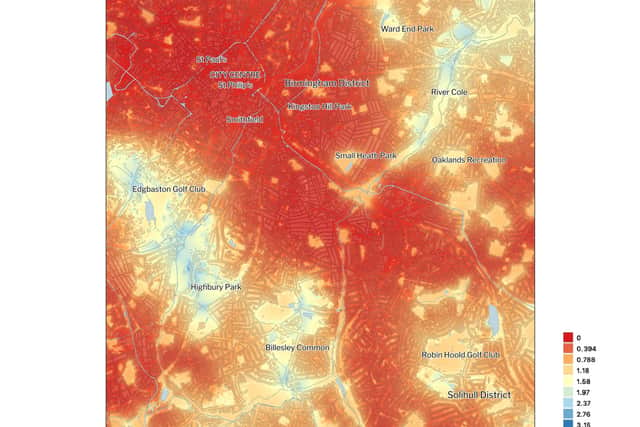
New heat maps show the temperature variation in five English cities including London, Birmingham, Manchester, Bristol and Newcastle during the UK’s hottest day on record on 19 July 2022.
The hottest areas appear in dark red and the coolest areas that are the most nature-dense are highlighted in light blue.
The analysis found that people of colour make up 65% of the population in neighbourhoods with the least cooling which shows how marginalised communities can be the most affected by the climate crisis in the UK.
Mike Childs, FOE’s head of science, policy and research, said extreme weather is becoming “more frequent” and “severe” due to the climate crisis but “not everyone is affected equally”.

People living on lower incomes are also disproportionately affected by a lack of cooling near their homes while air pollution is worse in the hottest areas.
Rowha Mohid, founder of GuiltlessThreads, a social impact company that runs events like workshops for communities of colour on addressing eco-anxiety, said working-class communities “have as much of a right to clean air, green space and a healthy environment as wealthy ones.”
It is the first time research on the cooling abilities of green spaces and trees in built-up areas has been modelled.
It has prompted FOE to call on the government and local authorities to commit to no less than 20% tree cover across urban areas as part of the government’s upcoming Urban Trees Standard.
It is also calling for more than 3,000 of the most vulnerable neighbourhoods to be prioritised as part of a council-led, street-by-street insulation programme to help keep homes cool in summer and warm in winter, London’s Ulez expansion plans rolled out and Clean Air Zones in cities around the country.
Mr Childs said increasing the number of trees is “such a clear win for our communities and our planet” because of their “ability to cool urban areas” and “capture planet-warming carbon too.”
The calls come after a government watchdog committee has warned England is meeting less than half of its annual tree-planting target.
The Environmental Audit Committee said the government is “very unlikely” to meet its target of 30,000 hectares planted by March 2025 - with only two planting seasons left before the deadline.
Forestry England also currently lacked the resources to ensure trees were planted according to the UK Forestry Standard, the committee added, which should be rectified “urgently”.
A spokesperson for the Department for Environment, Food and Rural Affairs (Defra) said it was still committed to having 16.5% of England’s total land area covered by woodland by 2050, but recognised there was “much more to do” to speed up planting.