
OceanGate: what did co founder Guillermo Sohnlein say about Stockton Rush and Titan submersible implosion?

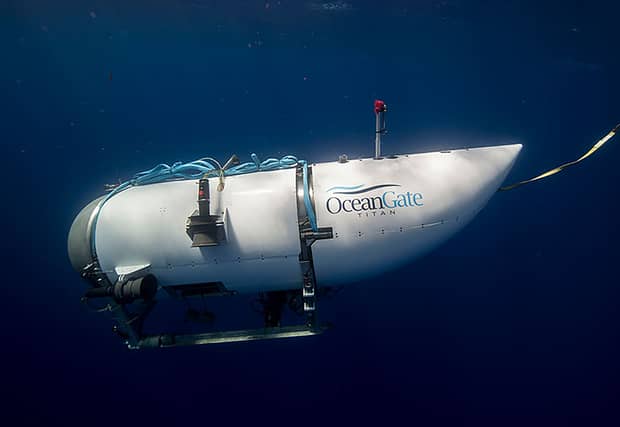

Five people are believed to have died after OceanGate Expeditions' Titan submersible imploded en route to the Titanic wreck
The co-founder of OceanGate Expeditions, the parent company of the Titan submersible, has said the best way to remember those who lost their lives during the implosion is to find out what went wrong and learn from it.
When asked about whether the incident was a setback, Guillermo Sohnlein told Times Radio that "one of the risks that the community takes every time it operates is that if there is some sort of catastrophic failure, the general public will backlash against the entire community and basically say that it shouldn’t occur".
“But, just like with space exploration, the best way to preserve the memories and the legacies of these five explorers is to conduct an investigation, find out what went wrong, take lessons learned and then move forward," he said.
Sohnlein added that his goal is not to conduct “joyrides” down to the wreck of the Titanic, and that “everyone who goes down there has extreme reverence for the wreck as a grave site".

He said: "If anything, everyone who goes down there is going there to preserve the memories and to document the grave site itself... the intent of all of these missions is not to conduct joyrides down to this wreck.
“The ocean’s a massive, massive environment," he continued, “Stockton [Rush, one of the five killed and fellow co-founder of OceanGate] and I used to commiserate about the fact as explorers it provides a fertile ground for exploration because you could drop a sub almost anywhere in the ocean and you’re almost assured of being the first humans to ever set eyes on it.
“The Titanic itself has a kind of mystical kind of draw to it because of the reverence with which everyone has viewed that wreck over the last century since it sank.”
What did he say about the cause of the implosion?
Speaking to BBC Radio 4’s Today programme, Sohnlein was asked about the potential cause of the implosion. He said: “Anyone who operates in that depth of the ocean... knows the risks of operating under such pressure and that at any given moment, on any mission, with any vessel, you run the risk of this kind of implosion.”
Sohnlein explained it is “tricky to navigate” the current regulations on submersibles telling Times Radio that "there are regulations in place but as you can imagine there aren’t many subs that go that deep.
"The regulations are pretty sparse and many of them are antiquated and designed for specific instances. It’s tricky to navigate those regulatory schemes.”
As to what exactly went wrong with the Titan submersible, Sohnlein said "there’s data that’s going to have to be collected over the coming days, weeks and months, and I’m sure the team will work with whoever is conducting the investigations to cooperate and provide as much information as possible. At that point, we’ll be in a better position to tell [what went wrong].”
Sohnlein told the programme that the Titan had undergone 14 years of “rigorous” and “robust” checks during development.