
Is the Earth flat? And what is an analemma? Flat Earth arguments ignite again after video on X

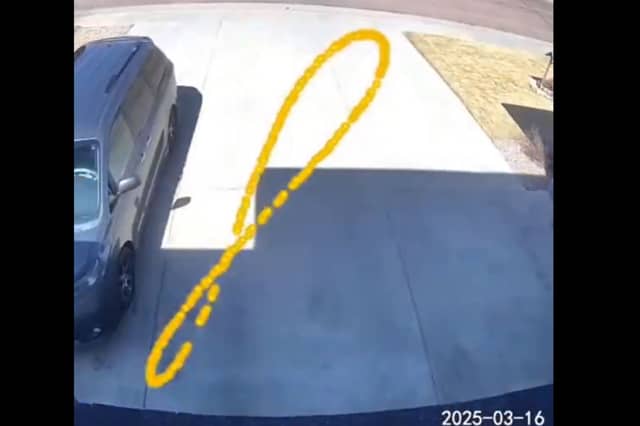

You might have thought that this argument had been put to bed by now, but there are still some people popping up today to advocate the Flat Earth Theory.
It’s been sparked by an analemma time-lapse video posted on the @interesting_aIl X account which shows the shadow cast by the corner of a house on a driveway. It was tracked every day and produced a thin figure of eight path, and the video was posted with the message: “Proof our planet isn't flat.”
The post has so far had 4.8m views.
What is an analemma?
An analemma is a diagram that usually shows the position of the sun in the sky at the same solar time every day for a year - but can be traced using shadows instead. It is created by the combined effects of the Earth's axial tilt and its elliptical orbit around the sun. It shows how the sun’s position is changeable at anyone given time.
Because this video shows one end of the eight being elongated, it can be deduced that it was not shot near the equator, where the path would be more regular. This is borne out by the snow that appears at one point.
What have sceptics said?
Flat Earth advocates have argued that in fact the video shows the possibility of a stationary Earth with a local Sun.
Some - although it’s hard to know how serious the answers are - have made points such as “How is this proof? Is it plausible that the earth isn't moving, but the sun is!”, or “Except it doesn't. It only proves that 1: the sun follows an ecliptic orbit. 2: the earth is closer to the sun in the winter period.”
One person replied: “That's like saying my basement recessed lighting changes my porcelain floor make up and shape. Weak thinker. Sad.”
What did others say about the analemma?
One, with tongue firmly in cheek, said: “NASA now also manipulates every shadow in front of every garage.”
And others pointed out interesting facts, such as “Note the dates when the markers crossed - March 20 and September 20. The Equinoxes. And the furthest parts of the curves: June 20 and December 20: The Solstices. I'll bet somebody could figure out the house's rough latitude based on the relative size of the two curves.”