
Annual solar eclipse: Rare 'Ring of Fire' eclipse to be visible in skies - when, where to see, what is it?

An annular solar eclipse will be visible in days time - but only in a remote part of the world.
On 17 February 2026, an annular solar eclipse will be visible from a remote part of Antarctica, forming a "ring of fire" for up to two minutes, 20 seconds as 96% of the sun's center is eclipsed by the moon. The eclipse path will be limited to a remote region of Antarctica, so the event will be seen by almost no humans.
"It's possible that only a few people will view this eclipse from within the annular zone," eclipse meteorologist Jay Anderson wrote on his website, Eclipsophile.com. "It's a challenge to reach and there are only two inhabited locations within the annular shadow, neither of which is set up to welcome tourists."
The eclipse will rise over mainland Antarctica and set off the Davis Sea coast of the Southern Ocean. The ring of fire will be visible only to those in Antarctica or the Southern Ocean.
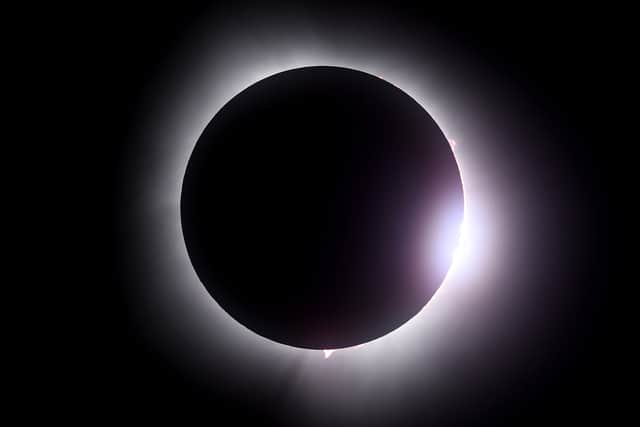

An annular solar eclipse occurs when the moon passes in front of the sun but is too far from Earth to completely cover it, leaving a brilliant “ring of fire” around the moon's silhouette. A partial solar eclipse will be visible on either side. It’s only safe to view with eclipse glasses, even during the annular phase.
Unlike a total solar eclipse, which plunges parts of Earth into midday darkness, an annular eclipse delivers a subtler show. The moon, near apogee (its farthest point from Earth), appears slightly smaller than the sun — in this case, blocking 96% of the center of the sun’s disk to create a ring of sunlight for a maximum of 2 minutes 20 seconds.
After 17 February 2026, the following three “ring of fire” annular solar eclipses will be:
- Feb. 6, 2027: Chile, Argentina, Uruguay, Brazil, Cote d'Ivoire, Ghana, Togo, Benin and Nigeria.
- Jan. 26, 2028: Galápagos Islands, mainland Ecuador, Peru, Brazil, Suriname, French Guiana, Morocco and Spain.
- Jun. 1, 2030: Algeria, Tunisia, Libya, Greece, Turkey, Russia, Kazakhstan, China and Japan.