
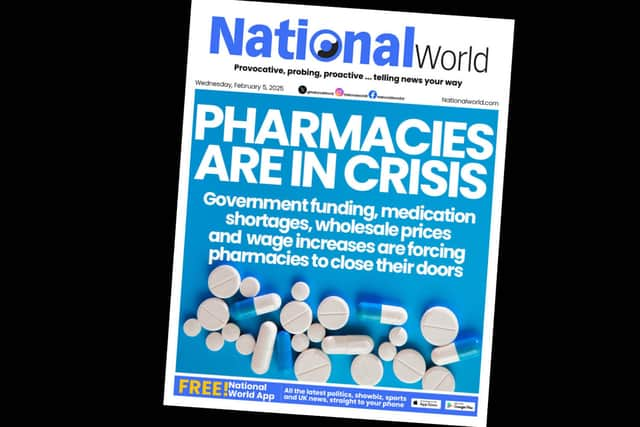
Protecting our pharmacies is vital: Crisis in shortages of medication and closures of pharmacies

Following surgery, my husband has to take regular medication, which - like so many currently - is in short supply and, at the moment, only available from the hospital pharmacy.
We are fortunate to live in a city with public transport, so collecting the prescription is easy. However, this is not so for everyone.
It is difficult enough when a regularly-taken medication is not available in an urban area, forcing the patient to spend time and money trekking from pharmacy to pharmacy in an attempt to discover a supply but, in rural areas, a combination of pharmacy closures and drug shortages is leaving patients in a perilous position. During the last 10 years, the UK has lost 1,200 pharmacies and too many are teetering on the edge.
Pharmacy owners are having to resort to re-mortgaging their houses just to keep their pharmacies going.
The Pharmacy in Sheffield – open every day since 1951
The award-winning Wicker Pharmacy in Sheffield opened its doors in 1951. Since then, those doors have remained open until late in the evening every single day – Christmas Day and Bank Holidays too. Over those years, at least 11 million prescriptions have been dispensed.
Martin Bennett, chair of this employee-owned Pharmacy – who was awarded an MBE for Services to Pharmacy in Sheffield – and his colleagues take great pride in serving their community but they are only too well aware of the enormous number of independent pharmacies finding it impossible to survive and who are having to close their doors permanently.

Pharmacy First
Yet, these closures are coming at the same time as the Pharmacy First scheme – initiated by the previous Government - which enables pharmacies to treat seven common conditions with prescription-only antibiotic and antiviral medications. This Government is keen to take the scheme further, with more primary care being placed in the hands of pharmacists.
All pharmacists welcome this opportunity but how many will be able to remain open if the NHS does not begin to put its payments’ house in order? First of all, the contract between the pharmacists and the NHS expired in March last year. Funding from the NHS – which has fallen 40% in the last 10 years - no longer covers the cost of medications, yet it is meant to cover 90% of the pharmacy’s costs. Secondly - despite the information for a completed prescription being sent instantly to NHS England, it takes three months for the reimbursement to arrive.
Funding a Pharmacy
Medications and vaccines (apart from the Covid vaccine) must be bought from wholesalers but pharmacists – and the National Pharmacy Association – describe the formula for reimbursement as ‘unbelievably complicated’. Individual medicines may cost more than expected and those pharmacies dispensing the most are hit the hardest.
Every month, announcements of new shortages of certain medications means price rises at the wholesalers – a £10 drug can leap in price to £50, but the pharmacist receives just £2 for dispensing it.
On top of this is the rise in the minimum wage – which no one would dispute was necessary – plus the increase in the employers’ National Insurance contributions, which will come into effect in April. It would seem to be the perfect storm.
Janet Morrison, CEO of Community Pharmacy England said: ‘Community pharmacies simply will not withstand another season of winter pressures and if they are left to collapse, the impact on businesses and their staff, on patients, on the wider NHS and, ultimately, on the nation’s health will be unthinkable’.
Pharmacists and GPs
Pharmacists are so much more than just the white-coated people who dispense prescriptions. They act as an advisory service to the local GPs, a swift, listening ear to worried patients – who are often more comfortable confiding in the pharmacist – and, most importantly, ensure that the drugs prescribed by the GP are compatible. Home deliveries for the elderly and chronically sick, smoking cessation support and emergency contraception services are at risk.
GPs find themselves overwhelmed by patient numbers and paperwork.
The aim of Pharmacy First is to free up 10 million appointment slots – leaving GPs able to give more time to their patients with complex diagnoses and conditions.
Pharmacists and GPs are both independent contractors – businesses working for the NHS. Ridiculously, GPs are in competition with pharmacies over the vaccines. They are paid extra for delivering vaccinations but if too many vaccines are left unused, no profit is made.
Surely it is not beyond the wit of local GPs and pharmacists to reach an agreement about this.
There is also the territorial nature of GPs about their patients. For some reason, GPs refuse to inform people about the recognised health charities – like Breast Cancer Now, Parkinsons UK or Diabetes UK - who have specialist nurses and up to date information. Patients who really only need reassurance after major surgery or diagnosis could be helped by these charities. By not doing so, GPs are heaping more pressure on themselves. Pharmacies carry information about all diseases and conditions and can signpost patients to the right charity.
Serious funding challenges
The government’s plan to shift the focus of the NHS out of hospitals and into the community with ‘less emphasis on dispensing and more on providing advice and other support for patients.’ can only happen if independent, community pharmacies are properly supported financially with instant reimbursements.
Nick Kaye, Chair of the National Pharmacy Association, described the impact years of cuts has had on community pharmacies: ‘Our ability to be an effective shock-absorber for disruption elsewhere in the healthcare system has been eroded and we have serious capacity challenges.’
Protecting our pharmacies is vital. Martin Bennett will continue to open Wicker until 10 pm but he is having to halve the size of the pharmacy to make ends meet.
This summer, graduating Pharmacists will be in possession of prescribing qualifications and will be ready and willing to use them. The pharmacies that are still open are at the heart of our communities and that is where they must stay.
Let us hope the Government does not wake up to the plight of these essential centres of our communities when it is too late.
SNIPPETS FROM THE CHARITY SECTOR
The tiny charity I founded in 2021 – Esme’s Umbrella – has a Just Giving page. Over the last year, donations arrived and were gratefully received. When I tried to establish how much Gift Aid I had earned, Just Giving refused to give that information unless I upgraded my account. The cost for this would be £15 per month – money which the charity cannot afford, particularly as there is no guarantee anyone will donate via this platform. This means that information which belongs to Esme’s Umbrella is being withheld by Just Giving. Can this be right?