
Cruise expert warns that massive 'floating festivals' could spell the end of traditional cruising as we know it – with potential ‘mega-ships’ on the horizon
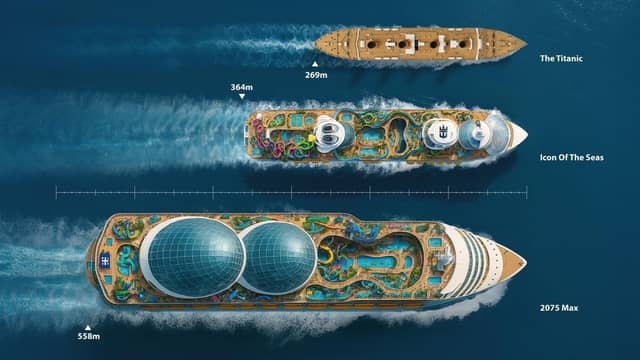

Mark Barton, cruise expert at Avanti Travel Insurance, reveals how festival cruises carrying thousands of music fans could drive demand for ‘mega-ships’ with nearly 35,000 passengers by 2075.
A cruise expert has warned that the boom in 'floating festivals' is fundamentally changing the cruise industry and could lead to ships carrying as many people as a small city.
Mark Barton, who has 25 years of maritime experience, says festival cruises like the heavy metal cruise '70000 Tons of Metal' are driving demand for bigger ships that prioritise non-stop entertainment over traditional port hopping.
The warning comes as new analysis reveals cruise ships could theoretically grow to carry 34,860 passengers by 2075 - equivalent to the crowd at major festivals - if current growth trends continue.

Festival ships already carry thousands
The trend is already well underway, with dedicated festival cruises selling out in hours and attracting thousands of passengers who rarely leave the ship.
The 70000 Tons of Metal cruise, dubbed 'the world's biggest heavy metal cruise', carries 3,000 metal fans and features 60+ bands performing 120+ shows across four stages. The festival has run annually since 2011 and sells out rapidly.
Meanwhile, EDSea - the Electronic Dance Carnival cruise - transforms ships into floating nightclubs with multiple stages and 24/7 music programming. The Groove Cruise also takes place on Royal Caribbean's massive Allure of the Seas, holding nearly 7,000 ravers.
Other floating festivals include the Country Music Cruise featuring 50+ performances over seven days, Rock the Bells hip-hop cruise, and Broadway at Sea featuring Tony and Emmy winners.
Ships could rival small cities by 2075
An analysis of growth in cruise ship size over the past 25 years by cruise travel insurance provider Avanti has revealed just how big vessels could become.
Using compound annual growth rate, they found that if current trends continue, cruise ships by 2075 could theoretically carry up to 34,860 passengers and reach 902,000 gross tonnage - more than twice the internal volume of Wembley Stadium.
For comparison, today's largest ship, Icon of the Seas, carries around 7,600 passengers. In 1999, the largest vessel, Voyager of the Seas, had a maximum capacity of 3,602 passengers.
The growth is being driven by younger passengers seeking experience-first holidays. Millennials and Gen Z now make up over a third of cruise passengers worldwide, with many preferring onboard entertainment to traditional sightseeing.
Only 'superports' could handle mega-ships
However, Barton warns these projections face real-world constraints that could reshape the entire industry. "While the mathematical projections suggest ships could one day carry 35,000 passengers, this is future-gazing based on past growth patterns. The reality is different, as there are significant real-world constraints," he explains.
"Port infrastructure, safety protocols, and fuel demands make vessels of that scale highly unlikely. Only a handful of global superports, such as Miami, Barcelona, Shanghai or Dubai, could potentially accommodate vessels of this size, and critically, the environmental impact of building and operating ships at this scale cannot be ignored.”
This could leave traditional cruise destinations unable to accommodate the new mega-ships, fundamentally altering cruise itineraries.
“The cruise industry is already under pressure to reduce emissions and embrace cleaner fuel technology. Scaling up must go hand-in-hand with sustainability,” explains Mark.
Port stops becoming irrelevant
Perhaps most significantly, Barton warns that traditional cruise elements, such as port visits, are becoming less important to younger passengers.
"We are seeing a clear shift, especially among younger travellers, towards experience-first, entertainment-rich holidays, and port stops are becoming less important. Gen Z will be in their 60s by 2075, so we'll have to wait and see how customer behaviour continues to develop as to whether floating festivals at scale become a trend of tomorrow."
This shift means that future cruise passengers may rarely disembark, treating ships more like floating resorts or festival venues than means of transportation to destinations.
Traditional cruising being pushed aside
Barton says the industry is already shifting away from traditional cruising toward specialised experiences.
"What we're actually seeing in the industry is a move towards specialisation rather than just growing the size of cruise ships for the sake of it. Many industry insiders believe the future will see vessels designed for specific types of passengers. We've already seen Disney Cruise Line catering to families and Disney fanatics. Still, we could be in for other specialisations, such as Formula 1, football, and tennis-themed vessels, on their way."
The cruise expert notes a counter-trend toward smaller, specialist vessels for traditional cruise passengers.
"There's also a growing trend towards smaller, specialist vessels that can reach more exotic places. Think ships designed specifically for the Galapagos, Iceland expeditions, or Brazilian rainforest cruises that can navigate as far up as the Parana River. These ships carry fewer passengers but offer experiences you simply can't find on larger cruises." For these, Mark recommends the Quiet Cruise Guide, helping holidaymakers find smaller ships and alternative routes with more space and cultural connections.
The cruise industry appears to be splitting into two distinct markets: massive festival ships for experience-seekers, and intimate vessels for traditional cruise passengers who still want to explore destinations.
As the cruise industry continues testing the limits of size and scale, Barton questions whether bigger is always better. "It's not about saying no to cruising, it's quite the opposite," he concludes. "It's about asking: is bigger always better?"