
Supreme Leader of Iran - Ayatollah Ali Khamenei - is dead, according to Iranian state media

The Supreme Leader of Iran - Ayatollah Ali Khamenei - is dead, according to Iranian state media.
After US President Donald Trump and Israeli Prime Minister Benjamin Netanyahu said they believed the 86-year-old had been killed in a swathe of air stirkes carried out by the two countries on Saturday, the country's state-run broadcaster later confirmed the news.
The reports have added to confusion in the Islamic Republic over what comes next amid fears over regional instability. Following the announcement, President Trump said it gave Iranians their “greatest chance” to “take back” their country.
It is understood Khamenei, the second leader of the Islamic Republic regime which took over Iran in 1979, was killed in an airstrike targeting his compound in downtown Tehran, with satellite photos showing devastation at the site.
His death at his office “showed that he consistently stood among the people and at the forefront of his responsibilities, confronting what officials call global arrogance,” state TV said.
In a social media post, Mr Trump branded Khamenei "one of the most evil people in history" and warned bombing would continue throughout the week and possibly beyond in a bid to knock out Iran's military capabilities and nuclear project.
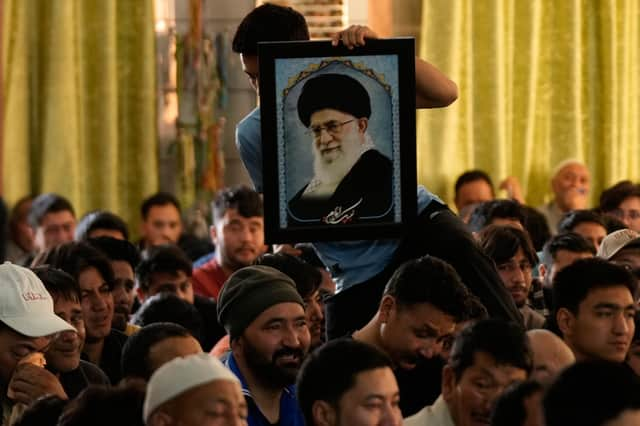

However Iran, which responded to the strikes with its own counterassault on Saturday, warned of further retribution, with the cabinet saying that this “great crime will never go unanswered”. The paramilitary Revolutionary Guard threatened to launch its “most intense offensive operation” ever.
Middle East experts fear the US and Israeli actions could spark a wave of retaliatory violence and a wider war, despite Trump's previous claims of being an “America First” president and vowing to avoid launching “forever wars”.
The killing of Khamenei is the second Trump administration assault on Iran in eight months and looks set to create a leadership vacuum, with reports also claiming several relatives of Khamenei were killed, including a daughter, son-in-law, daughter-in-law and grandchild.
The attack came after the apparent failing of negotiations over Iran's nuclear programme - despite some reports an agreement was nearing.
About 12 hours after the attacks began, the US military reported no US casualties and minimal damage at US bases despite “hundreds of Iranian missile and drone attacks”. It said targets in Iran included Revolutionary Guard command facilities, air defence systems, missile and drone launch sites, and military airfields.
Israel, for its part, said it had killed the commander of the Revolutionary Guard Corps and the country’s defence minister, as well as the secretary of the Iranian Security Council, a close adviser to Khamenei.
Khamenei “was unable to avoid our Intelligence and Highly Sophisticated Tracking Systems and, working closely with Israel, there was not a thing he, or the other leaders that have been killed along with him, could do,” Mr Trump said. “This is the single greatest chance for the Iranian people to take back their country,” he added, but gave no details of how that could work or any support for dissidents inside Iran.
An Iranian diplomat told the United Nations Security Council hundreds of civilians were killed and wounded in the strikes. Iran retaliated by firing missiles and drones toward Israel and at US military bases in the region, and exchanges of fire continued into the night.
In the US, Democrats decried that Mr Trump had taken action without congressional authorisation, which is required under the Constitution, but White House spokesperson Karoline Leavitt said the administration had briefed several Republican and Democratic leaders in Congress in advance.
Tensions have soared in recent weeks as the Trump administration built up the largest force of American warships and aircraft in the Middle East in decades. The president insisted he wanted a deal to constrain Iran’s nuclear program while the country struggled with growing dissent following nationwide protests.
In southern Iran, at least 115 people were reported killed when a girls’ school was struck, and dozens more were wounded, the local governor told Iranian state TV. US Central Command spokesperson Captain Tim Hawkins said he was “aware of reports” that a girls’ school was struck and that officials were looking into them.
Flights across the Middle East were disrupted, and air defence fire thudded over Dubai, the United Arab Emirates’ commercial capital, while shrapnel from an Iranian missile attack on the UAE killed one person, state media said.