
Ayatollah Ali Khamenei: Who was Supreme Leader of Iran killed in US airstrikes and why he was loved and hated

Following the death of Supreme Leader of Iran, Ayatollah Ali Khamenei, how he came to power and why he was loved and hated.
In 1979, the ruling Pahlavi dynasty was overthrown, ending the historical monarchy of the Middle Eastern country. It came after a series of moves by Mohammad Reza Pahlavi - the last Shah of Iran - to modernise the country, isolating much of the historic religious leadership - who led a resistance movement which ultimately was able to take power.
The revolution ultimately saw Ruhollah Khomeini, an Islamist cleric and rebel faction leader who had been exiled for his anti-government efforts, return to Iran and take control. His leadership of what was now an anti-Western Islamic republic immediately ended the increasingly-close relationship between Iran and the Western world, replacing it with strict authoritarian/totalitarian regime.
With the destruction of Israel at its core, the Iranian leadership began to build and support militant groups opposed to the Jewish state across the Middle East, with the ultimate goal of establishing domination of the region and under Shia political control.
A decade after taking control, Ruhollah Khomeini died in June 1989 at the age of 89. He was succeeded by Ali Hosseini Khamenei, the man killed in US and Israeli airstrikes on Saturday.
He had previously served as president of Iran from 1981 until assuming the role as Supreme Leader, which he would hold for more than 36 years.
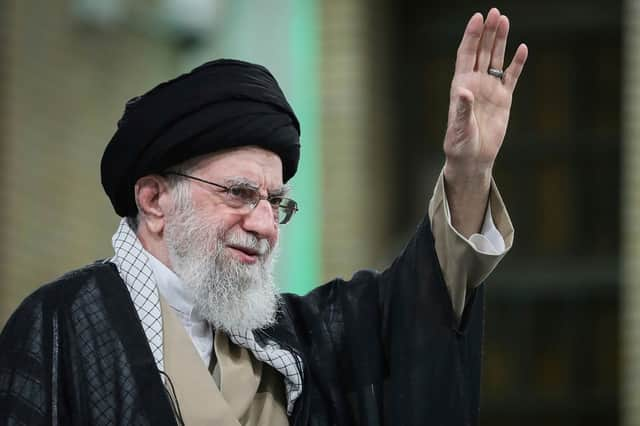

Having been a leading figure in the 1979 revolution, Khamenei was a constant target of Israeli forces, including an attempt in 1981 which saw a bomb explode in front of him. The attack left him with a paralysed right arm.
Khamenei, a religious fundamentalist, sought to export the Iranian Shia system and developed the Islamic Revolutionary Guard Corps (IRGC), a branch of the Iranian military with the sole mission of preserving the Islamic Republic through his crushing of political opposition and foreign interference.
The nation's anti-Israel stance has long seen Iran provide support to Palestinian groups, as well as being a pivotal backer of the Axis of Resistance coalition in Syria, Iraq, Yemen and backing Russia in its invasion of Ukraine.
Now he is dead, their is speculation over who will succeed him.
Why Ayatollah Ali Khamenei was loved and hated
Anti-government demonstrations have been growing in recent years, with tens of thousands of Iranian dissidents believed to have been killed, including protestors machine-gunned in the streets, as the IRGC protected the regime.
But despite the seemingly large opposition to Khamenei and his regime, he was seen as the religious and military leader - considered one of the most eminent Shia clerics in the world - making all decisions over policy.
As a result, the country is split. Eyewitnesses in Tehran told the Associated Press some residents were rejoicing, cheering from rooftops, blowing whistles and letting out ululations.
However others were seen to be devastated by the news, including presenters on state television breaking down in tears as the informed viewers of his death. Some saw him as a spiritual guide and Ayatollah, while others labelled him a repressive despot and mass murderer.
He was married to Mansoureh Khojasteh Bagherzadeh, with whom he had six children; four sons (Mostafa, Mojtaba, Masoud, and Meysam) and two daughters (Boshra and Hoda).
Presented to the world as stern and austere, it has also been reported Khamenei enjoyed poetry and gardening, but lived a 'simple' life, despite his absolute power over a nation of 90 million people.
Details over a potential successor are sparse, with a 40-day mourning period declared in Iran, plus a national holiday on the day of his death.
A new Supreme Leader would need to be agreed by all branches of the Iranian system, including religious, military and political leaders, while opponents of the establishment will also be vying to take advantage of the loss, supported by Western leaders.
Meanwhile, the IRGC itself is seen as potentially taking the opportunity to carry out a military coup, putting power back in the hands of the army, not the clerics. Suzanne Maloney, of the Brookings Institute think tank, said "military commanders hold the country’s future in their hands".
"That imperative could well expand their appetites, and when Khamenei passes from the scene - either as a result of natural causes or decapitation strikes - so too could any effort to sustain the pretence of religious legitimacy in favour of military rule," she added.