
J. K. Rowling and Emma Watson: Timeline of row and why Harry Potter stars fell out in the first place

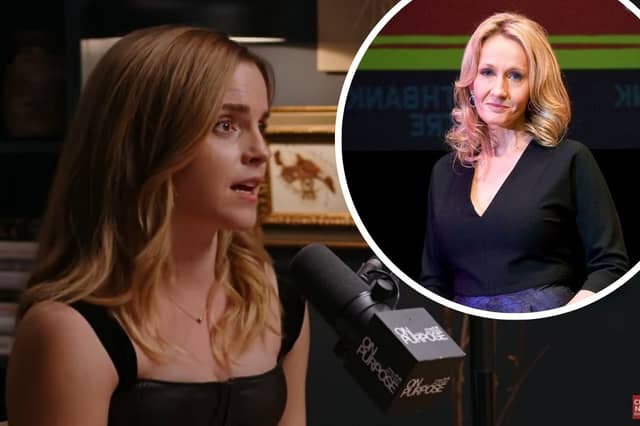

The war of words between Harry Potter writer, J. K. Rowling, and Emma Watson, who played Hermione Granger in the film adaptations of the books, has been simmering for years, but has it now reached boiling point?
Harry Potter - an international phenomenon since Hogwarts was first introduced to the public in 1997 and with a TV remake in the works, it doesn’t look set to die down any time yet. However, more recently the row between writer and actors has perhaps hit more headlines than the magical storylines.
Harry Potter and the Philosopher's Stone, the first book in the series, was published in the UK in 1997 with the film adaptation, Harry Potter and the Sorcerer's Stone, released four years later in 2001. The book series concluded with Harry Potter and the Deathly Hallows in 2007, while the film series wrapped up in 2011.
During that time, the public became familiar with pictures of the beaming young stars together with the equally ecstatic author. Yet, less than a decade later, those images were a dim and distant memory and the idea of a Harry Potter happy family firmly dislodged.
This week, the war of words between author J. K. Rowling and actress Emma Watson - who played the character Hermione Granger in the film adaptations - has come to a head resulting in a lengthy tweet posted by Rowling about the current state of the relationship between the ‘former friends’. Here’s how the story has played out so far…
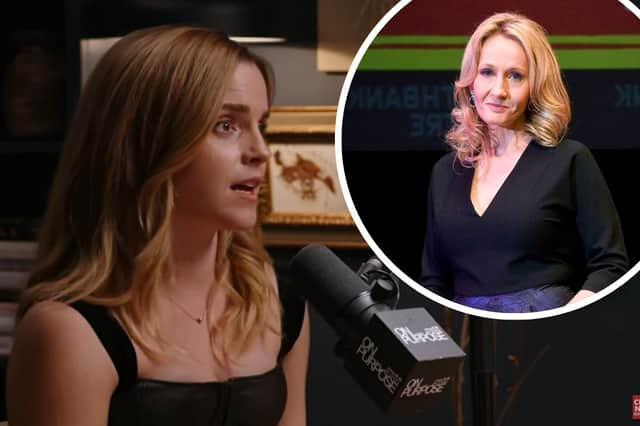
J. K. Rowling Emma Watson timeline
Causing conflict between Rowling and Watson is their differing views on transgender rights. While Watson has supported trans rights, stating "Trans people are who they say they are", Rowling, on the other hand, has made statements regarded by some as anti-trans, arguing that biological sex is a material fact and that the trans rights movement erodes women's rights.
- 2001-2011: Watson played Hermione Granger in the eight films based on Rowling's books.
- 2018: Rowling "liked" a tweet that called transgender women "men in dresses".
- 2019: Rowling openly opposed the concept of gender identity differing from birth sex, marking the beginning of her vocal stance on transgender issues.
- June 2020: Rowling shares her views on sex and gender in a series of Tweets and an essay. Following a Tweet from Rowling saying a woman is defined by biological sex, Watson responds on social media, saying "Trans people are who they say they are and deserve to live their lives without being constantly questioned". Daniel Radcliffe also issued a statement in support of trans rights, emphasizing that "Transgender women are women".
- 2022: AT the BAFTA Film Awards, ceremony host, Rebel Wilson, introduced Watson by playfully referencing Rowling, saying, "She calls herself a feminist, but we all know she's a witch". Watson responded by saying “I'm here for all the witches!” The statement was widely interpreted as a subtle but pointed jab at Rowling.
- April 2024: Rowling states she would not forgive Radcliffe and Watson for their comments labelling them as "celebs who cosied up to a movement intent on eroding women's hard-won rights".
- September 2025: Emma Watson speaks on the rift in a podcast interview with Jay Shetty, saying she hopes to maintain their association, despite their differing views on transgender identity and rights. Rowling responds to the interview on X, calling her "ignorant" and criticizing her public stance on the issue.
What did Emma Watson say to Jay Shetty about about JK Rowling
Watson spoke on Jay Shetty’s ‘On Purpose’ podcast, released on Thursday (September 25), reflecting on her decision to step away from Hollywood. It was inevitable that Rowling would come up in the conversation - here’s how it went…
Shetty: “Something I wanted to ask you about that's difficult and challenging because it's something you spoke about earlier as being such a big part of your life, an important part of your life. But recently, there's been so many conversations and comments directly from JK Rowling, whether it's her saying she'd never forgive you for your views or the fact that when she was asked what ruins the movies for her, she named yourself and some of your co-stars and I imagine that's an extremely difficult thing when you've been a part of someone's world, when you felt connected to their work, and then for it now to kind of be a full 180, and for someone to publicly say these things that can be quite, extremely hurtful, actually. How do you think about that?
Watson: “I really don't believe that by having had that experience and holding the love and support and views that I have mean that I can't and don't treasure Jo and the person that I had personal experiences with, I will never believe that one negates the other and that my experience of that person I don't get to keep and cherish. To come back to our earlier thing, I just don't think these things are either or. I think it's my deepest wish that I hope people who don't agree with my opinion will love me, and I hope I can keep loving people who I don't necessarily share the same opinion with and I think that's a very, very important way for me that I need to be able to move through life. I just really, I guess I, to circle back around, I really do believe in having conversations and that those are really important and that, I don't know. I guess where I've landed is, it's not so much what we say or what we believe, but very often how we say it that's really important. That's really frustrating and not what you want to hear when you're really angry and upset with someone. But I don't know. I just see this world right now where we seem to be giving permission for this kind if like, throwing out of people or that people are disposable. I will always think that's wrong. I just believe that no one is disposable. Everyone, as far as possible, whatever the conversation is, should and can be treated with, at the very least, dignity and respect.
Shetty: “Thank you for challenging us and pushing us. It takes a lot. I think that's what we're all being challenged to do is try and hold two truths at once. Those two truths don't have to [be] complementary, but they can stand at the same time.”
Watson: “I think the thing I'm most upset about is that a conversation was never made possible.”
Shetty: “So, you remain open for that dialog?”
Watson: “Yeah, and I always will. I believe in that. I believe in that completely. I believe in that completely. I just don't want to say anything that continues to weaponise a really toxic debate and conversation, which is maybe why I don't... Well, it is why I don't comment or continue to comment, not because I don't care about her or about the issue, but because I just, the way that the conversation is being had feels really painful to me. And so, that's why that decision.”
Shetty: “Yeah, I really appreciate that mindset and deeply, deeply feel like if people are challenged to go there themselves, like it takes a lot to think that way and feel that way, but it's what healing really requires around the world. I can't imagine how many young people who look up to you and people who look up to you will feel the same way to recognize that that's how we engage. That's what we look for. It's not that we're trying to make everything pretty and perfect. It's that we're willing to engage in an uncomfortable conversation”
Watson: “Yes. Her kindness and words of encouragement and that steadfastness. Also, honestly, just as a young woman, for her to have written that character, created that world, given me an opportunity, which, to be honest, barely exists in the history of English literature. There's just no world in which I could ever cancel her out or cancel that out for anything. It has to remain true. It is true. This is where this holding of these, I just don't know what else to do other than hold these two seemingly incompatible things together at the same time and just hope maybe they will one day resolve or co-join themselves and maybe accept that they never will, but that they can both still be true. And, I can love her, I can know she loved me, I can be grateful to her, I can know the things that she said are true. And that can be this whole other thing. My job feels like to just hold, just to hold all of that. But the bigger thing is just what she's done will never be taken away from me.”
JK Rowling’s response to Emma Watson on Twitter
“I’m seeing quite a bit of comment about this, so I want to make a couple of points.
“I’m not owed eternal agreement from any actor who once played a character I created. The idea is as ludicrous as me checking with the boss I had when I was twenty-one for what opinions I should hold these days.
“Emma Watson and her co-stars have every right to embrace gender identity ideology. Such beliefs are legally protected, and I wouldn’t want to see any of them threatened with loss of work, or violence, or death, because of them.
“However, Emma and Dan in particular have both made it clear over the last few years that they think our former professional association gives them a particular right - nay, obligation - to critique me and my views in public. Years after they finished acting in Potter, they continue to assume the role of de facto spokespeople for the world I created.
“When you’ve known people since they were ten years old it’s hard to shake a certain protectiveness. Until quite recently, I hadn’t managed to throw off the memory of children who needed to be gently coaxed through their dialogue in a big scary film studio. For the past few years, I’ve repeatedly declined invitations from journalists to comment on Emma specifically, most notably on the Witch Trials of JK Rowling. Ironically, I told the producers that I didn’t want her to be hounded as the result of anything I said.
“The television presenter in the attached clip highlights Emma’s ‘all witches’ speech, and in truth, that was a turning point for me, but it had a postscript that hurt far more than the speech itself. Emma asked someone to pass on a handwritten note from her to me, which contained the single sentence ‘I’m sorry for what you’re going through’ (she has my phone number). This was back when the death, rape and torture threats against me were at their peak, at a time when my personal security measures had had to be tightened considerably and I was constantly worried for my family’s safety. Emma had just publicly poured more petrol on the flames, yet thought a one line expression of concern from her would reassure me of her fundamental sympathy and kindness.
Like other people who have never experienced adult life uncushioned by wealth and fame, Emma has so little experience of real life she’s ignorant of how ignorant she is. She’ll never need a homeless shelter. She’s never going to be placed on a mixed sex public hospital ward. I’d be astounded if she’s been in a high street changing room since childhood. Her ‘public bathroom’ is single occupancy and comes with a security man standing guard outside the door. Has she had to strip off in a newly mixed-sex changing room at a council-run swimming pool? Is she ever likely to need a state-run rape crisis centre that refuses to guarantee an all-female service? To find herself sharing a prison cell with a male rapist who’s identified into the women’s prison?
I wasn’t a multimillionaire at fourteen. I lived in poverty while writing the book that made Emma famous. I therefore understand from my own life experience what the trashing of women’s rights in which Emma has so enthusiastically participated means to women and girls without her privileges.
The greatest irony here is that, had Emma not decided in her most recent interview to declare that she loves and treasures me - a change of tack I suspect she’s adopted because she’s noticed full-throated condemnation of me is no longer quite as fashionable as it was - I might never have been this honest.
Adults can’t expect to cosy up to an activist movement that regularly calls for a friend’s assassination, then assert their right to the former friend’s love, as though the friend was in fact their mother. Emma is rightly free to disagree with me and indeed to discuss her feelings about me in public - but I have the same right, and I’ve finally decided to exercise it.