
Should your dog be wearing a coat? As Storm Goretti drops “weather bomb” on UK should you provide your pet with extra layer?

As Storm Goretti drops a “weather bomb” on the UK - should your dog be wearing a coat when it goes out? Here’s what the experts recommend.
Storm Goretti has brought a “weather bomb” to the UK with the Met Office warning the multi-hazard event will cause “disruption and dangerous travelling conditions”. However, no matter what the weather, your four-legged friend will still want to stretch their legs.
The question is, with as much as 30cm of snow possible in parts of the UK, should your dog be wearing a coat when it goes out for a walk? We’ve asked an expert for their advice on keeping your tail-wagger happy when the temperatures drop.
Named by French weather forecaster Meteo France, Storm Goretti has been described as a “multi-hazard event” by the Met Office. Weather warnings have been issued for snow, wind, rain and ice across the country, ahead of likely “disruption and dangerous travelling conditions”.
Met Office chief forecaster Neil Armstrong said: “Storm Goretti will be a multi-hazard event, with the most significant impacts from snow in parts of Wales and the Midlands and the very strong winds in the far South West, though heavy rain in some parts of Wales and East Anglia also has the potential to bring disruption to many.”
Officially a “weather bomb” - also known as explosive cyclogenesis - which happens when the central pressure in an area of low pressure falls rapidly. The pressure has to fall by 24 millibars in 24 hours to qualify and Storm Goretti has seen a pressure drop of 36 millibars.
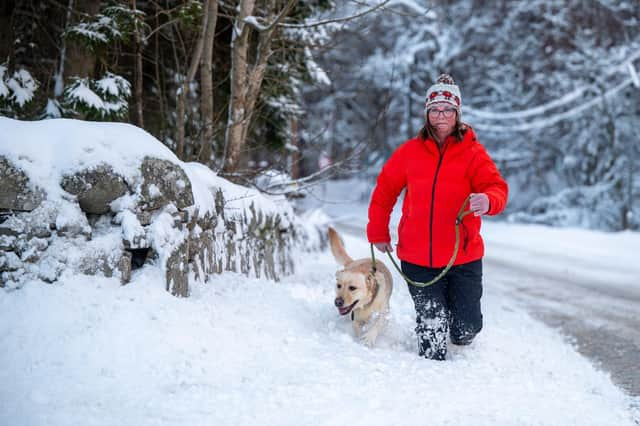

Dog coats: Should all dogs wear one in the snow?
In a National Library of Medicine study, owners reported that they were 48.2% less likely to exercise their dogs in the cold weather, however, as long as you keep your pet cosy, you shouldn’t need to cut their daily exercise altogether. Helen Webb, spokesperson at pet supplement brand YuMOVE, has shared insight on whether or not your dog needs a coat during cold weather snaps.
“Dogs with short hair or a low body fat percentage may struggle with the temperature change, and a coat can provide the extra warmth they need during cold winter walks,” says Helen. “Breeds with thicker coats or those naturally adapted to colder climates might be able to regulate their body temperature more efficiently.”
What breed of dog you have will generally influence whether they need to pp on an extra layer or not. Helen says: “Size, build and coat type will be the biggest indicators, and some dogs may feel the cold more than others. The key is to observe your dog’s response to differing temperatures. Look for behaviour signals that may hint your dog is feeling the cold.
“Shivering, seeking warmth or looking uncomfortable in chilly weather are good indicators that your dog may benefit from a coat on winter walks. If you have a puppy or a senior dog (aged 8+), we recommend having a coat to hand as these dogs can regulate body heat less efficiently.”
The assumption that dogs are naturally protected from the cold because they have fur can be dangerous. “Dogs with an undercoat and structured, thick fur are built for winter weather and will keep well insulated, but most dog breeds don’t have this advantage,” says Helen.
“Unless your dog’s breed is known to have evolved to colder climates, we’d advise that you keep a coat on hand. Any dog with a thinner coat, without the essential insulating underlayer, will benefit from a bit of extra protection from the cold.”