
Universal Credit reforms: Benefits and pensions changes coming in this week

Laws coming into force today will see changes to changes to benefits and pensions come in this week.
Changes to the benefits and pensions systems starting this week will reform a system that has “for too long locked disabled people and people with long-term conditions out of work”, the Government said. Universal Credit (UC) reforms aim to tackle what ministers called “perverse incentives” for people to stay on benefits, rather than look for work.
From today (April 6), new claimants for the health element of UC will get a lower rate of £217.26 a month. Universal credit is a payment to help with living costs and is available for people in work who are on low incomes, and those who are out of work or cannot work.
Those with the most severe, lifelong conditions, people nearing the end of life, and all existing UC health claimants will continue to receive the higher monthly rate of £429.80 in a move the Government said will save taxpayers around £1 billion.
Statistics published last month showed there were 2.7 million people on UC assessed as having limited capability for work and work-related activity (LCWRA) across England, Scotland and Wales. People in this category are not required to undertake any interviews or work-related activity.
The Government has pledged investment in tailored employment support can offer people opportunities, supporting them to move into and stay in work “rather than leave people stuck on benefits”.
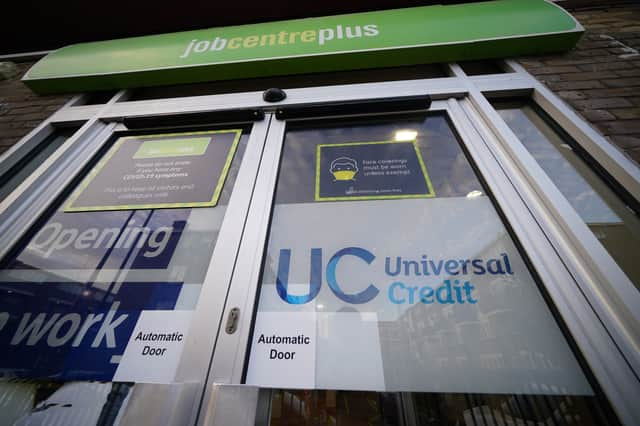

Also this week, the standard rate of UC will be boosted, in what ministers have said is an effort to “bear down on the cost of living”. The change would see almost four million households on the standard rate of UC receive around £295 extra this year in cash terms.
Social security and disability minister, Sir Stephen Timms, said: “The welfare system we inherited has for too long locked disabled people and people with long-term conditions out of work. Laws coming into force today will change that, reducing projected expenditure on universal credit by almost £1 billion.
“Simultaneously boosting the standard allowance and investing £3.5 billion in employment support means we’re creating a welfare system that backs people to work and helps them build a better future.”
Last year, ministers were forced to climb down on plans to also reform disability benefits, including for those with mental health conditions, in the face of backbench Labour opposition. Instead of immediate reform, the Timms review is seeking views on personal independence payment (Pip) and how it works.
Minsters have promised any changes to the benefit – which helps with extra living costs for people who have a long-term physical or mental health condition or disability and difficulty doing certain daily tasks or with mobility because of their condition – have been postponed until after that takes place.
The review is expected to report to Work and Pensions Secretary Pat McFadden by autumn, with the Government stating that an interim update will come ahead of that.
Pensions changes from April 6
Key alterations to state pensions are happening from this month - meaning some pensioners will see changes to the amount of income they receive - as well as when people can retire. With a new tax year starting today (April 6), pensioners are seeing a boost to the amount of income they receive.
Under the triple lock guarantee, the state pension increases every April in line with whichever is the highest of total earnings growth in the year from May to July of the previous year, Consumer Prices Index (CPI) inflation in September of the previous year, or 2.5%.
This year’s 4.8% increase – in line with wages – means people receiving the full new state pension (for those reaching state pension age on or after April 6, 2016) will see their income increase from £230.25 to £241.30 per week. Those on the full basic state pension (the core amount under the old state pension system) could see their weekly payment rise from £176.45 to £184.90.
However, in another significant change, the state pension age is undergoing a phased rise, gradually increasing in steps from 66 to 67, affecting new pensioners. People are being urged to visit gov.uk for more informationand to check on their retirement.
Zoe Alexander, executive director of policy and advocacy at Pensions UK, said: “The state pension age is rising for three reasons: improved life expectancy, to support the sustainability of the public finances and improving intergenerational fairness.
“People understandably want certainty about when they can claim the state pension, and the upcoming rise in the qualifying age may be causing some confusion. Because the change happens in monthly steps, a single day’s difference in your birthday can shift your state pension age by weeks or months. You can check when you can claim your pension via gov.uk.
“Once you know your date, think about whether this creates a gap between when you plan to stop work and when the state pension begins. If it does, take a moment to plan ahead. A few simple checks today can make a real difference to your income and peace of mind later.”
Kirsty Ross, proposition director for People’s Partnership, the provider of People’s Pension, said: “The value of the state pension is essential information for millions of people, including those still in work, as it forms the foundation of retirement income for most savers.
“For those thinking about retirement, it’s also crucial to understand the age at which they can start claiming the state pension. For example, people hoping to retire early will need to plan how they will bridge the gap until their state pension kicks in.”
She said workplace pension schemes “provide planning tools, which will help their members work out whether they are saving enough via automatic enrolment or other pensions to achieve the kind of retirement they hope for”.
Rachel Vahey, head of public policy at AJ Bell, said: “While the increase in the state pension age to 67 will come as a shock to many, this is very much the beginning rather than the end of this story. Under current plans, the state pension age will rise again to 68 between 2044 and 2046.”
She said that in future, a government may “need to bring this forward – and possibly set out plans to increase the age further still”.
The Institute for Fiscal Studies (IFS) said increasing the state pension age delivers significant savings to the public finances, with the rise from 66 to 67 expected to save around £10 billion a year by the end of the Parliament.
But it also said that past evidence indicates that an increased state pension age reduces incomes and increases poverty rates among the affected groups, and that the effects are felt particularly acutely by those who are already out of work and relying on working-age benefits.
Laurence O’Brien, senior research economist at the IFS, said: “It makes sense to increase the state pension age in response to the public finance pressures caused by an ageing population, as the fiscal savings are significant. But it does reduce household incomes and therefore leads to higher poverty rates for affected age groups.
“And the people most affected are often those least able to adjust through staying in work or drawing on other savings – for example, those already out of work or in poor health.”
Tips from Pensions UK to understand changes
- Tiny shifts in birth dates can create meaningful differences in when the state pension will arrive for people. The move from 66 to 67 will not impact everyone on the same day. Instead, it climbs in monthly increments. People born on or after April 6, 1960, may qualify at 66 and one month, 66 and two months, and so on, all the way up to people born on or after March 6, 1961, with a full state pension age of 67.
- Many people have a broad sense of when the state pension kicks in, but the rise might catch some off guard. The government calculator can be used to check state pension ages.
- Some people may find they have a “financial gap year”. If someone was planning to end work at 66 but their state pension age is higher, they may face an unplanned period between their last pay packet and their first state pension payment. This could be a good time to look at savings and emergency funds or see whether an additional few months at work could help bridge the difference.
- Many people may also need to factor in other rule changes as they plan their retirement. For example, the normal minimum pension age (the age from which someone may be able to access their workplace pension) rises from 55 to 57 in April 2028. The system is not straightforward, but checking your state pension age and making a simple plan could be a good place to start.
- Remember that retirement planning is not a “set once and forget” exercise. A once‑a‑year check in on pension forecast, savings, and state pension age can prevent shocks later in life. Pensions UK regularly updates its retirement living standards, which help people to understand whether they are on track to have the lifestyle they expect in retirement. Midlife “MOTs” or action plans can also help people to sense-check whether their retirement plans are realistic.
Once people know their retirement date, understand whether they have a gap and make a simple plan, they can take control of their retirement.