
England's oldest pub revealed after 600 years as experts dismiss rival claims
A Somerset pub dating back more than 600 years has been identified as England's oldest surviving purpose-built inn, with experts using medieval records and tree-ring dating to back its claim.
A historic village pub has emerged as the strongest contender for England's oldest inn, with scientific evidence helping to settle a centuries-old argument.


Every pub landlord likes a good story, but one Somerset watering hole has something rather more impressive than a colourful tale about its past: the evidence to back it up.
The George Inn, in the village of Norton St Philip, has been welcoming travellers for more than 600 years and has now been identified by heritage experts as having the strongest claim to being England's oldest surviving purpose-built inn.

Building archaeologist Dr James Wright says many other pubs claiming to be the country's oldest have little more than local legend to support their boasts.
But at The George, medieval documents, architectural evidence and scientific testing of ancient timbers tell a remarkably consistent story.
Speaking in a video shared by Historic England, Dr Wright said: "Most of what you've heard about the oldest pubs in England are myths."
He added: "There are many many claims to be the oldest pub in the country and yet so few of them actually have evidence to back up those claims."
The Grade I-listed building was originally established in the late 14th century by monks from nearby Hinton Priory, who spotted an opportunity to make money from merchants attending local markets and fairs.

Rather than simply serving drinks, the inn provided overnight accommodation, somewhere to store goods and facilities for travellers and their horses. It became an important part of the area's thriving medieval wool trade.
The biggest breakthrough in establishing its age came from analysing the building's timber, with tree-ring dating showing that wood used in its construction was felled between 1430 and 1432.
Dr Wright explained that medieval carpenters typically used freshly cut timber, meaning the date the trees were felled provides a remarkably accurate guide to when parts of the building were constructed.
He said: "In history memories can fade and stories can be embellished, but the science pinpoints the archaeological development of the George Inn."
He added: "We're not guessing at its age - now that's the difference between a local legend and a national treasure."
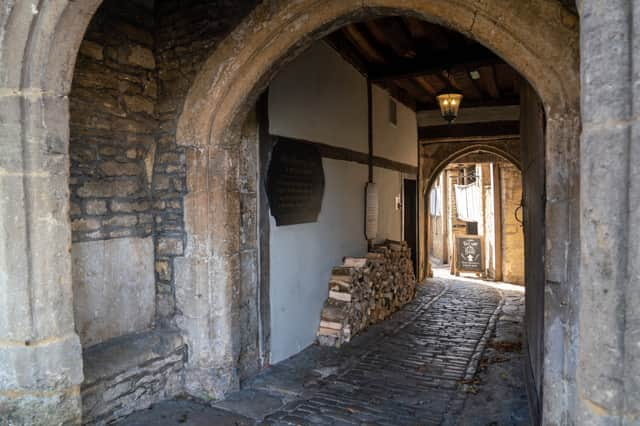
Historic England says the inn's medieval origins, surviving architecture and documentary history give it the strongest claim to being England's earliest surviving purpose-built inn, rather than definitively proving it was the first licensed pub.
The distinction matters because medieval inns were different from the alehouses and taverns that also served thirsty customers.
Alehouses primarily sold ale, while taverns specialised in wine. Inns offered a much wider range of services, making them the medieval equivalent of a pub, hotel and stopping-off point for business travellers rolled into one.
The George has another claim to historical fame. It was associated with the Duke of Monmouth during his failed rebellion against King James II in 1685, while the diarist Samuel Pepys is also among the famous figures linked to the building.
And the good news for anyone who fancies raising a glass to six centuries of English history is that The George is still operating today, complete with a restaurant, bar and 13 guest bedrooms.
The historic building is now part of the Butcombe Boutique Inns collection, meaning visitors can enjoy a pint in surroundings that would have been familiar to travellers hundreds of years ago.